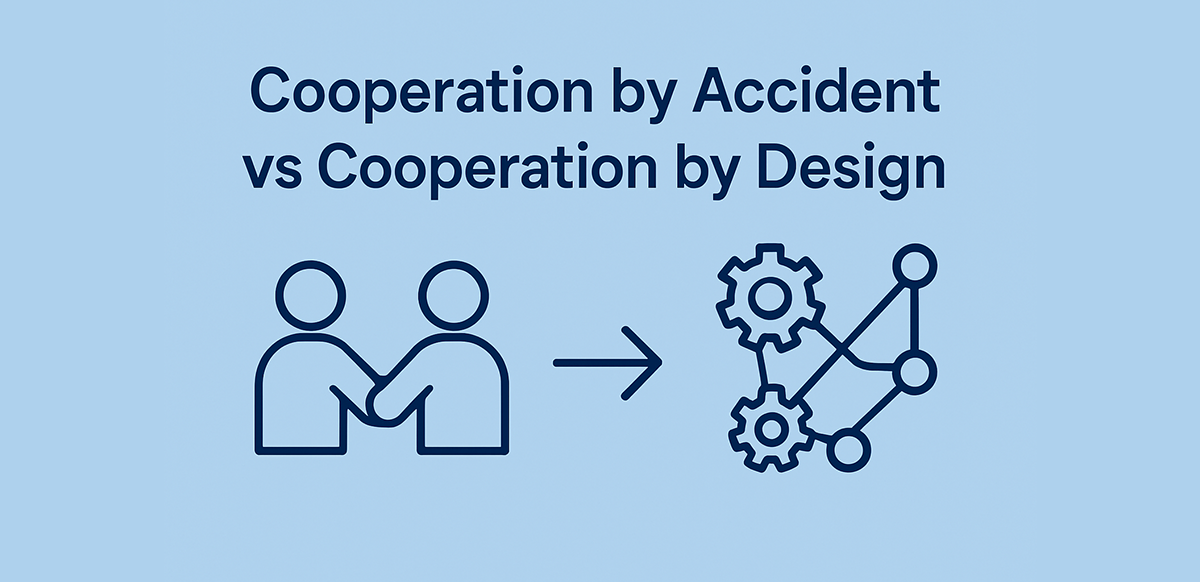
Teams become resentful when cooperation is vague, unfair, or accidental. Designed cooperation creates clearer expectations, role recognition, and healthier teamwork.
Cooperation has always existed in real estate. But it has almost never been designed. For decades, cooperation happened accidentally — through friendships, favours, urgency, or coincidence. Two agents matched a buyer and a seller. A deal closed. Everyone moved on.
The industry mistook these moments for a system. They were not. They were exceptions inside a structure that quietly punished cooperation.
When cooperation is accidental, it runs on:
It works when:
It collapses when:
This is why most teams start friendly — and end bitter. Not because people change. But because the system never supported cooperation in the first place.
The traditional structure trains agents to think: “If I don’t protect myself, I’ll lose.”
Because:
In this environment, cooperation feels dangerous. Every shared listing feels like leakage. Every shared lead feels like a risk. So agents cooperate only when forced by circumstance — and retreat the moment pressure appears. That isn’t culture. That’s design.
Accidental Cooperation
Designed Cooperation
As soon as cooperation involves more than two people, the same questions surface:
Without rules, memory fills the gap. Without visibility, suspicion grows. This is the stage where screenshots replace trust and tone replaces facts. The issue is not dishonesty. It lacks architecture.
When cooperation is designed, something fundamental shifts: People no longer need to choose cooperation. They simply operate inside it.
Design replaces negotiation.
Instead of asking:
“Can we cooperate?”
The system answers:
“This is how cooperation works.”
This is the difference between:
Culture → fragile
Architecture → durable
Designed cooperation has four non-negotiable properties:
Exposure, inventory, and tools are pooled. No one pays alone to exist.
Everyone contributes differently — and visibly. Value is defined, not assumed.
Who did what is recorded by action, not memory. Arguments disappear because data exists.
The easiest way to work is the cooperative way. Friction is removed from the behaviour you want repeated.
None of these require trust.They require rails.
Trust is not a foundation. Trust is a byproduct.
In every mature system:
When architecture is weak, trust is overloaded — and breaks. When architecture is strong, trust becomes optional. That is why designed cooperation feels boring. And why it works.
Across the industry, cooperation is evolving:
This shift does not feel dramatic. It feels calm. That is how you know it is real.
Cooperation has always existed. But accidental cooperation burns people out. Designed cooperation lets people stay. The future of real estate will not be decided by better attitudes, louder leaders, or stronger personalities. It will be decided by one question:
Is cooperation an accident — or is it engineered?
The moment it is designed, everything else follows.

Founder of ListingMine and author of Agent for Life. Building ERP for Malaysian real estate agencies since 2008 — and writing to reshape how agencies grow.
More about Marvin Foong →More articles in this topic