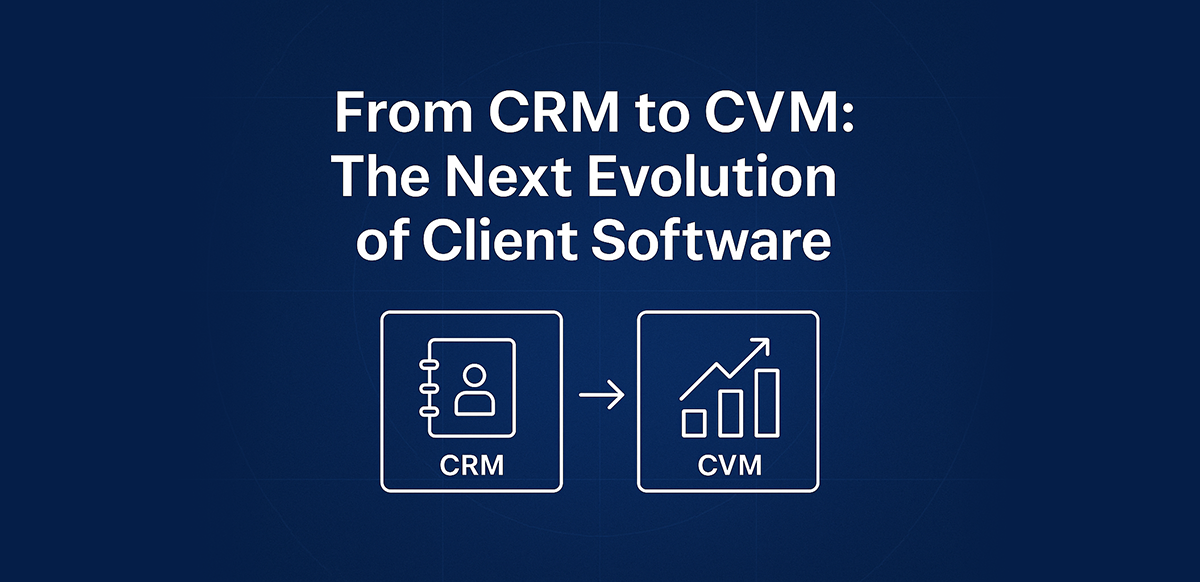
CRM stores client relationships, while CVM focuses on increasing lifetime customer value. Agencies need systems that turn data into repeat business and better service.
ListingMine Academy | Client Economics, Software Strategy & Real Estate Transformation
For decades, the real estate industry has depended on CRMs—Customer Relationship Management systems.
They were built to: store contacts, track conversations, and manage pipelines. CRMs made agents more organized.
But they did not make agents more profitable.
Why? Because a CRM is little more than a digital filing cabinet. It helps you remember things—but it does not help you extract value from your client base.
This is where CVM, or Customer Value Management, comes in.
CVM represents the next evolution of client software—one that focuses not on collecting data, but on monetizing relationships, maximizing lifetime value, and managing client economics at scale. This shift is already happening in major global industries. Real estate will follow.
The fundamental difference is the goal of the system:
| Focus Area | CRM (Customer Relationship Management) | CVM (Customer Value Management) |
|---|---|---|
| Primary Goal | Store information; Track conversations. | Monetize relationships; Maximize lifetime value (LTV). |
| Core Question | "Who is this person?" | "What is this person worth?" |
| Logic | Data entry, reminders, and follow-up attempts. | Predictive modeling, value extraction, and sequential action triggers. |
The traditional CRM model is now outdated for three structural reasons:
CVM is transformative because property clients produce value across decades, not months. A single client can generate multiple transactions: their first home, their investment home, their upgrade, their children's homes, their refinancing, and their sustained referral network.
CVM designs software around: retention, reactivation, cross-selling, timing predictions, and relationship sequencing. This is not traditional CRM logic. This is revenue architecture.
To evolve from a digital filing cabinet (CRM) to a wealth engine (CVM), software needs five layers:
ListingMine is fundamentally a CVM-first system, built to support this multi-cycle strategy.
By capturing listings, inventory, ACN contributions, tenant renewal cycles, and granular deal history, ListingMine forms the auditable foundation for future CVM layers such as:
ListingMine is not building "a better CRM." It is building the next category after CRM.
The future belongs to those who manage value, not just relationships. Agencies that adopt CVM thinking will:
Generate more repeat business.
Maximize referral networks.
Become less portal-dependent.
Build a compounding business model that leverages their existing database.
Agencies that stay stuck in CRM thinking will keep chasing new leads—while ignoring the goldmine they already own.

Founder of ListingMine and author of Agent for Life. Building ERP for Malaysian real estate agencies since 2008 — and writing to reshape how agencies grow.
More about Marvin Foong →More articles in this topic