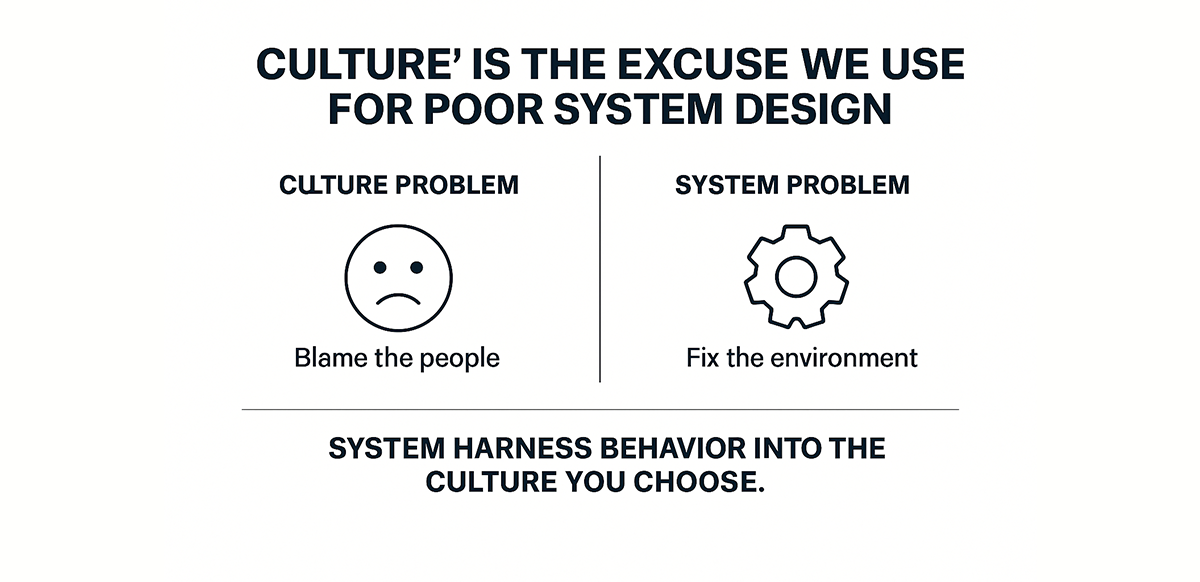
Many so-called culture problems are actually system design failures. Clear workflows, incentives, and accountability can solve issues that speeches cannot.
We talk about "culture" constantly. We plaster our values on the wall—"Innovation," "Integrity," "Teamwork." We host town halls and hope the message sinks in. And when things go wrong, we point to a "cultural problem."
But what if "culture" has become a convenient scapegoat? What if the real issue isn't the people, but the invisible architecture that guides their every move?
The hard truth is this: You don't have a culture problem. You have a system design problem.
When a team is disengaged, we blame a "toxic" employee. When deadlines are missed, we blame a "lazy" team. When quality slips, we blame a "lack of care."
This is the "Bad Apple" fallacy. It’s a comforting lie because it suggests the system is sound; we just need to find and remove the rotten fruit. But people don't wake up wanting to do a bad job. They are responding, rationally, to the environment they are in.
Your culture is not what you proclaim. It is what you permit and promote through your systems.
Your employees navigate a landscape of processes, incentives, and tools every day. This landscape, your system, dictates their behavior far more powerfully than any poster or pep talk.
| If Your System... | Your "Culture" Will Be... |
|---|---|
| Punishes honest mistakes | "Risk-averse" and "blame-shifting." |
| Rewards heroic fire-fighting | "Chaotic" and "exhausted." |
| Silos teams and metrics | "Territorial" and "uncooperative." |
| Offers no clear growth path | "Uninspired" and "transactional." |
Blaming culture for these outcomes is like blaming a plant for wilting in poor soil. You can lecture the plant about the importance of photosynthesis, or you can fix the soil.
An agency leader complains: "My team lacks accountability. They don't take ownership of problems."
The "Culture" Solution: A workshop on accountability! A new value statement! Motivational speeches.
The System Design Solution: Audit the workflow. Is there a clear, single point of ownership for each task? Do they have the authority to solve the problems they own? The system is teaching them that "ownership" leads to more work and more risk, with no upside. The culture is simply reflecting that lesson.
Stop trying to change culture. Start building systems that cultivate the behavior you want.
Culture isn't something you install. It's the residue left over after your systems have done their work. It's the collective sigh of relief when a process is intuitive, or the collective groan when it's broken.
Stop using "culture" as a mystical explanation for failure. Look behind the curtain.
The levers of change aren't in your mission statement. They are in your project management software, your commission structure, and your approval workflows.
Fix the machine, not the people.

Founder of ListingMine and author of Agent for Life. Building ERP for Malaysian real estate agencies since 2008 — and writing to reshape how agencies grow.
More about Marvin Foong →More articles in this topic
This article is one of the sources behind this assessment. Take it to see what you already know and what to read next.
Educational self-assessment. Not a licensing examination or professional certification.