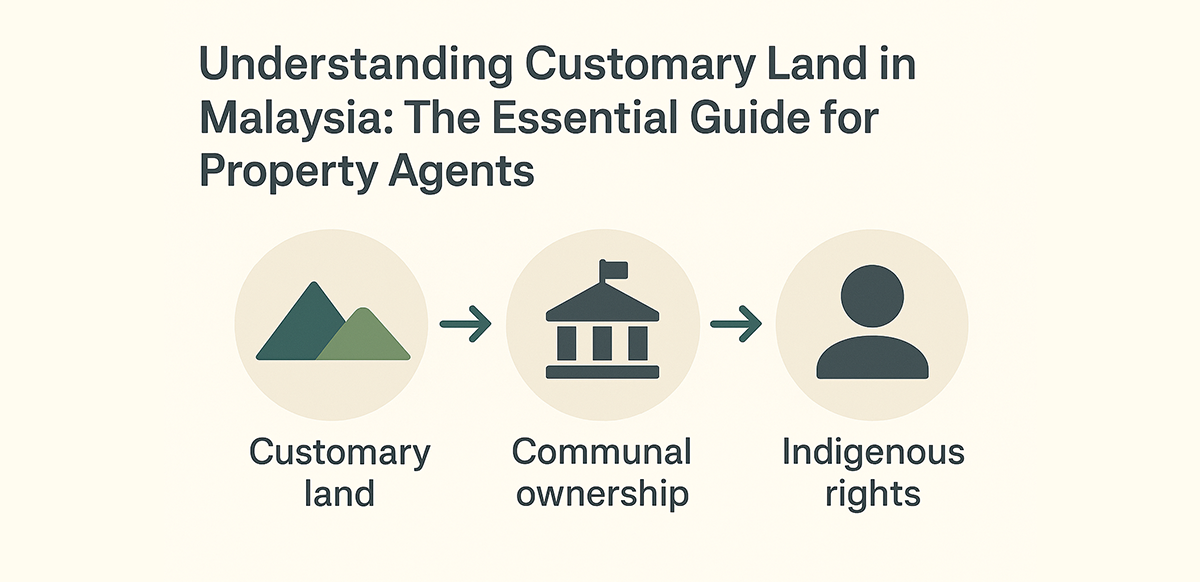
Customary land involves unique ownership, usage, and transfer issues that differ from ordinary registered land. Agents must understand local rules and sensitivities before marketing or advising on such properties.
A professional, research-informed breakdown of NCR, NT, Orang Asli, Malay Reserve, and Customary Titles — and what every REN, PEA, and REA must know before touching these high-risk categories.
Malaysia's land system is not uniform.
While most agents are familiar with the Torrens System (National Land Code 1965, "NLC"), large parts of Malaysia — especially Sabah, Sarawak, Negeri Sembilan, and Orang Asli territories — operate under customary land frameworks that do not follow normal Torrens rules.
Customary land can be:
For property agents, customary land is one of the highest-risk areas in Malaysian real estate.
Missteps lead to:
This guide integrates Malaysian legislation, case law, NCR/NCL principles, Adat systems, federal constitutional protections, and practical transaction risks.
"Customary land" refers to land held by indigenous or native communities based on ancestral occupation, continuous use, or traditional practices, rather than by Torrens-style registered ownership.
It exists in three national contexts:
Customary land does not behave like Torrens land. Registration alone does not guarantee validity of transfer. Customary law, community rules, or native restrictions may override the SPA even after registration.
A. Peninsular Malaysia (West Malaysia)
1. Orang Asli Customary Land (Aboriginal Peoples Act 1954)
Key Characteristics
Agent Implications
2. Negeri Sembilan Customary Land (Adat Perpatih – Tanah Adat / Tanah Pesaka)
Key Characteristics
Agent Implications
B. Sabah — Native Customary Rights & Native Titles (NT)
Governed under Sabah Land Ordinance 1930.
Key Title Types
Agent Implications
C. Sarawak — Native Customary Rights Land (NCR Land)
Governed under Sarawak Land Code 1958.
Key Restrictions
Agent Implications
Though not "customary" in the indigenous sense, Malay Reserve is governed by state Malay Reservation Enactments.
Key Characteristics
Agent Implications
| Aspect | Customary Land | Torrens Land (NLC) |
|---|---|---|
| Ownership Proof | Customary use, lineage, community recognition; sometimes untitled | Register Document of Title (RDT) is conclusive |
| Transfer Rules | Restricted to natives/tribe; requires community or state consent | Freely transferable after registration |
| Sale Risks | Invalid SPAs, community injunctions, criminal penalties | Fraud exceptions only; state-backed registration |
| Buyer Eligibility | Limited by ethnicity / tribe / native status | Generally open |
Agents must walk away or escalate to lawyers when encountering:
In customary land: If you're unsure — the correct move is to stop the deal.
Mastery of customary land is the mark of a high-skill, compliance-ready, trusted advisor. Agents who ignore customary frameworks expose themselves to litigation and breach BOVAEA rules. Professional agency practice begins with understanding the law that governs ownership.

Founder of ListingMine and author of Agent for Life. Building ERP for Malaysian real estate agencies since 2008 — and writing to reshape how agencies grow.
More about Marvin Foong →More articles in this topic
This article is one of the sources behind these assessments. Take one to see what you already know and what to read next.
Educational self-assessment. Not a licensing examination or professional certification.