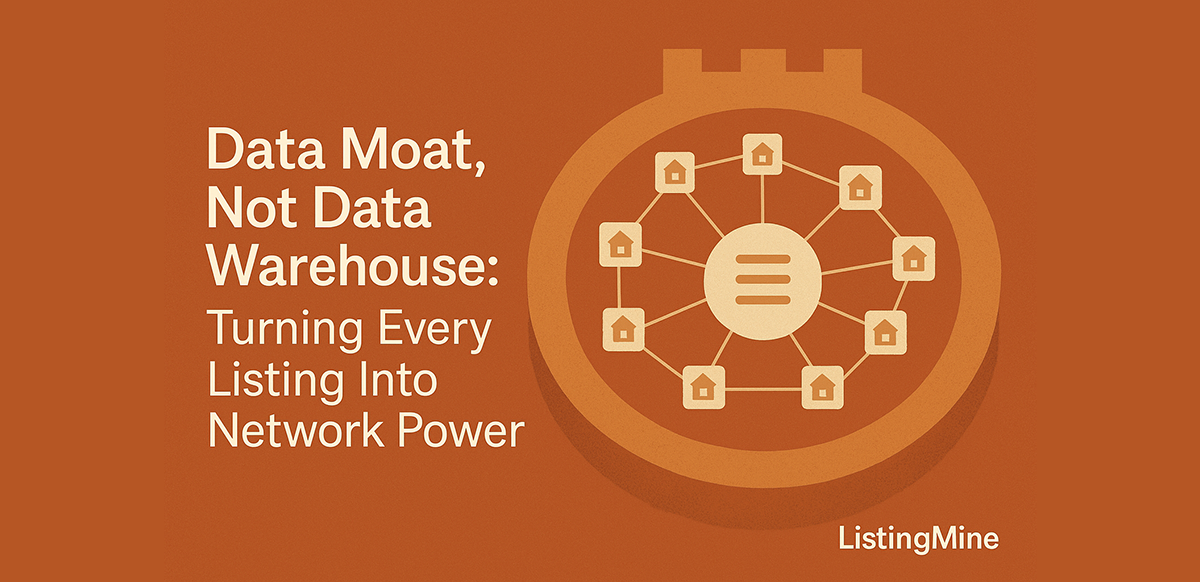
Listing data becomes valuable only when it strengthens cooperation, matching, trust, and network effects. A database without workflow power is not a moat.
A thought piece on why ownership of structured listing data becomes the ultimate moat
Every agency today says it “owns” its listings. But ownership without structure is an illusion — like owning a library where all the books are scattered and unlabeled.
Most listing data sits in silos: WhatsApp images, PDF brochures, Google Sheets, and chat histories. None of it compounds. None of it connects. Each agent starts from zero, every time.
This is not a moat. It’s entropy.
A data warehouse is just storage. A data moat is structure, governance, and reuse.
A data moat turns every listing into an intelligent node:
Suddenly, your data stops being passive memory — it becomes active capital. Every listing reinforces your system’s accuracy, trust, and intelligence.
This is how Beike’s ACN model created the largest moat in Chinese real estate — not by owning more listings, but by owning the structure that defines trust.
When listings are structured, every new input strengthens the network:
Each agent benefits individually, yet collectively they build an ecosystem that no outsider — not even a giant portal — can replicate.
That’s the compounding effect of networked data. The moat deepens with every transaction because the system learns faster than competitors can copy.
Portals chase traffic; networks cultivate truth. A portal’s value ends at visibility. It monetizes attention. A network’s value begins with structure. It monetizes integrity.
Portals can host listings, but they can’t govern them. They can generate leads, but they can’t enforce fairness or verify cooperation. Their data model stops at exposure; yours must extend into accountability.
That’s why the next generation of real estate platforms will not be bigger databases, but smarter ecosystems — built on relational, auditable, and role-based data logic.
A structured listing is more than a record — it’s a web of relationships. It connects agents, roles, verifiers, photos, documents, and commissions into one coherent graph.
That graph — not the listings themselves — becomes the defensible asset. Because even if another company scrapes your listings, they cannot replicate your relational context:
That’s what turns ordinary data into network power.
Data warehouses store. Data moats defend.
The difference is purpose. One is built for reporting; the other for compounding trust.
When your system treats every listing as a building block of credibility — not just content — you stop running a portal and start running a protocol.
That’s the real game: The one who structures truth, governs collaboration, and compounds trust — owns the future of real estate.

Founder of ListingMine and author of Agent for Life. Building ERP for Malaysian real estate agencies since 2008 — and writing to reshape how agencies grow.
More about Marvin Foong →More articles in this topic