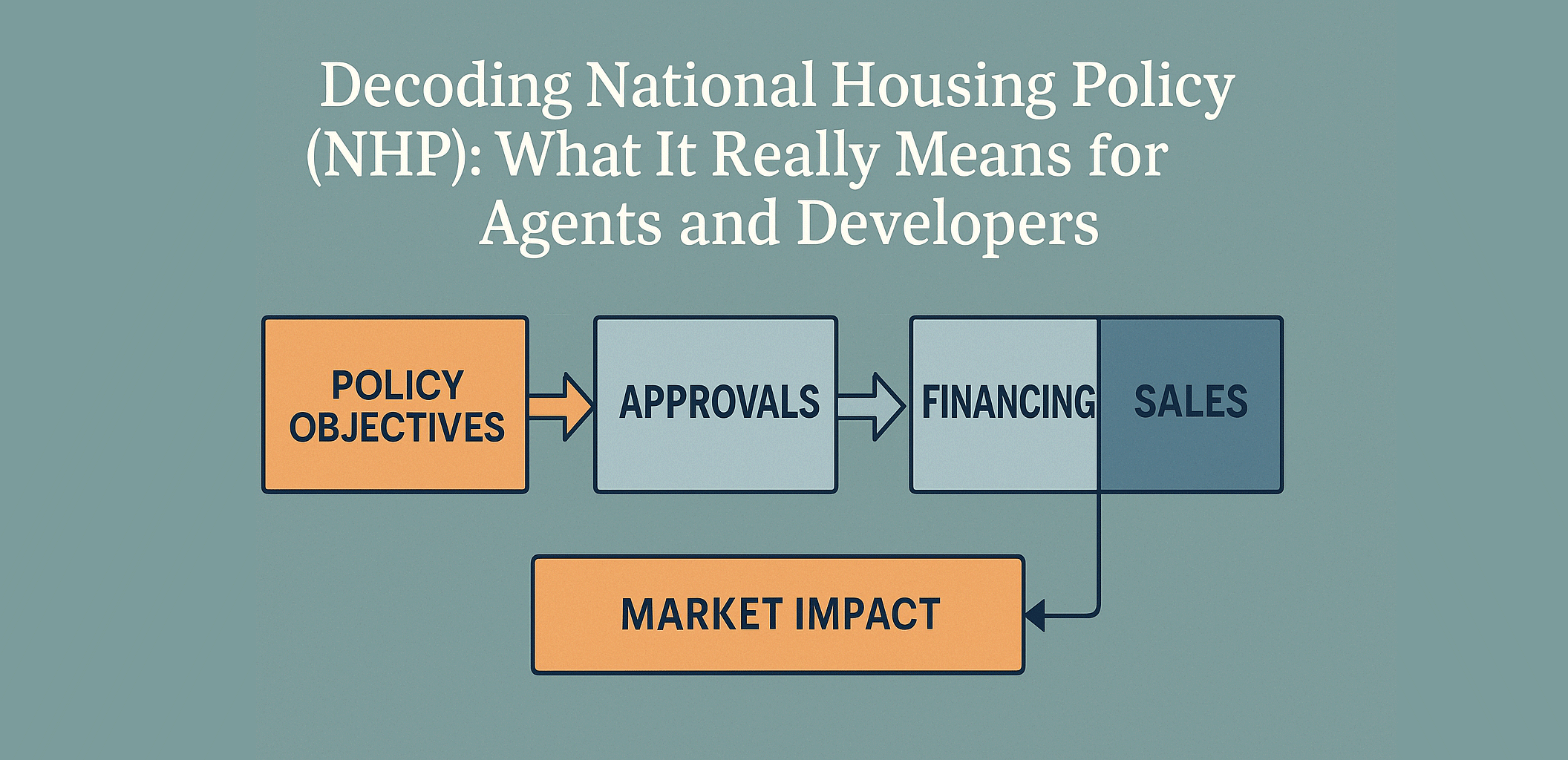
National Housing Policy affects affordability, supply, planning, and buyer demand. Agents and developers should understand how policy direction shapes market opportunities.
Every few years, Malaysia’s National Housing Policy (Dasar Perumahan Negara — NHP) is updated with grand promises: “Affordable homes for all Malaysians.” But beneath the policy headlines and press releases, the real question remains:
What does it actually mean for agents, developers, and the property market on the ground?
Let’s decode the NHP from an industry perspective — not the political one.
At its core, the NHP is not a single law — it’s a policy framework. It guides how the government, private sector, and financial institutions should act in achieving “adequate, quality, and affordable” housing.
The key objectives revolve around:
But here’s the reality — NHP doesn’t build houses. It influences incentives and rules that shape developer behavior, financing policies, and market pricing signals.
Gone are the days when developers could launch high-rise condos with 80% unsold units and still call it a success. NHP, especially under the “Housing 4.0” framework, is quietly shifting expectations toward:
Government-linked housing agencies (like PR1MA, SPNB, PNB, and LPPSA) are now coordinating with state governments to reduce supply-demand mismatch — meaning approvals increasingly depend on need-based justification.
For developers, this means the era of speculative overbuilding is ending. Only those who align with NHP objectives — affordability, integration, sustainability — will get smoother approvals, financing, and sales uptake.
For agents, NHP’s affordability agenda looks like a constraint at first. But in reality, it opens new niches:
In short, policy doesn’t remove opportunity — it redistributes it. Agents who understand how housing policy shapes demand will capture the migration flows others overlook.
Financial institutions are quietly enforcing NHP priorities through:
This means project viability now depends on financing eligibility, not just land cost. Developers can’t simply pass higher land prices to consumers anymore — the banks won’t support inflated buyer segments.
For agents, this also means understanding financing structures becomes a competitive edge. An agent who can explain to a client why certain loans qualify or fail will earn trust faster than one who only “shows units.”
Under the NHP’s latest iteration, the National Housing Data Repository (NHDR) acts as a central database linking:
This database gives the government a clearer picture of unsold stock, rental trends, and affordability gaps.
Over time, this will lead to data-based licensing and project quotas — effectively controlling how many units of certain price categories are launched.
Agents and developers who master this data — through tools like ListingMine ERP — will gain an advantage by predicting where real demand and approvals will shift next.
The agency of the future will not just sell listings — it will:
This alignment will attract both developers (who need compliant distribution partners) and regulators (who want more data transparency).
Agencies that stay purely transactional — ignoring the macro policy signals — will be left behind.
The National Housing Policy doesn’t shrink opportunity — it filters it. It rewards developers who build responsibly and agents who sell intelligently.
If the last decade was about speculation and speed, the next decade will be about data, credibility, and policy alignment.
The winners will not be the fastest sellers, but the best-informed ones — those who can connect what policymakers intend with what real buyers actually want.
| Stakeholder | Opportunity Under NHP | Risk If Ignored |
|---|---|---|
| Developers | Faster approvals, easier financing for compliant projects | Unsold high-end units, delayed permits |
| Agents | Access to new affordable, RTO, and government-linked markets | Shrinking buyer pool, outdated inventory |
| Buyers | Better access to financing, more realistic pricing | Limited selection if waiting for wrong price bracket |
The future belongs to agents who can translate policy into action. Because in Malaysia’s evolving real estate market, understanding the rules of housing may soon matter more than the rules of selling.

Founder of ListingMine and author of Agent for Life. Building ERP for Malaysian real estate agencies since 2008 — and writing to reshape how agencies grow.
More about Marvin Foong →More articles in this topic
This article is one of the sources behind this assessment. Take it to see what you already know and what to read next.
Educational self-assessment. Not a licensing examination or professional certification.