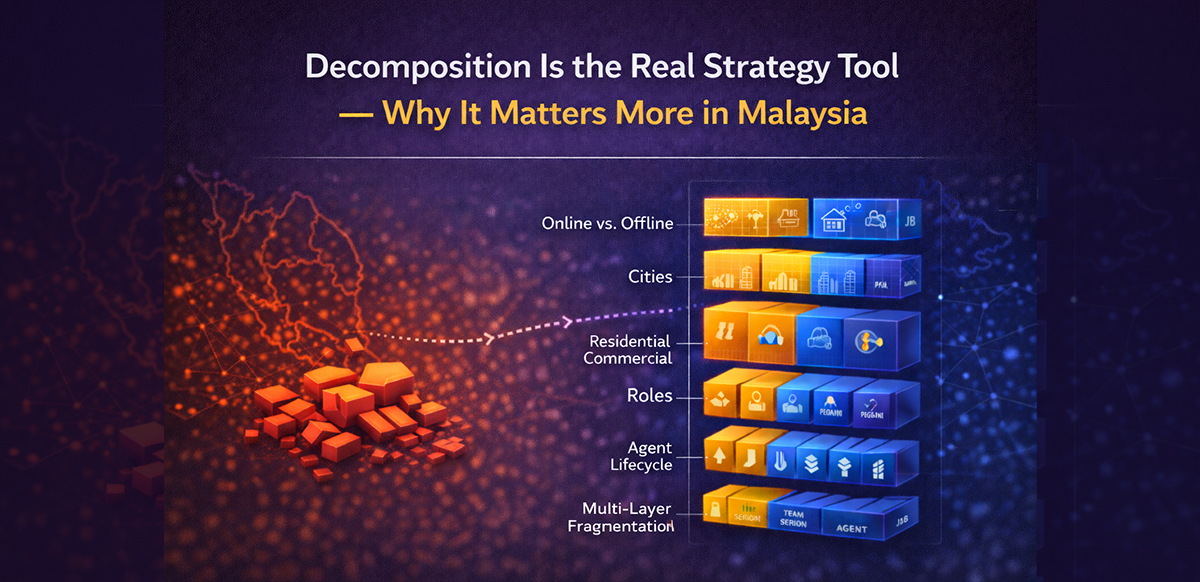
Decomposition breaks large problems into smaller parts that can be solved systematically. Agencies need this discipline to turn vague ambition into actionable work.
Most failed "disruptions" in Malaysia share the same mistake: they attack the industry head-on. They try to out-advertise portals, out-recruit agencies, or out-scale incumbents.
In a small, margin-thin, and fragmented market like Malaysia, brute force does not work. Precision does. And precision comes from Decomposition.
Decomposition is the act of breaking an industry into its real operating parts instead of pretending it is one uniform machine. You don't ask, "How do we disrupt property agencies?" You ask, "Which specific part of the system is failing—and how do we isolate it?"
In Malaysia, there are five decompositions that most agencies ignore, to their own peril.
Despite the dominance of portals, Malaysia's property transactions remain stubbornly offline.
The Reality: Trust is built face-to-face; negotiation happens on WhatsApp; decisions rely on personal relationships.
The Strategy: Don't try to replace the offline human element. Decompose it. Use technology to structure and record the offline work so the agency owns the data, even if the agent owns the relationship.
Treating residential and commercial as the same business is lazy.
Residential (A-Point): High volume, emotional, and currently suffering from a massive high-rise overhang (over 26,000 units in 2025).
Commercial (B-Point): Lower volume, rational, and requires deep specialization.
The Strategy: A system that doesn't distinguish between these two will fail both. Decomposition forces you to design different "rails" for different assets.
Malaysia is not one market. KL is a competition-heavy scale play; Penang is a supply-constrained legacy play; JB is an infrastructure-driven cross-border play (RTS/SEZ).
The Strategy: A "national one-size-fits-all" approach is a sign of shallow thinking. Decomposition allows you to build localized playbooks that respect regional buyer behavior.
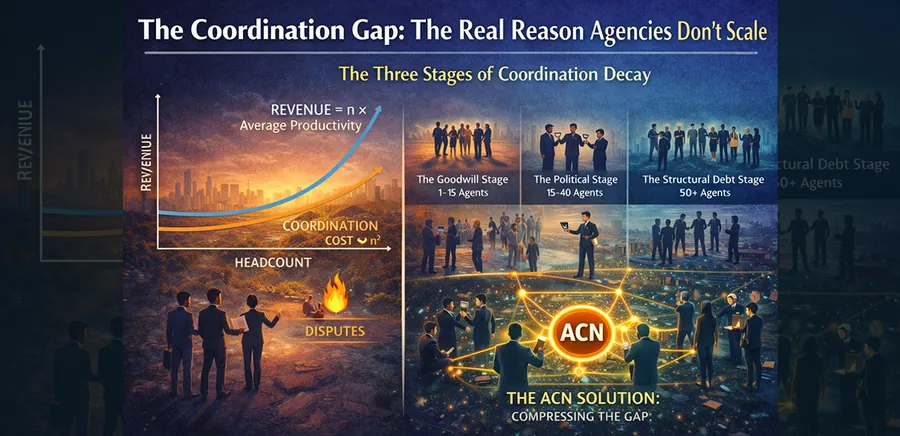
This is Malaysia's biggest structural mistake. We pretend one agent (the REN) must do everything: source the listing, market the unit, manage the buyer, and handle the closing.
The Failure: When you collapse all value into a single person, contribution becomes invisible and cooperation becomes irrational.
The Strategy: Break the "Agent" into roles (Sourcing, Serving, Closing). This makes cooperation economically rational and prevents one person from holding the entire transaction hostage.
A junior REN and a principal REA have completely different motivations. Most systems treat them as identical units with the same KPIs.
The Strategy: Acknowledge the shift from Junior → Senior → Specialist → Leader. Ignoring this lifecycle is the primary cause of the 30%–50% churn rates seen in traditional agencies.
There is a common misconception that "Role Separation" only works in big markets. The opposite is true. Malaysia's fragmentation makes role separation more necessary, not less.
In an Agency Cooperation Network (ACN) model:
You do not win in Malaysia by being the loudest. You win by being the most precise.
Decomposition allows you to design a system that matches Malaysian reality, governs cooperation without forcing "team spirit," and lets institutional memory compound.
Malaysia does not need disruption theatre. It needs structural clarity.
You don't disrupt Malaysia's property industry by attacking it as a monolith. You disrupt it by decomposing it—fixing the parts that are broken and governing the parts that work.

Founder of ListingMine and author of Agent for Life. Building ERP for Malaysian real estate agencies since 2008 — and writing to reshape how agencies grow.
More about Marvin Foong →More articles in this topic