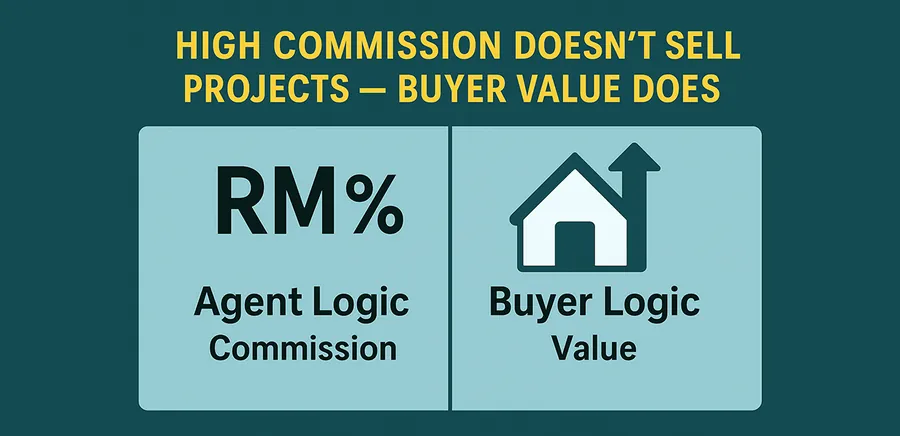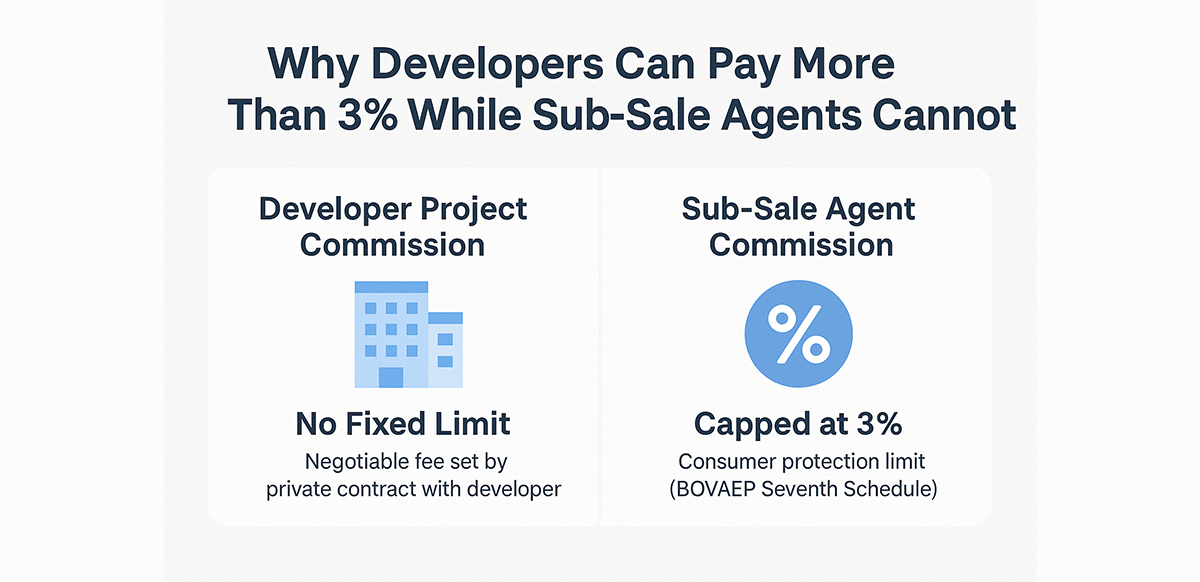
Developer commissions and sub-sale fees operate under different commercial structures and legal expectations. Agents need to understand why project payouts can differ from sub-sale limits.
Understanding the Regulatory Difference in Malaysian Real Estate Practice
A common question in the industry is this:
“If the maximum fee for an estate agent is 3%, how can developers legally pay 5%, 7%, or even 10%?”
The answer lies in the legal distinction between consumer agency work and corporate project marketing. Both are real estate transactions, but they are governed differently because they protect different parties.
Under the Seventh Schedule of the Valuers, Appraisers, Estate Agents and Property Managers Rules, the 3% maximum fee applies when:
This is a consumer-protection rule, not a universal fee limit for all real estate work.
| Type of Client | Treated As | Fee Capped at 3%? |
|---|---|---|
| Private owner selling a condo | Consumer | Yes |
| Buyer appointing agent for a landed home | Consumer | Yes |
When the client is an individual, the fee is regulated to prevent abuse.
When a real estate firm is appointed to market a new project, the client is a developer — a corporate entity hiring a professional sales and marketing service.
The Seventh Schedule makes this exception explicit:
“For sale and marketing of projects by registered estate agents, the fees are to be agreed between the estate agent and the client.”
This clause removes the fee ceiling entirely for project sales, because it is not a consumer-level transaction.
| Type of Client | Treated As | Fee Capped at 3%? |
|---|---|---|
| Developer launching a 300-unit project | Corporate | No |
That is why developers can legally offer:
All are permitted because they are B2B contracts, not regulated consumer fees.
Developer appointments typically include far more than agency representation. They may cover:
This is not the same scope as selling a single subsale unit. Therefore, the fee is not treated as “commission” in the sense of a capped percentage — it is a negotiated commercial service fee.
Sub-sale involves:
So the 3% limit applies automatically. Any attempt to charge more — even if “agreed” verbally — is treated as a breach of the statutory fee scale.
| Sub-Sale Example | Status |
|---|---|
| Agent charges 4% to a homeowner | Not allowed |
| Agent charges 7% “like a project” | Not allowed |
| Agent claims “seller agreed verbally” | Still not allowed |
The difference is not in the property. It is in who the client is, and what the law protects.
| Scenario | Client Type | Regulated Fee? | Why |
|---|---|---|---|
| Selling a private owner’s terrace house | Public | Yes (max 3%) | Consumer protection |
| Acting for a buyer purchasing a condo | Public | Yes (max 3%) | Consumer protection |
| Marketing a new development for a developer | Corporate | No cap | Commercial contract |
If the client is a member of the public, the statutory fee scale applies.
If the client is a developer, the fee is fully negotiable.
The law does not limit income — it limits how much can be charged to the public under an agency role.

Founder of ListingMine and author of Agent for Life. Building ERP for Malaysian real estate agencies since 2008 — and writing to reshape how agencies grow.
More about Marvin Foong →More articles in this topic
This article is one of the sources behind these assessments. Take one to see what you already know and what to read next.
Educational self-assessment. Not a licensing examination or professional certification.