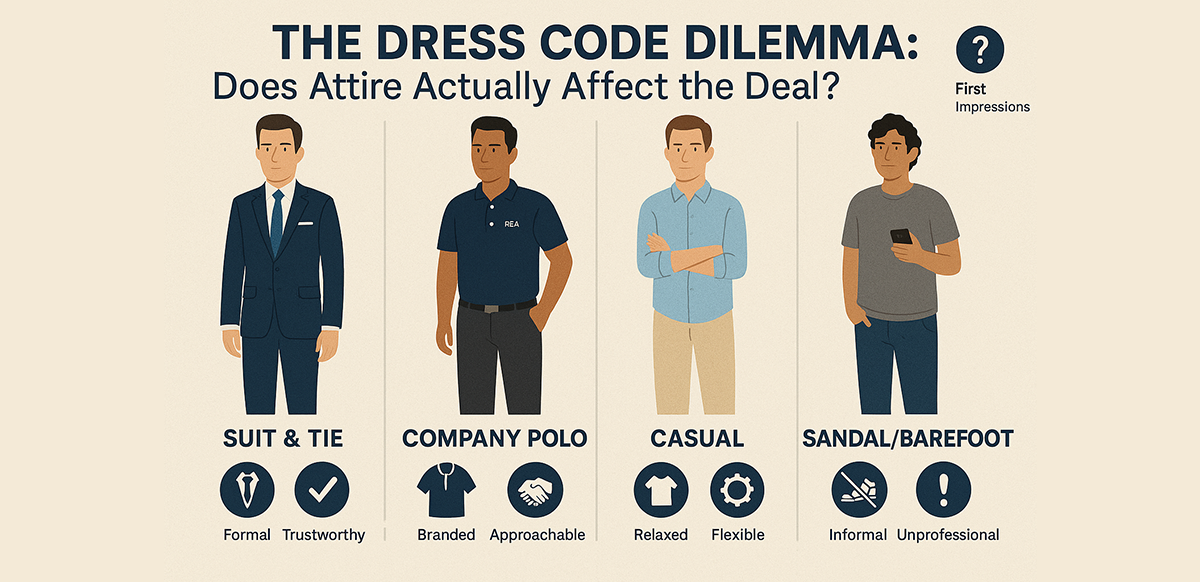
Attire affects first impressions, trust, and professional image, but it cannot replace competence. Agents should dress to match client expectations and transaction context.
Every property professional faces the same strategic decision before meeting a stranger:
"Do I dress formally to establish authority? Or will that make me seem disconnected?"
"Does a company uniform signal professionalism—or does it brand me as a salesperson?"
The answer is rarely black and white. However, the commercial reality is undeniable: Your attire is a fundamental component of your negotiation strategy.
The goal is not to look wealthy. The goal is to establish Congruence—to align your visual presentation with the price point of the asset and the psychology of the client.
Here is the commercial logic behind attire in the modern real estate market.
Psychological studies confirm that strangers form a judgment within 0.2 seconds of visual contact. Before you utter a single word, your attire has already communicated your:
In professional services, clothing is not fashion. It is Positioning.
Target Demographic: First-time buyers, M40 families.
Strategic Attire: Smart Casual (Polished).
The Look: Polo shirt, clean corporate uniform, or a button-down shirt with chinos. Closed shoes or smart sneakers.
The Rationale: Overdressing in a full suit can create psychological distance, making the agent appear intimidating or "too corporate." This demographic values approachability and friendliness over hierarchy.
The Risk: Under-dressing (slippers/worn jeans) destroys credibility immediately.
Target Demographic: Professionals, managers, business owners, upgraders.
Strategic Attire: Business Casual / Smart Formal.
The Look: Long-sleeve button-up shirt, trousers/slacks, leather shoes. A blazer is optional but recommended.
The Rationale: These clients are making a significant life decision. They expect a handler who looks organized, respectful, and competent. Good grooming signals: "I respect your time and I am capable of managing this transaction."
The Risk: Company T-shirts are often too casual for this bracket. At this price point, you are a consultant, not a promoter.
Target Demographic: C-Suite executives, investors, High-Net-Worth Individuals (HNWI).
Strategic Attire: Business Formal.
The Look: Tailored blazer or suit jacket, crisp dress shirt, polished leather shoes.
The Rationale: These clients regularly interact with private bankers, lawyers, and corporate directors. They expect their property consultant to mirror that level of professionalism. If you arrive in casual wear, you have not just lost points; you have likely lost the mandate.
The Risk: Casual attire signals that you are not a "serious handler" of multi-million ringgit assets.
Is wearing a company T-shirt professional? It depends entirely on the context.
YES — It is appropriate when:
The goal is to be identified as "Staff" or "Representative."
NO — It damages your positioning when:
The goal is to be identified as a "Trusted Advisor."
The Verdict: A uniform positions you as an employee. A suit (or smart formal wear) positions you as an independent professional. People trust professionals with RM3 million decisions.
There is no grey area here.
Slippers: unacceptable. They signal a lack of preparation and a lack of respect for the meeting.
Sandals: Only acceptable if the site is a hazardous construction zone or a flood-prone area, and even then, safety boots are the superior choice.
Closed Shoes: The universal standard.
Shoes are the anchor of an outfit. They signal discipline. A client may not consciously notice polished shoes, but they will subconsciously notice dirty ones.
Does it actually change the result of the deal? Absolutely.
A. It Frames the Asset
If the agent looks premium, the property feels premium. If the agent looks unkempt, the buyer subconsciously wonders if the property management is also negligent. The agent is the proxy for the asset's value.
B. It Facilitates Disclosure
Clients are hesitant to discuss their genuine budget, financial struggles, or motivations with someone who looks unprofessional. They open up to individuals who look capable of solving complex problems.
C. It mitigate Buyer Remorse
Real estate is an emotional transaction. Buyers need to feel safe. A professionally dressed agent provides a subconscious layer of security and certainty.
You must mirror the sophistication of the transaction.
| Context | Strategic Attire |
|---|---|
| Mass Market / Project Launch | Corporate Uniform / Smart Casual |
| Sub-sale / Family Home | Smart Formal (Shirt & Slacks) |
| Luxury / Corporate Deal | Business Formal (Blazer / Suit) |
| Construction Site | Safety / Practical Gear |
| Zoom Consultation | Smart Top & Professional Background |
Your attire will not close the deal for you—but it can absolutely lose it for you.
In this industry, you are not merely selling brick and mortar. You are selling Trust, Competence, and Professionalism.
Clothes do not define your skill, but they shape the client's willingness to believe in it. Dress like the consultant who deserves the commission, not the novice who is hoping for it.

Founder of ListingMine and author of Agent for Life. Building ERP for Malaysian real estate agencies since 2008 — and writing to reshape how agencies grow.
More about Marvin Foong →More articles in this topic
This article is one of the sources behind this assessment. Take it to see what you already know and what to read next.
Educational self-assessment. Not a licensing examination or professional certification.