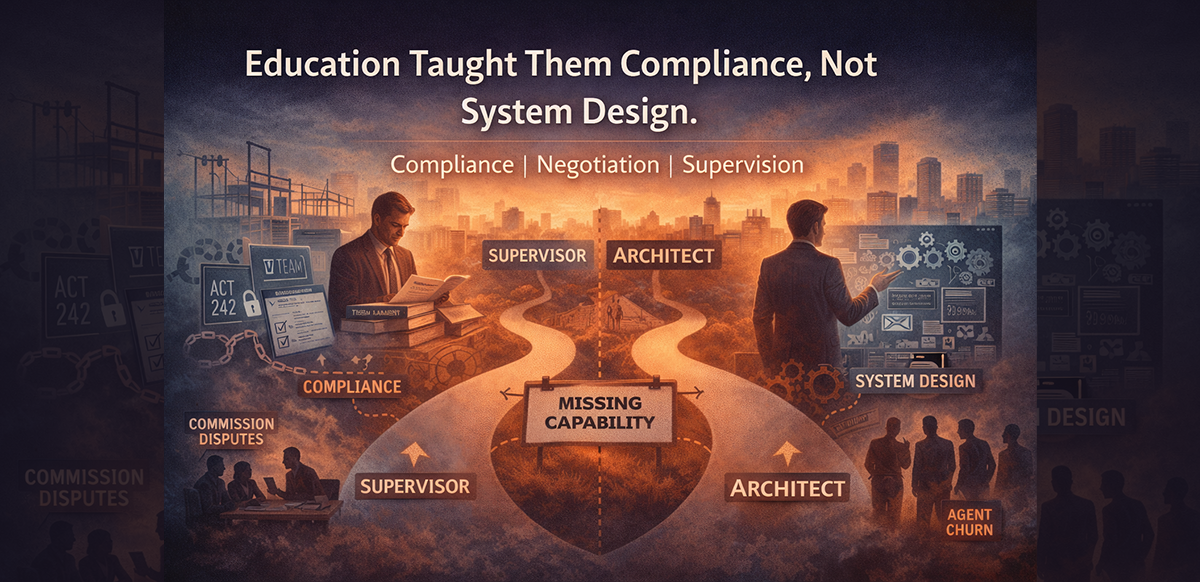
Traditional industry education often teaches legal compliance but not agency system design. Future professionalism needs training in workflows, economics, cooperation, and infrastructure.
Most agency principals are highly educated, technically proficient, and ethically sound. They followed the rules, passed the exams, and earned their licenses.
But there is a silent gap in that education:
It trained them to be participants in a system—not the architects of one.
The modern real-estate curriculum is built on three pillars:
These are necessary skills. But one capability is almost entirely absent: System Design.
When an agency begins to experience friction—commission disputes, high agent turnover, or stalled growth—principals reach for the tools they were trained to use. Because they were educated as supervisors and negotiators, their responses are behavioral, not structural.
They default to:
These responses are not stupid. They are structurally inadequate. You cannot fix a systems problem with moral pressure.
The core misunderstanding is this: Agency problems are assumed to be people problems, when they are actually economic design failures.
| Supervisor’s View (Behavioral) | Architect’s View (Structural) |
|---|---|
| "Agents are leaving because they aren't loyal." | "The retention economics are weaker than the cost of switching." |
| "They're fighting over this lead because of greed." | "The attribution logic is vague and creates conflict." |
| "We need a meeting to align the team." | "The incentive structure rewards solo play over ACN cooperation." |
| "We need more discipline in the office." | "The workflow contains too much Shadow Labor." |
Education taught you how to be a good negotiator—which helps you close deals. It did not teach you how to be an economic architect—which helps you design a commission engine that runs without you.
When a principal says, “Just be fair lah,” they are using morality as a substitute for mechanics.
But fairness is subjective. What feels fair to a team leader, a high-performing solo agent, and an agency owner is almost never the same. When fairness is undefined, every dispute requires personal arbitration.
This is the birth of Shadow Labor: the invisible, unbilled work a founder does to patch a leaking system.
A system, by contrast, is objective. A well-designed Agent Cooperation Network (ACN):
The shift from managing people to designing systems is the hardest pivot a founder will ever make. It requires admitting that:
This is uncomfortable—but liberating. Because once systems replace supervision, growth stops depending on your presence.
The “proper path” of education stopped one step too early. It taught the rules of the game, but not how to build the stadium.
The goal is no longer to be a responsible supervisor. The goal is to become an economic architect—someone who builds a system so clear, so logical, and so automated that fairness is no longer debated.
It simply emerges—as a byproduct of design.

Founder of ListingMine and author of Agent for Life. Building ERP for Malaysian real estate agencies since 2008 — and writing to reshape how agencies grow.
More about Marvin Foong →More articles in this topic
This article is one of the sources behind this assessment. Take it to see what you already know and what to read next.
Educational self-assessment. Not a licensing examination or professional certification.