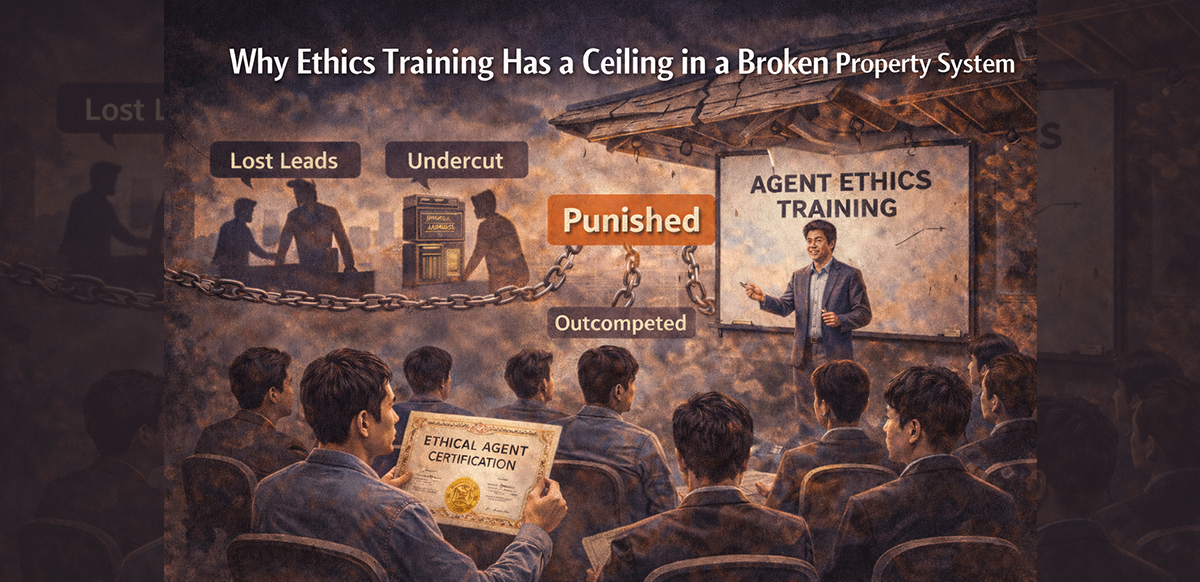
Ethics training alone cannot fix bad incentives, weak enforcement, and unclear systems. Better structure is needed to make ethical behaviour practical.
Courses like:
are not useless.
They do work — but only at the personal layer. That's the ceiling no one explains.
Ethics training assumes one thing: If individuals behave better, the industry will improve.
This assumption fails in a low-trust equilibrium. Why?
Because behaviour is not driven by values alone — it is driven by survival incentives. An ethical agent inside a broken system faces this reality:
At that point, ethics becomes a personal tax, not a professional advantage.
What it can do
What it cannot do
This is the ceiling. No amount of training can override a system that punishes ethical behaviour.
In a broken system:
Not because ethics is wrong — but because the system does not support it. So agents internalise the wrong lesson: "Being ethical doesn't pay."
That is a structural failure, not a moral one.
This is the tragedy.
Agents attend ethics courses. They genuinely want to improve. They return to the same system. Nothing changes.
So they either:
Both outcomes are predictable. Ethics training without infrastructure is like teaching swimmers perfect technique — and then throwing them into a river with no lifeguards, no lanes, and no rules.
Ethics training must sit on top of structure, not replace it.
It works only when:
In that environment, ethics training compounds. Outside it, ethics training evaporates.
Agents are not lazy. They are not unethical by default. They are not "the problem".
They are working hard — in the wrong direction. The direction must change from:
When ethics becomes structurally supported, training finally matters.
Until then, ethics courses will continue to feel inspiring — and change almost nothing.

Founder of ListingMine and author of Agent for Life. Building ERP for Malaysian real estate agencies since 2008 — and writing to reshape how agencies grow.
More about Marvin Foong →More articles in this topic