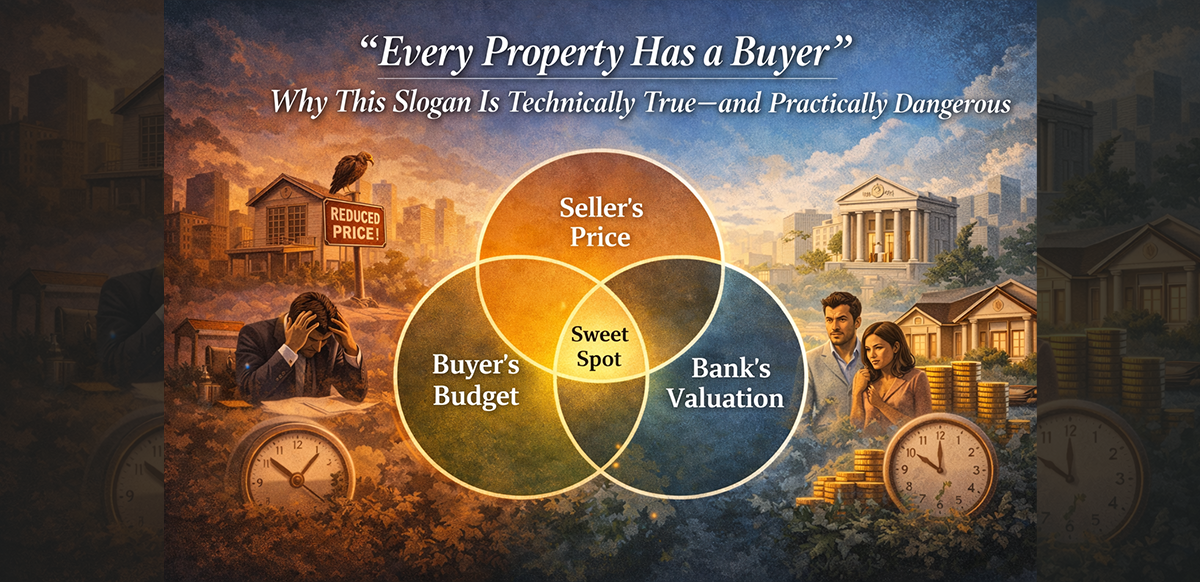
Every property may have a buyer at some price, but the slogan can mislead sellers into unrealistic expectations. Agents need pricing discipline and market honesty.
In real estate, there is an old saying often used to calm anxious sellers and close uncomfortable meetings: "Don't worry. Every property in the world has a buyer."
It sounds reassuring. It feels like a law of nature. And yet, when taken literally, it is one of the most misleading ideas in the property industry. The statement is not exactly false—but it is dangerously incomplete.
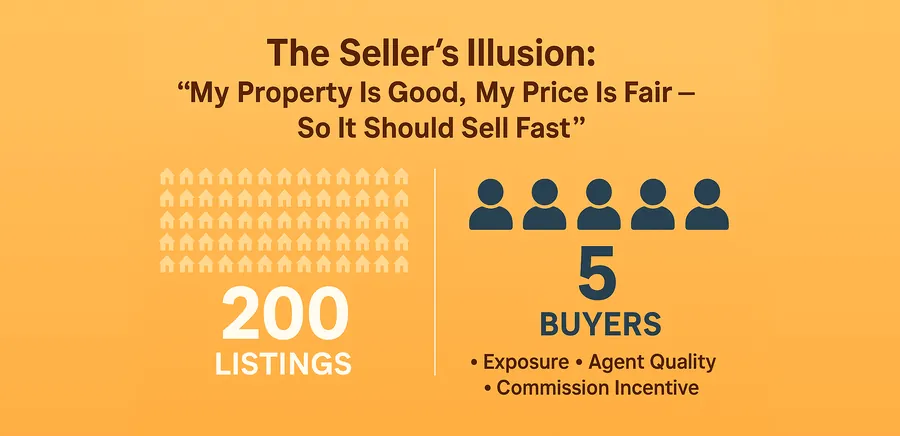
A property will find a buyer, provided you have an unlimited supply of three variables:
In the world of theory, the saying holds. But sellers do not live in the world of theory.
Most sellers do not mean they are willing to wait indefinitely or accept any pittance. What they actually mean is: "This property should sell at my expected price, within my financial runway, to a qualified buyer."
Under those real-world constraints, many properties simply do not have a buyer. They fail because of a fundamental misalignment between the asset and the environment.
Properties typically fail to find a buyer because:
A professional does not sell hope; they manage variables. To make a buyer appear, three pillars must be aligned:
1. Price Alignment (Target Audience)
Most "unsellable" properties are not bad assets; they are mispriced for their specific audience. An Investor Price is based on yield; an Owner-Occupier Price is based on emotion and utility. A property priced for the wrong audience doesn't just feel expensive—it feels invisible.
2. Time Reality (The Cost of Waiting)
Time is not neutral; it is a decaying asset. Holding costs—loan interest, maintenance, and opportunity costs—accumulate every day. A property that could sell in three years may be effectively "unsellable" if the seller needs the liquidity in three months. Ignoring time risk is how patience turns into loss.
3. Narrative Fit (From Listing to Product)
Properties do not sell on facts alone; they sell on Fit. If the story is unclear—Who is this for? Why now? What problem does it solve?—buyers hesitate even if the numbers technically work. This is the difference between advertising a raw listing and presenting a finished product.
Why do agents keep repeating this saying? Because it serves a defensive function. It reduces seller anxiety, buys the agent time, and postpones a difficult confrontation with reality.
However, overusing this slogan is a Risk Transfer. The agent provides the comfort, but the seller absorbs the holding cost. When the market turns, the slogan does not pay the bank interest; the seller does.
A dignified service provider does not hide behind slogans. They replace optimism with Structure. They answer hard questions clearly:
Who is the specific buyer profile for this asset?
What price makes it the most attractive option for that buyer?
How does today's financing environment constrain demand?
If a property has no buyer under any reasonable scenario, the problem is no longer marketing—it is Structural. It could be a legal constraint, financing exclusion, or a land-use mismatch. At that point, it is no longer a sales problem; it is an Asset Design Problem.
Final Thought
"Every property has a buyer" is a sedative, not advice. Used carelessly, it delays necessary decisions and erodes professional credibility.
A dignified agent understands that professionalism is not about optimism—it is about telling the truth early enough for it to matter. Real value is not created by waiting for a buyer to appear; it is created by engineering the conditions that make a buyer inevitable.

Founder of ListingMine and author of Agent for Life. Building ERP for Malaysian real estate agencies since 2008 — and writing to reshape how agencies grow.
More about Marvin Foong →More articles in this topic
This article is one of the sources behind this assessment. Take it to see what you already know and what to read next.
Educational self-assessment. Not a licensing examination or professional certification.