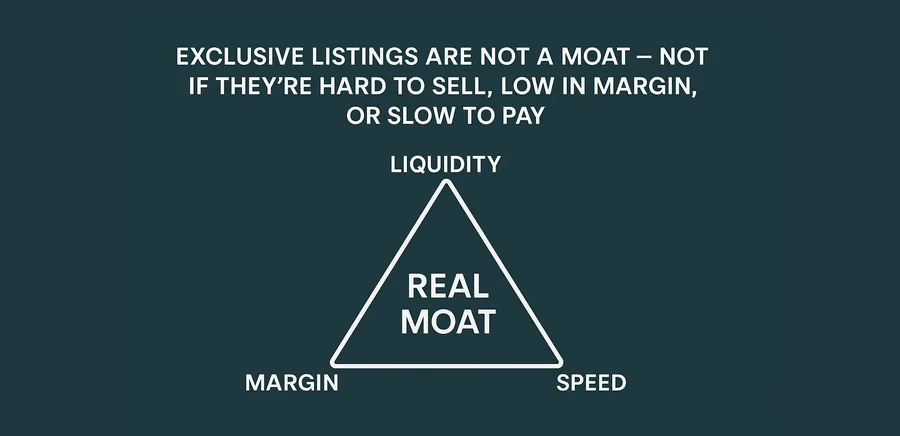
Exclusive listings become liabilities when they are overpriced, unsellable, or unsupported by proper owner commitment. Agencies should judge exclusivity by quality, not label.
ListingMine Academy | Agency Strategy, ACN Economics & Operational Reality
In theory, exclusive listings are the holy grail of real estate.
Bosses tell agents to “collect exclusives.”
Agents believe exclusives mean control, pricing power, and guaranteed sales.
Agencies proudly claim, “We specialise in exclusive mandates.”
But the truth inside Malaysian agencies is far less glamorous:
Most exclusives are not assets.
They are liabilities.
They drain time, manpower, cashflow, and management bandwidth — and often deliver zero ROI.
This article explains the structural, economic, and operational reasons why.
In countries with a strong MLS or ACN governance, exclusive listings work because:
But in Malaysia?
None of this exists.
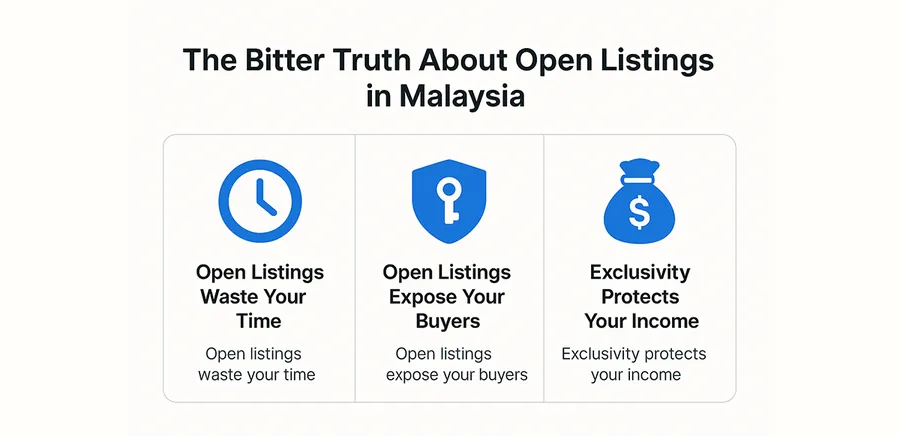
So exclusivity gives the agency responsibility without support, liability without leverage, and burden without buy-in.
An exclusive listing requires the agency to deliver a full value-chain:
Each of these is a cost.
But the agency cannot spread that cost across the market because the mandate is exclusive — meaning zero cost-sharing and zero co-broking leverage.
Without a large internal team or ACN-style cooperation, the agency is stuck holding the entire operational burden.
This turns an exclusive into a mini development project — but without developer-level marketing budgets.
A hard truth:
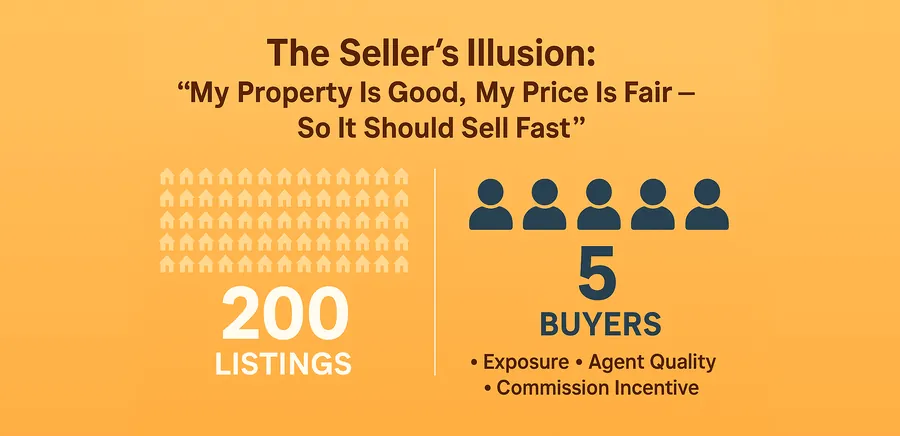
Exclusives in Malaysia do not automatically attract buyers.
Why?
A. Buyers Prefer Options, Not Restrictions
Malaysians hate being told:
“You must go through only this agent.”
They want:
An exclusive blocks this behaviour instead of aligning with it.
B. The Market Is Buyer-Led, Not Agency-Led
Malaysia is not New York, Singapore, or Sydney.
We don’t have an open, trusted, multi-agent MLS ecosystem.
Buyers don’t trust exclusive listings because:
This hesitation reduces buyer flow — the opposite of what the exclusive model promises.
A non-exclusive listing can be marketed by:
This increases exposure through distribution, not control.
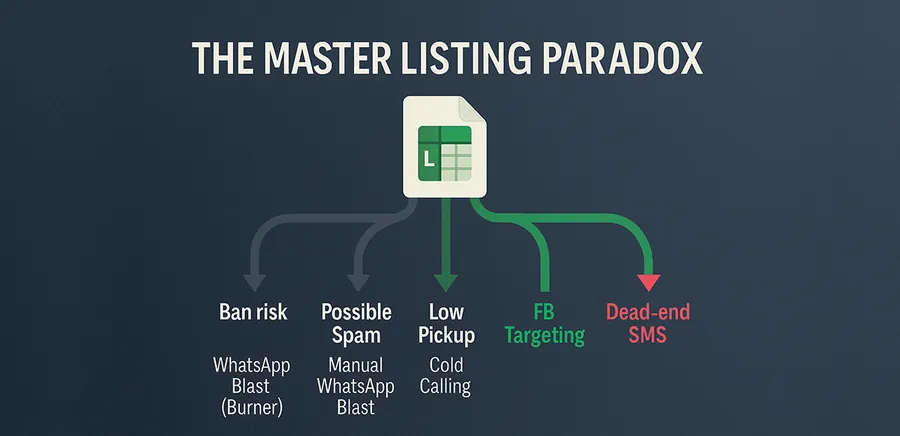
But an exclusive restricts distribution.
Unless the agency has:
… the listing stays frozen inside a small internal bubble.
Low exposure = slow sale.
Slow sale = liability.
Even if the agency wants the exclusive to succeed, the agents don’t.
Because:
The exclusive becomes an orphan listing.
The only person pushing it is the person who brought it in — who may not be the strongest closer.
This creates a structural mismatch:
The person who secured the exclusive is rarely the person best at selling it.
Most Malaysian landlords believe:
“Exclusive = higher price.”
So they demand 5–15% ABOVE the market.
That alone kills the listing.
When the price is wrong:
The agency ends up holding a ticking time bomb of expectations.
When you collect an exclusive, you implicitly signal:
But inside the agency:
The exclusive becomes a promise without infrastructure.
This damages the brand more than an expired open listing.
Beike’s exclusive model succeeds because:
They turned exclusives into network assets, not isolated projects.
Malaysia lacks these rails.
This is why ListingMine’s approach is “ACN first, exclusive second.”
Without ACN, exclusives are fragile.
Agencies should not chase exclusives until they can support them through:
Without these, exclusives become:
This is why ListingMine warns agencies:
“A bad exclusive is worse than no exclusive.”
A bad exclusive wastes money.
A bad exclusive kills morale.
A bad exclusive exhausts your team.
A bad exclusive damages your brand.
A bad exclusive is a liability.

Founder of ListingMine and author of Agent for Life. Building ERP for Malaysian real estate agencies since 2008 — and writing to reshape how agencies grow.
More about Marvin Foong →More articles in this topic
This article is one of the sources behind this assessment. Take it to see what you already know and what to read next.
Educational self-assessment. Not a licensing examination or professional certification.