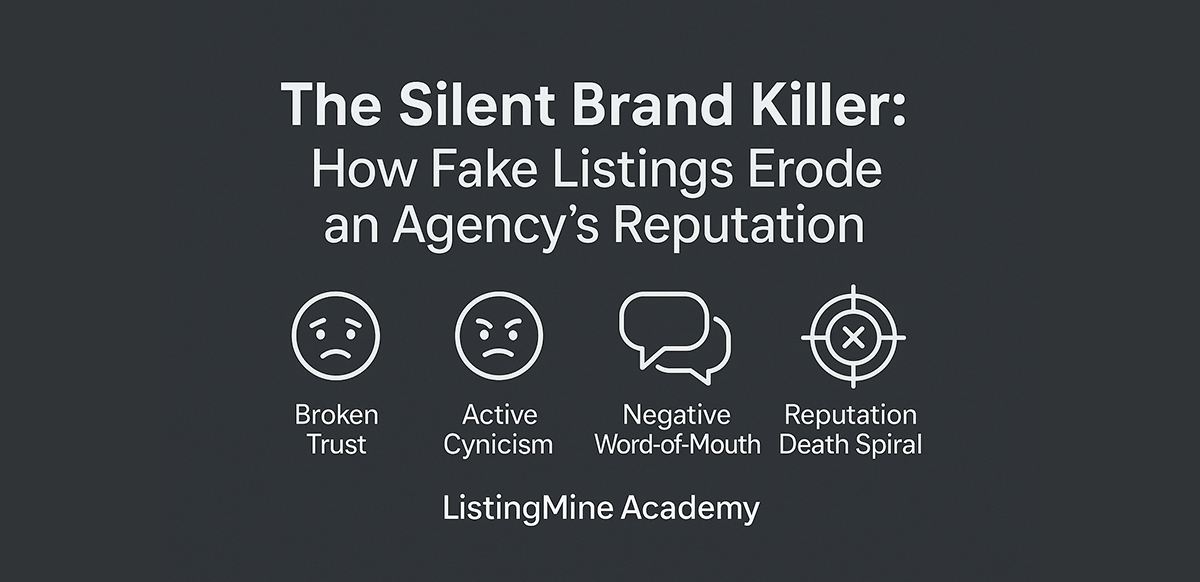
Fake listings slowly destroy agency reputation by teaching buyers to distrust the brand. Listing integrity is a branding asset, not only an admin issue.
ListingMine Academy | Brand Strategy & Market Trust Insight
Fake listings are often treated as a marketing tactic, a “necessary evil,” or just “how the industry works.” But from a branding perspective, they are something far more dangerous:
A slow-acting poison that eats away at trust, credibility, and long-term survival.
Most agencies don’t collapse because of competition. They collapse because consumers silently blacklist them long before leaders notice the damage. This is the brand erosion cycle fake listings create—and why it’s almost impossible to reverse.
A buyer sees your listing. The photos look good. The price is attractive. The copy is persuasive. They call.
“It’s not available anymore.”
“The photos are not accurate.”
“The price is wrong.”
At that moment, they experience brand betrayal. Not disappointment—betrayal. And here is the part most agencies underestimate: In branding terms, this is catastrophic. You never get a second chance to make a first impression that isn’t a lie. The consumer walks away not just from the listing… but from your entire brand.
Fake listings do not merely frustrate consumers; they change their worldview. After two or three bad experiences, buyers move into Active Cynicism:
“Agents always lie.”
“Listings are never real.”
“Everyone is trying to trick me.”
“They're all the same.”
This destroys the foundation every agency depends on: The belief that we are here to help. Once that belief collapses, no amount of branding, ads, or training can repair it.
When a consumer expects a lie, everything becomes harder:
This doesn’t just hurt your conversion rate—it stains your brand with an emotional memory of stress and distrust. People do not avoid “bad brands.” They avoid brands that make them feel stupid.
When someone has a good buying experience, they tell a friend—maybe. When someone feels lied to, they tell everyone.
And unlike positive word-of-mouth, which is slow and organic… Negative word-of-mouth is viral and permanent.
You cannot out-advertise it. You cannot drown it out with PR. A single fake listing can create hundreds of private conversations about how “this agency cannot be trusted.”
Consumers compare everything:
If your public identity and your actual behaviour do not match, consumers will expose the contradiction. And once your digital reputation dips…
Every future lead becomes more expensive.
Every campaign becomes less effective.
Every conversion becomes harder.
That’s how a brand dies—not loudly, but slowly.
Fake listings create a loop that agencies cannot escape:
Round and round it goes, until the brand becomes toxic. At the bottom of this spiral lies a brutal truth: A brand blacklisted in the consumer's mind is commercially terminal.
You won’t know when it happens. You will only realise when it’s too late.
Trust cannot be rebuilt with slogans. It can only be rebuilt with truth.
Verified listings signal that an agency is willing to do what others will not:
This creates a new brand identity: “This agency tells the truth.”
Truth becomes a competitive advantage. Trust becomes a brand asset. Integrity becomes market differentiation.
Fake listings are not a marketing shortcut. They are a brand killer, a reputation toxin, and a long-term profitability trap. In an industry where every agent sells the same bricks and mortar…
Your brand’s integrity is your only true asset. And trust is that brand. Everything else is just noise.

Founder of ListingMine and author of Agent for Life. Building ERP for Malaysian real estate agencies since 2008 — and writing to reshape how agencies grow.
More about Marvin Foong →More articles in this topic