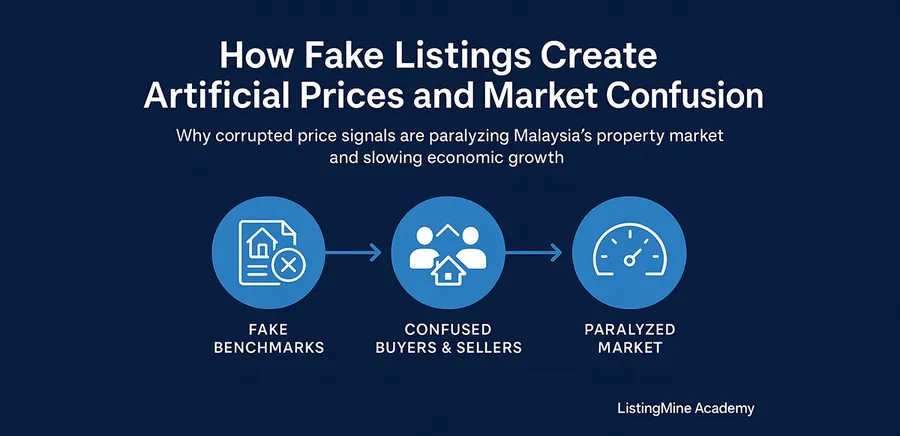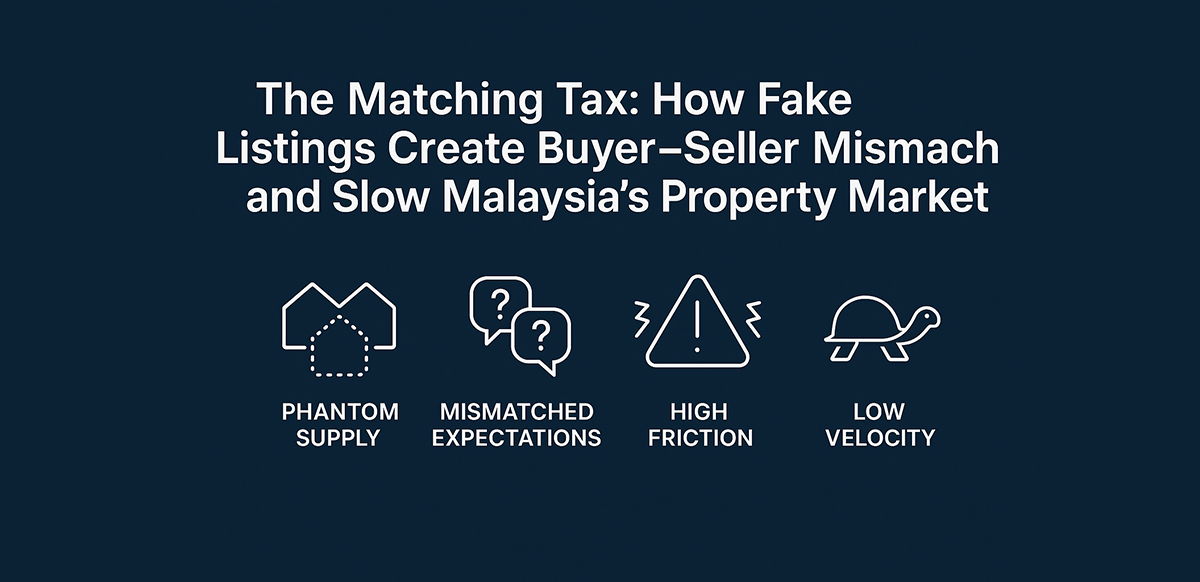
Fake listings create mismatch by connecting buyers to unavailable, inaccurate, or misleading properties. This slows matching efficiency across the market.
ListingMine Academy | Market Efficiency & Structural Insight
Why inaccurate data increases transaction friction, reduces deal velocity, and quietly taxes Malaysia’s entire economy.
Pricing confusion. Phantom supply. Mismatched expectations.
These are not surface-level annoyances—they are the direct mechanical consequences of a market fed by fake listings. And whenever the information layer becomes polluted, the matching process between buyers and sellers collapses into a slow, grinding, high-friction system.
Fake listings don’t just mislead individuals. They slow down the entire property market.
Fake listings create the illusion of abundant choices—cheap, beautiful, perfectly located units that do not actually exist. This “phantom supply” doesn’t just mislead—it actively suppresses real demand by convincing buyers to wait for deals that will never appear.
Buyers believe there are dozens of “better options.”
Sellers believe they must compete with unrealistic prices.
Agents waste hours handling inquiries for units that were never real.
The result: A market that looks liquid on the surface, but is hollow underneath.
Fake prices become psychological anchors.
When buyers expect RM500k because of fake listings, but real sellers expect RM600k, the negotiation gap becomes unbridgeable. This is no longer a price negotiation. It is a reality negotiation. And reality always loses.
In a healthy market, qualification means understanding the buyer’s needs and budget. But in a fake-listing market, qualification becomes something much more difficult:
Agents must now spend precious cycles rehabilitating a buyer’s corrupted price expectations—a costly, time-consuming process that should never have been necessary. Instead of moving buyers forward, agents spend hours undoing damage caused by misinformation.
Sellers compare their home to fake listings:
They anchor to these illusions and reject legitimate offers. Their holding time increases. Their frustration increases. The market slows.
When 50% of listings are unverified:
More noise does not create more matches. More noise destroys the signal.
This is the economic impact of fake listings:
In economic terms, fake listings create a Matching Tax: A structural penalty applied to every buyer, seller, agent, and bank participating in the ecosystem. A slower market is not just inefficient—it is expensive.
Verified listings act as frictionless infrastructure. They don’t just improve one deal—they increase the throughput of the entire system:
A verified data layer doesn’t accelerate one part of the market—it accelerates all of it.
Malaysia’s real estate market cannot modernise—cannot achieve the liquidity, transparency, and efficiency it needs—until its information layer is clean.
Fake listings slow matching. Slow matching slows deals. Slow deals slow the economy.
Verification is not cosmetic. Verification is infrastructure.
The Matching Tax disappears the moment the truth returns.

Founder of ListingMine and author of Agent for Life. Building ERP for Malaysian real estate agencies since 2008 — and writing to reshape how agencies grow.
More about Marvin Foong →More articles in this topic