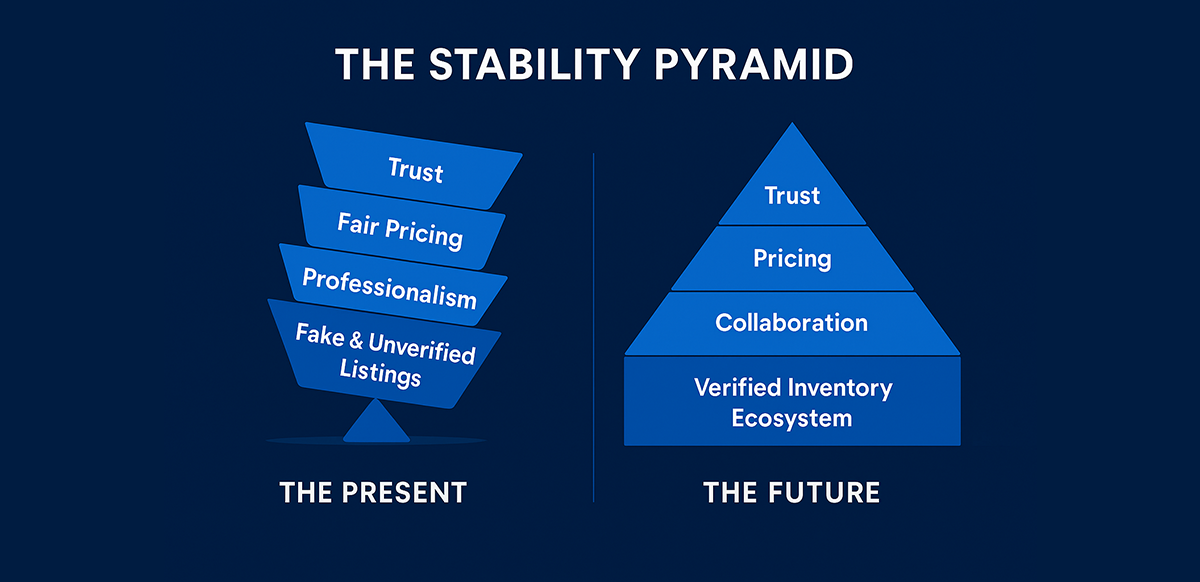
Fake listings damage trust, waste time, distort market signals, and weaken industry credibility. The harm extends beyond individual agents to the whole property ecosystem.
Imagine a young couple, after years of saving for a down payment, spending their entire Saturday visiting three “perfect” apartments.
The first was rented years ago.
The second looks nothing like its photos.
The third’s price was merely a bait to capture their phone number.
Hope turns to frustration, and then to cynicism. This isn’t an unlucky day — it is the normal experience in a broken information environment.
Fake listings are not a small inconvenience. They are a structural flaw that undermines trust, distorts pricing, wastes national productivity, and delays the professionalisation of Malaysia’s entire real estate industry.
A property market can only function when its foundation — data accuracy — is trustworthy. When the information layer collapses, everything on top collapses with it: pricing, negotiation, agency reputation, buyer confidence, and transaction velocity.
Fake listings are not created by a handful of “bad agents.” They are the predictable output of a system designed around incentives that favor quantity over accuracy.
A. Subscription-Based Portals Incentivise Spam
Most portals charge agents a flat monthly fee to upload listings. This model encourages agents to:
Portals profit from volume, not validity, making fake listings both attractive and scalable.
B. The “Bait-and-Switch” Business Model
A misleading listing is the fastest way to obtain a lead. If the advertised unit doesn’t exist or is no longer available, the agent simply redirects:
“That one just got taken — but I have others. When can you view?”
Because this tactic produces immediate results, agencies often tolerate it quietly. The system rewards manipulation and punishes honesty.
C. The Information Vacuum
Without a verified inventory system, there is:
A fragmented, unregulated information landscape makes abuse effortless.
Fake listings impose a hidden Productivity Tax on the nation.
A. The Destruction of Consumer Trust
When consumers repeatedly encounter:
They stop trusting agents, platforms, and even the entire real estate process. A market without trust becomes a battlefield rather than a marketplace.
B. A National Drain on Productivity
Malaysians collectively waste millions of hours each year:
This is time that could have been spent on productive economic activity. Instead, it becomes national inefficiency.
C. Artificial Market Distortion
Fake data creates a false reality:
Buyers enter with unrealistic expectations
Owners misjudge the market
Negotiations become confused and hostile
Banks and valuers struggle with inconsistent benchmarks
The entire pricing mechanism becomes polluted.
The industry itself suffers most. This is a live example of Gresham’s Law: bad behaviour drives out good.
A. It Rewards Unethical Behaviour
Agents who manipulate listings gain:
More calls
More viewings
More closings
Meanwhile, honest agents lose leads simply because they refuse to lie. The system pushes the entire profession downward.
B. The Erosion of Professional Skill
When “hooking” a client replaces real advisory work:
Market knowledge declines
Negotiation skills stagnate
Relationship-building disappears
The industry becomes transactional instead of professional
Long-term reputation gives way to short-term tricks.
C. It Blocks Collaboration (The ACN Problem)
Modern collaboration networks — including ACN-style systems — rely on shared, accurate data. If the underlying information cannot be trusted:
Co-broking collapses
Automated matching becomes impossible
Role-based commission models fail
Cooperation breaks down
Fake listings are the biggest roadblock to modernising Malaysia’s real estate industry.
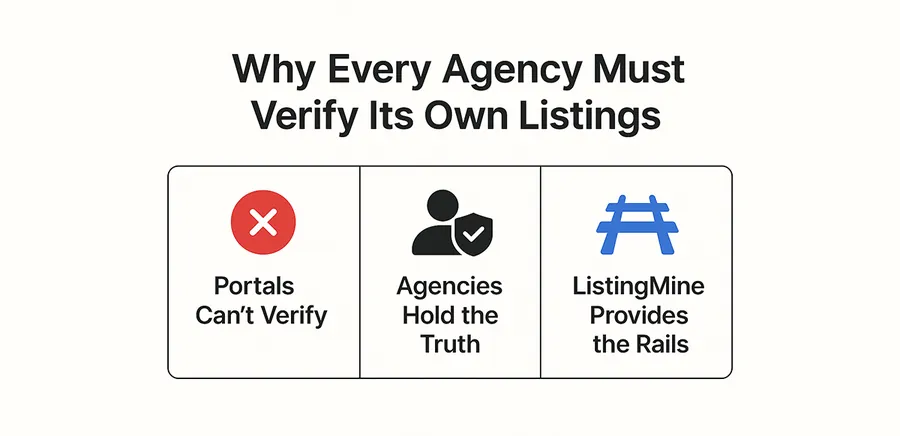
A structural problem requires a structural solution. Verified Listings create a reliable foundation by confirming:
The property exists
The owner has authorised the listing
The price and availability are current
The photos accurately match the unit
This transforms the entire market.
A. Restoring Consumer Confidence
A Verified badge gives buyers certainty:
They can trust the listing
They can make decisions instantly
Viewings become meaningful
Transactions accelerate
Trust becomes a competitive advantage again.
B. Enabling the ACN Revolution
Verified data enables:
Accurate co-broking
Automated commission workflows
Transparent, role-based collaboration
Governance and audit trails
High-confidence matching across agencies
You cannot build a modern real estate network on unreliable data. Verification is the fuel that powers ACN.
Both terms are powerful — but they serve different strategic goals.
| Term | Target Audience | Psychological Impact |
|---|---|---|
| True Listing | Consumers | Warm, trustworthy, simple, emotionally reassuring. Great for marketing and branding. |
| Verified Listing | Industry / B2B | Technical, rigorous, governance-driven. Ideal for ERP, ACN, compliance, and enterprise adoption. |
Best strategy:
Use True Listing for public communication.
Use Verified Listing for professional and system communication.
Fake listings are not just annoying ads. They are a market failure. They:
Harm society
Waste national productivity
Damage professionalism
Distort prices
Block cooperation
Stop the industry from evolving
Malaysia’s real estate future cannot be built on misinformation. It begins with a Verified Inventory Ecosystem—the concrete foundation beneath trust, pricing, collaboration, and industry growth.

Founder of ListingMine and author of Agent for Life. Building ERP for Malaysian real estate agencies since 2008 — and writing to reshape how agencies grow.
More about Marvin Foong →More articles in this topic
This article is one of the sources behind this assessment. Take it to see what you already know and what to read next.
Educational self-assessment. Not a licensing examination or professional certification.