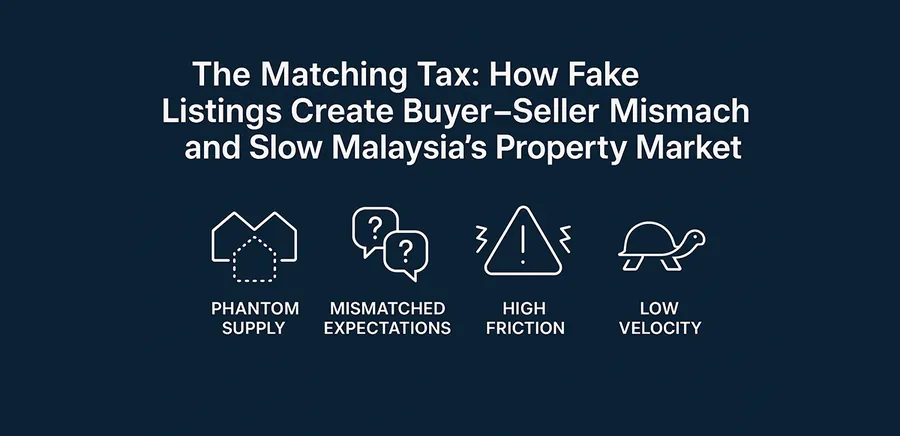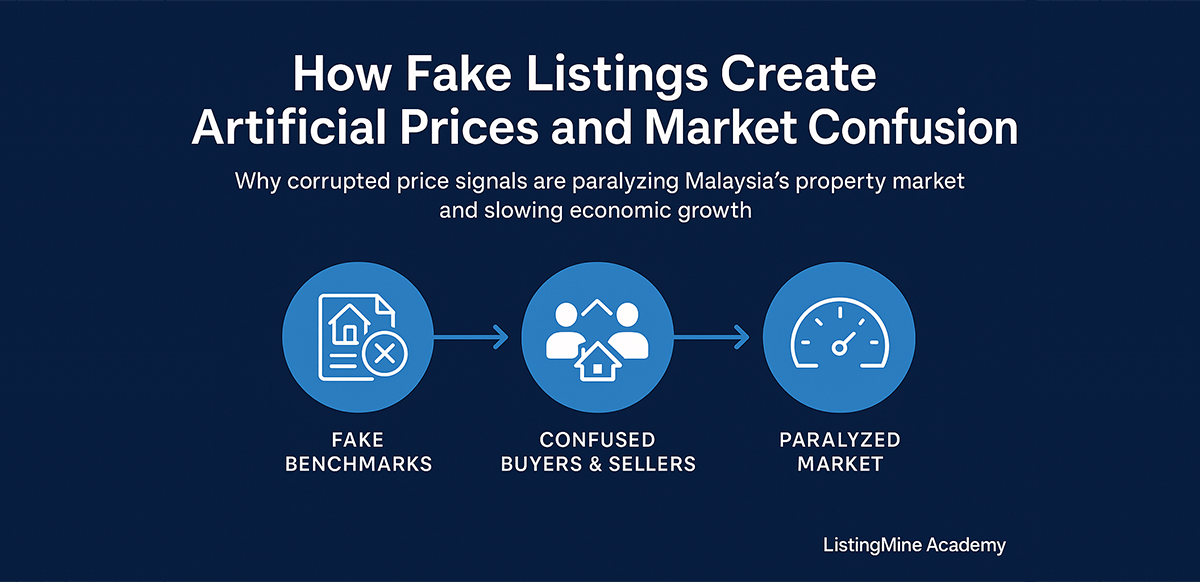
Fake listings distort perceived prices, availability, and demand. Buyers, sellers, and agents make poorer decisions when market signals are polluted.
ListingMine Academy | Market Mechanics & Structural Insight
Pricing is the nervous system of any market. It carries the signals that coordinate millions of independent decisions. When those signals are corrupted, the market's body seizes up.
Fake listings do more than mislead buyers—they distort the price signals that determine negotiation, valuation, confidence, and transaction velocity across Malaysia’s entire real estate ecosystem.
A market cannot function when the numbers are lies.
Most Malaysians believe online prices represent the market. But online platforms today are filled with:
This creates an economic problem known as signal distortion— when bad data overwhelms good data, causing the market to misread itself.
The result? Nobody knows what anything is truly worth.
Price discovery is the process where buyers and sellers reach a shared understanding of value. Fake listings disrupt all three components of that process.
A. The False Floor (Fake Lows)
These “too good to be true” prices create:
It becomes impossible to anchor value when the floor itself is fake.
B. The False Ceiling (Fake Highs)
Owners browsing online see inflated fake prices and anchor upward:
“Why is this agent pricing my unit lower than what I see online? Other units look higher—maybe I can push my asking price.”
Now sellers resist feedback, believing the illusion is real.
C. The Noise Layer
When fake highs and fake lows collide, the market becomes noise—not information. This creates a fog of uncertainty. And in this fog, the only rational response is inaction. People wait instead of transact.
Sellers Become Overconfident
They anchor to fake highs and refuse realistic offers.
Buyers Become Suspicious
They anchor to fake lows and distrust genuine pricing.
Agents Become Powerless
They lose credibility because consumers “saw something else online.”
Banks Become Cautious
Valuers struggle to find clean comparables. Loan approvals slow.
Developers Become Misguided
Launch pricing, incentives, and take-up rate forecasts become distorted. Fake pricing does not stay in listings. It spreads like a virus into all decision-making.
When a market’s pricing is polluted long enough, it enters a self-reinforcing loop:
What emerges is not a functioning market, but a shared pricing hallucination. And you cannot transact in a hallucination.
When price accuracy collapses, friction skyrockets:
Every additional hour of friction is a hidden tax on the economy. Fake pricing makes every transaction harder, slower, and more uncertain.
There is only one antidote to pricing distortion: verified data. A Verified Inventory Layer creates:
A Clean Price Floor - Only real, available units with real numbers.
A True Price Ceiling - No inflated anchors, no artificial manipulation.
A Transparent Signal Layer - Buyers and sellers see the same reality—no fog.
Faster, Fairer Negotiation - Trust replaces suspicion, clarity replaces noise.
A Stronger Valuation Backbone - Banks can approve faster.
Developers can plan smarter. Agents can defend their pricing confidently.
A property market cannot modernise without clean pricing signals.
The equation is simple:
No pricing truth →
No pricing clarity →
No market efficiency →
No industry progress.
To modernise, pricing must be real first.
Verification isn’t an upgrade; it’s a reset.
And the reset begins with Verified Listings.

Founder of ListingMine and author of Agent for Life. Building ERP for Malaysian real estate agencies since 2008 — and writing to reshape how agencies grow.
More about Marvin Foong →More articles in this topic
This article is one of the sources behind this assessment. Take it to see what you already know and what to read next.
Educational self-assessment. Not a licensing examination or professional certification.