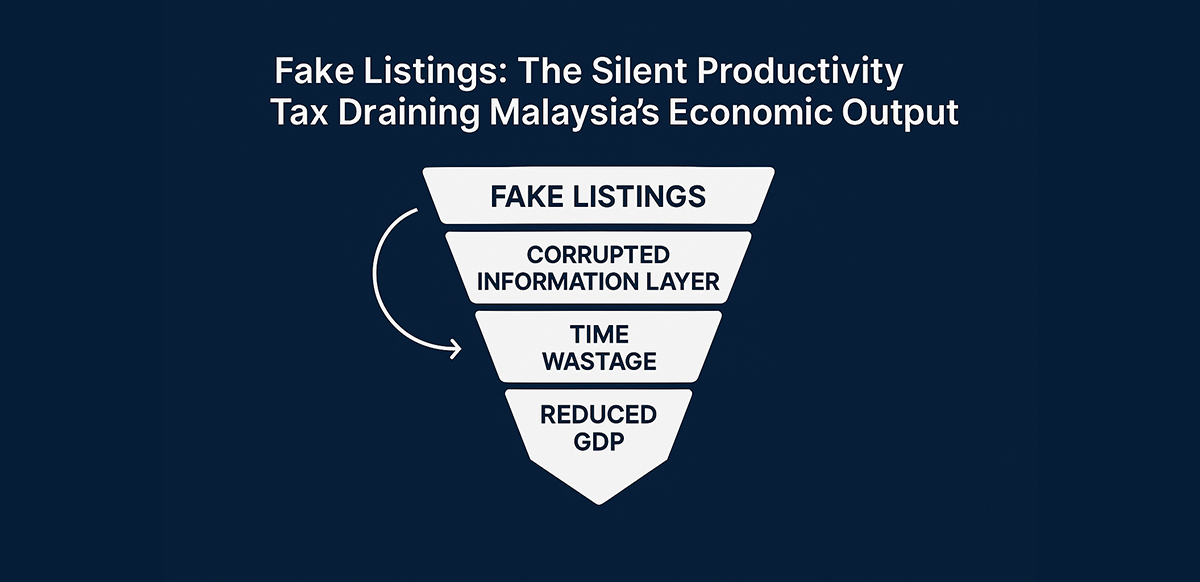
Fake listings create a productivity tax by wasting buyer time, agent effort, and market attention. Better listing integrity improves economic efficiency.
How corrupted property data sabotages market efficiency, slows GDP growth, and blocks Malaysia's real estate modernisation.
Most people think fake listings are just an annoyance—wasted viewings, misleading photos, bait pricing.
But the truth is far more serious:
Fake listings are a national productivity leak that silently drains Malaysia’s economic output every single day.
They don’t just waste individual time—they reduce transaction velocity, distort resource allocation, inflate operational costs, and weaken the efficiency of one of Malaysia’s largest economic sectors.
A modern economy cannot function when its information layer is corrupted.
Fake listings create the illusion of abundant options while wasting millions of productive hours across:
The Chain Reaction of Waste
Every fake listing triggers a multiplier effect:
A buyer calls an unavailable unit.
The agent explains, redirects, and often pushes another unverified option.
The buyer makes more calls, filters more listings, and attends wasted viewings.
The agent repeats this cycle with multiple prospects.
Valuers and bankers waste time filtering polluted data to find true comparables.
One unusable listing affects dozens of people, not one.
The “Back-of-the-Napkin” Cost
If just 100,000 fake listings each waste 5 collective hours:
100,000 × 5 = 500,000 hours lost annually.
At Malaysia’s average hourly productivity output, that is tens of millions of Ringgit evaporating from the economy—silently.
This isn’t an inconvenience. This is a structural efficiency failure.
A healthy economy depends on the velocity of transactions. Fake listings are “sand in the gears” of the property sector.
A. Slower Matching = Slower GDP
Buyers take longer to find real units.
Agents take longer to qualify leads.
Sellers wait longer for real offers.
Real estate contributes significantly to GDP. Slower matching = slower economic growth.
B. Misallocation of Human Capital
Agents—who function as frontline sales engineers—spend hours chasing dead units instead of:
prospecting
nurturing relationships
negotiating
closing deals
Productivity collapses.
C. Distorted Pricing Discovery
Fake prices confuse everyone:
Sellers anchor to unrealistically high expectations.
Buyers expect unrealistically low bargains.
The “pricing bridge” breaks, liquidity drops, and deals stall.
Fake listings are not “free marketing.” They impose a hidden tax on agency operations.
A. Higher Manpower Costs
Agencies handle unnecessary inquiries from bait pricing, outdated stock, and duplicated ads.
B. Higher Admin Burden
Every misrepresentation leads to:
customer frustration
internal escalation
negative reviews
brand damage
C. Marketing Inflation
Honest agents must increase advertising spend just to rise above the noise. When the information layer is polluted, the cost of acquiring one real customer skyrockets.
Accurate data is the foundation of a rational economy.
Fake listings disrupt the entire chain:
Developers misread demand from inflated supply indicators.
Banks misjudge collateral value using fake comparables.
Investors miscalculate risk and pricing trends.
Homebuyers delay decisions due to uncertainty.
In economics, uncertainty kills velocity. Fake listings manufacture permanent uncertainty.
Fake listings look like a micro problem. But at scale, they undermine national competitiveness.
A. National Labour Efficiency
Time wasted on misinformation = time not spent on productive work.
B. Trust as an Economic Asset
Trust reduces transaction cost. Fake listings increase friction in every transaction. Economically, fake listings become a transaction tax on the entire sector.
C. Foreign Investor Confidence
Global investors require transparent, audit-ready data ecosystems. Markets with unreliable information suffer a:
risk premium
lower investment appetite
higher cost of capital
Fake listings signal systemic immaturity, pushing big capital away.
A Verified Inventory Ecosystem—enabled by tools like ListingMine and ACN—does not simply “fix ads.” It transforms the economic structure of the market.
A. Efficiency Gains
Faster matching
Fewer wasted viewings
Higher productivity per agent
B. Accurate Pricing Discovery
Transparent data enables:
correct seller pricing
reliable bank valuations
rational buyer expectations
Pricing transparency is an economic multiplier.
C. Lower Transaction Costs
Verification reduces:
friction
negotiation cycles
administrative workload
D. Trust → Velocity → GDP Growth
Trust accelerates markets. Verified listings rebuild trust.
E. Foundation for Modernisation
Verified data unlocks:
AI property matching
digital contracts
role-based ACN cooperation
automated commission workflows
national housing data integration
This is economic infrastructure, not a feature.
Malaysia cannot afford to dismiss fake listings as a nuisance. They are:
A productivity leak
A pricing distortion
A market inefficiency
A trust destroyer
A brake on industry innovation
Verified Listings are the foundation of a high-efficiency real estate economy. Malaysia must choose:
Continue subsidising inefficiency with a hidden productivity tax… or invest in verified data infrastructure to fuel the next era of economic growth.
The future of the property sector is not built on more listings. It is built on more truth.

Founder of ListingMine and author of Agent for Life. Building ERP for Malaysian real estate agencies since 2008 — and writing to reshape how agencies grow.
More about Marvin Foong →More articles in this topic