Fake listings teach buyers to distrust agents and platforms. This trust damage increases friction for honest agents and slows real transactions.
ListingMine Academy | Consumer Behaviour & Structural Insight
Most people think fake listings waste time. They do far worse than that—
Fake listings damage the mind. They distort expectations, erode confidence, and permanently corrode trust in the entire property ecosystem.
Buying or renting a home is not a rational transaction. It is a deeply emotional decision.
It’s a decision wrapped in vulnerability.
When the information buyers rely on turns out to be false, the damage is not operational—it is psychological. And psychological damage does not heal on its own.
Fake listings do not fail immediately. They first activate hope, then systematically break it.
Below is the predictable emotional sequence almost every Malaysian home seeker experiences.
A. The First Betrayal: "It's already rented."
A young couple calls the perfect listing.
“Sorry, that one just got taken.”
Externally they nod, but internally they whisper:
“Was I being naive? Did I read it wrong?”
“Is this normal?”
“Did I just waste my time?”
The human mind begins its first crack.
B. The Second Betrayal: “The photos are only 'illustrative'.”
They arrive at the viewing. The unit looks nothing like the photos.
That moment—disappointment mixed with embarrassment—is powerful.
They don’t just distrust the agent. They begin to distrust themselves.
C. The Third Betrayal: The Bait Price
The advertised RM1,800 magically becomes RM2,300.
This triggers one of the deepest psychological wounds:
“The system is rigged.”
Not just this listing.
Not just this agent.
The entire environment feels hostile.
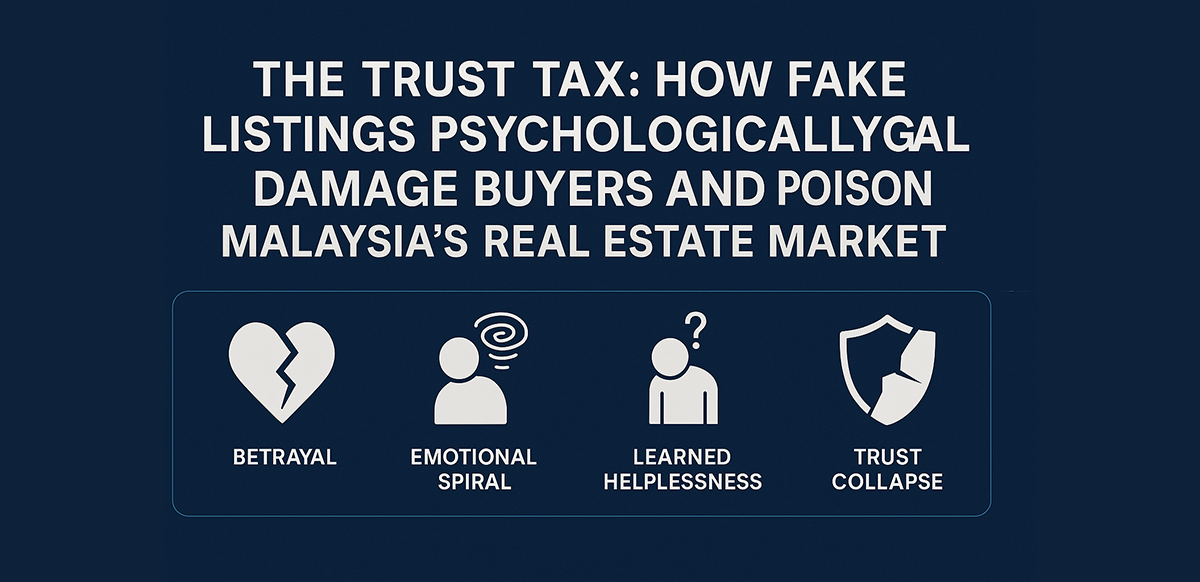
D. The Emotional Spiral
The journey becomes predictable:
Hope → Confusion → Frustration → Distrust → Active Cynicism
Active Cynicism is dangerous. It means the buyer assumes:
every listing is fake
every agent is manipulative
every price is a trick
every viewing is a trap
The market becomes adversarial. Every subsequent interaction becomes harder.
Fake listings cause four invisible, long-term harms.
A. Decision Fatigue
When 30–40% of listings are fake or misleading, buyers must constantly:
re-evaluate
re-filter
re-verify
re-organize
re-adjust expectations
Every cycle burns cognitive energy. Eventually they feel mentally exhausted—even before seeing a single real unit.
B. Erosion of Self-Confidence
Buyers begin doubting:
their judgment
their instincts
their financial readiness
their ability to “navigate the market”
When self-confidence drops, speed drops. When speed drops, the entire transaction cycle slows.
C. Learned Helplessness
After repeated betrayals, buyers conclude:
“Agents are all the same.”
“Property platforms don’t care.”
“Honest information doesn’t exist.”
“The system is rigged.”
This is psychological surrender.
Learned helplessness leads to:
delayed decisions
reduced engagement
lower viewing-to-offer conversion
longer marketing periods for sellers
depressed transaction velocity
The entire market pays the price of one consumer’s emotional defeat.
D. Broken Expectations = Broken Behaviour
When trust collapses:
buyers lowball
sellers become defensive
negotiations turn combative
agents lose influence
deals fail prematurely
This is the psychological equivalent of market corrosion.
The real danger is not frustration. It is trust collapse.
Trust collapse is the moment the consumer concludes:
“This industry does not deserve the benefit of the doubt.”
Once this happens:
every claim is questioned
every photo is doubted
every price is distrusted
every agent must prove innocence before conversation
every platform becomes guilty until proven trustworthy
The cost of every transaction increases
The speed of every decision decreases
The emotional resistance increases
Trust collapse is not an emotional side effect— it is structural corrosion. Once it sets in, every transaction becomes harder, slower, and more expensive for everyone.
Fake listings don’t just damage buyers. They damage the entire ecosystem.
Agents become assumed liars. Even the honest ones start every conversation with a credibility deficit.
Agencies lose long-term brand value. Repeated negative emotions create permanent brand avoidance.
Platforms become distrusted environments. High click-through, low closing = a sign of psychological rejection.
The industry loses moral authority. Buyers no longer trust guidance—even when it's accurate.
Psychological harm compounds faster than economic harm. And it lasts much longer.
Verification is not just operational—it is emotional medicine.
A. It Reverses Learned Helplessness
Buyers finally experience a listing that:
is real
matches photos
matches price
matches description
One honest experience rewrites their expectations.
B. It Restores Self-Confidence
When the information is reliable, buyers feel:
smart
capable
in control
Confidence speeds up decision-making.
C. It Re-establishes Trust
Trust is formed when reality matches expectation.
Verified listings guarantee that match.
D. Trust Becomes the Default
A predictable, honest environment replaces suspicion with stability—transforming the entire transaction experience.
This is how verified listings don’t just fix the market… They fix the psychology of the market.
Fake listings do not merely waste time. They damage minds, shatter confidence, and poison trust. They create:
exhausted consumers
defensive negotiations
slower decisions
weaker agents
lower conversion rates
a suspicious, hostile, emotionally damaged market
Verified listings do more than correct data. They rebuild trust—the psychological foundation that Malaysia needs to modernise its real estate industry and unlock its true economic potential.

Founder of ListingMine and author of Agent for Life. Building ERP for Malaysian real estate agencies since 2008 — and writing to reshape how agencies grow.
More about Marvin Foong →More articles in this topic