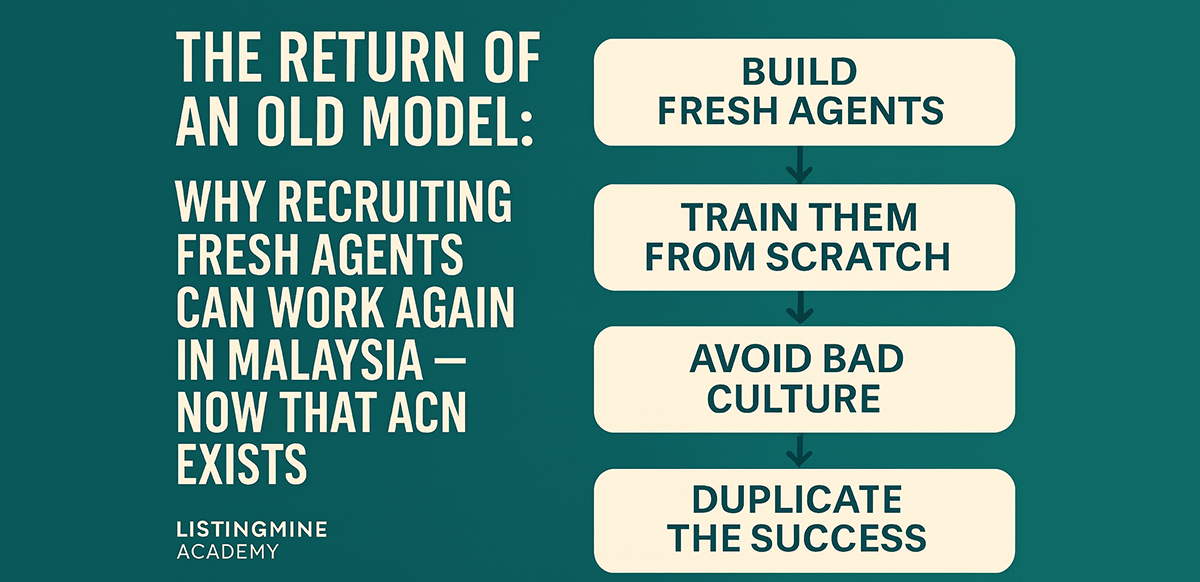
Fresh-agent recruitment can work again if ACN gives beginners clear roles, support, and cooperation pathways. New agents survive better when they do not need to master everything alone.
ListingMine Academy | Agency Leadership & Structural Insight
10–20 years ago, many Malaysian real estate agencies grew using a very specific strategy:
It was slow and demanding, but it worked.
Fresh agents entered with no baggage, no shortcuts, and no inconsistent workflows. They were loyal, teachable, and aligned with the agency’s standards.
Many of today’s top Malaysian leaders came from this exact era.
By the mid-2010s, however, the model collapsed.
This article explains why it originally succeeded, why it died, and why ACN (Agent Cooperation Network) finally makes it viable again.
The old “train fresh agents” model was built on one powerful cultural doctrine:
Collective Dedication vs. Individual Heroism
This was the backbone of the system.
Collective Dedication means the organisation succeeds as one.
This produced unity, discipline, and predictable performance. Agencies that trained fresh agents thrived because everyone grew under one rhythm, one standard, and one culture.
Individual Heroism is the opposite.
Most of the internal chaos we see today originates from this hero-based culture. The old model avoided hiring experienced agents specifically to keep the organisation clean of this virus.
| Feature | Collective Dedication (The Goal) | Individual Heroism (The Trap) |
|---|---|---|
| Primary Unit | The System & Team | The "Rockstar" Agent |
| Data Ownership | Shared (System-owned) | Siloed (Agent-owned) |
| Success Metric | Consistency & Duplication | Personal Sales Volume |
| Resilience | High (System survives departure) | Low (Agent leaves, revenue drops) |
| Culture | "We win together" | "I win, you watch" |
But despite the superiority of Collective Dedication, the model had a fatal flaw.
The old model failed for two reasons — one obvious, one heartbreaking.
The cycle was predictable:
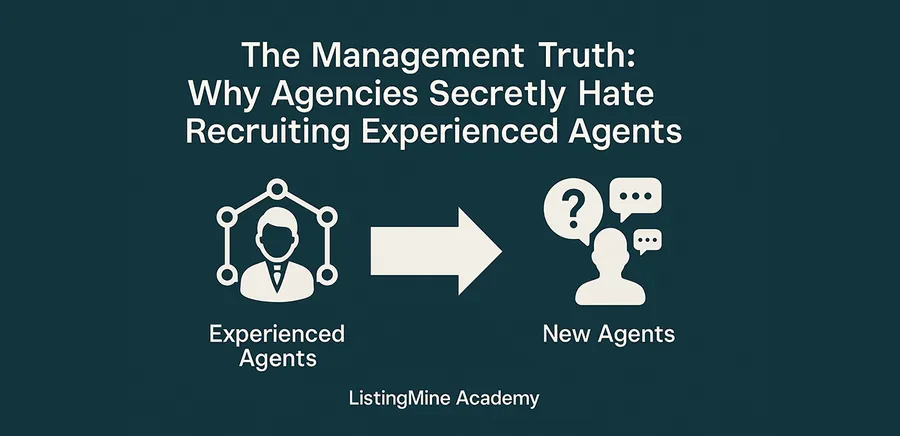
The principal loses time, money, culture, and leadership pipeline. The agency becomes an unpaid university for competitors.
This is the part almost nobody talks about.
Agents often thrive because of the culture, not because of their raw talent.
Once they leave the environment that built them, the structure, discipline, mentorship, and shared responsibility disappear. They are suddenly alone.
The painful truth:
Many agents who leave a strong culture for a high-payout platform drown within months because they cannot close cases without the environment that made them successful.
They struggle with no shared leads, no guidance, and no accountability. Their production crashes, their income collapses, and many eventually exit the real estate industry entirely.
Principals lose. The agents themselves lose.
This economic and human cost eventually killed the fresh-agent model.
By the mid-2010s, agencies changed strategy:
This avoided the training loss but created new problems: culture diluted, quality became inconsistent, and internal politics worsened. The organisation became fragile.
The old model didn’t die because it was wrong.
It died because there was no structural system to retain the talent it created.
ACN is that system.
ACN (Agent Cooperation Network) finally solves the retention, duplication, and fairness issues that made the fresh-agent model unsustainable.
Here’s how ACN revives it:
In the old model, listings, leads, and skills lived inside the agent. When an agent left, the agency lost everything.
ACN reverses this:
If an agent leaves, they lose the system that made them productive. Retention becomes structural, not emotional.
Previously, fresh agents needed 6–9 months to close their first case. Most quit before they earned anything.
ACN introduces micro-roles:
Fresh agents can contribute immediately and earn earlier without needing full closing skills. This leads to faster progression and lower dropout rates.
High-payout agencies only work for agents who can operate fully alone (Hunters).
ACN trains specialists (Farmers).
A specialist who leaves loses shared listings, team leads, and structured workflow. They realise they cannot survive solo. This prevents the exact cycle that destroyed the old model.
Most resignations happen because of perceived unfairness—stolen credit, hidden buyers, or manipulated splits.
ACN eliminates this:
Fairness becomes automatic. Politics disappear. Retention becomes natural.
The fresh-agent model collapsed because agents could leave too easily, and principals couldn’t secure their investment.
Today, the environment is different.
For the first time in a decade, the training-first, culture-first model can work again — because ACN fixes what broke it.
With ACN inside ListingMine:
The model that once died can now live again — with an engine powerful enough to sustain it.
ListingMine Academy

Founder of ListingMine and author of Agent for Life. Building ERP for Malaysian real estate agencies since 2008 — and writing to reshape how agencies grow.
More about Marvin Foong →More articles in this topic
This article is one of the sources behind this assessment. Take it to see what you already know and what to read next.
Educational self-assessment. Not a licensing examination or professional certification.