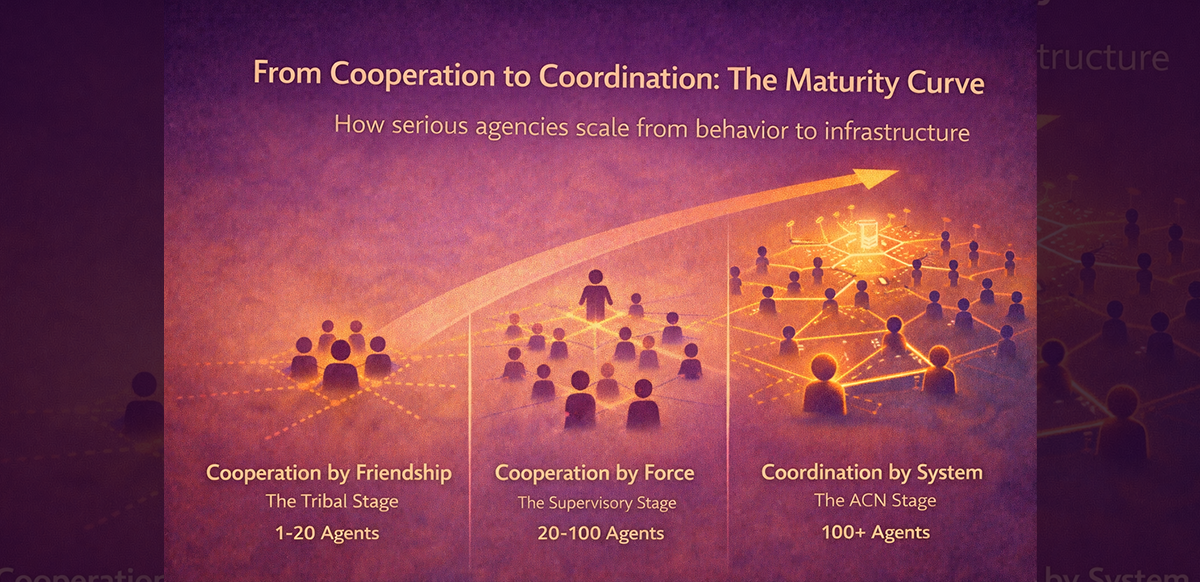
Agencies mature by moving from informal cooperation to structured coordination. Coordination requires rules, workflows, data, and shared operating standards.
Every real-estate agency says it wants people to "work together." What most fail to realise is that how people work together must change as the organisation scales. Agencies don't collapse because they lack cooperation. They collapse because they try to solve Stage-3 problems with Stage-1 tools.
The growth path of every serious agency follows the same maturity curve: from Cooperation, which is a human behaviour, to Coordination, which is a systemic achievement.
The Tribal Stage (1–20 Agents)
At the beginning, the agency is a tribe. Everyone knows everyone. Trust is personal.
The mechanism: Friendship and familiarity. If Ahmad has a buyer, he calls Chong because they had lunch yesterday.
The tools: One WhatsApp group, verbal "handshake" deals, and memory-based agreements.
The hidden weakness: This model is exclusionary. New agents struggle to break into inner circles. Personal conflicts instantly break cooperation.
At this stage, the agency is a social group that happens to sell property. It feels warm, but it cannot scale. Human intimacy does not compound.
The Supervisory Stage (20–100 Agents)
As the agency grows, friendship stops working. Agents no longer know each other personally, listings stop being shared, and disputes multiply. To compensate, the Principal intervenes.
The mechanism: Authority. Rules appear: "All listings must be shared," or "Internal co-broking is mandatory."
The tools: More managers, more meetings, and town halls.
The hidden cost: Shadow Labor. The Principal becomes the referee, judge, and exception handler.
The business is now held together by willpower. This creates a compliance culture: agents cooperate just enough to avoid trouble—not because it's optimal. This is where most agencies stall.
The ACN Stage (100+ Agents)
True dominance begins when the agency stops asking people to cooperate—and starts coordinating them. At this stage, the agency becomes an Agent Cooperation Network (ACN).
The mechanism: Infrastructure. Cooperation is no longer a favour, a rule, or a moral request. It is the most profitable path.
The tools: Immutable attribution, hard-coded split logic, and digital liquidity rails (e.g., ListingMine).
The result: 500 agents who have never met can cooperate with full confidence because cheating is structurally impossible.
The only real weakness? It requires the Founder to stop being the Grand Arbitrator and become an Economic Architect.
The hardest transition is not operational; it is philosophical.
| Stage | What You Manage | Primary Tool | Limitation |
|---|---|---|---|
| Stage 1 (Friendship) | Relationships | Personal trust | Cannot scale |
| Stage 2 (Force) | Behaviour | Authority & rules | Founder burnout |
| Stage 3 (System) | Liquidity | Infrastructure | Requires system thinking |
Most agencies trapped in Stage 2 believe their problem is "people." So they hire more managers and run more meetings. Each addition increases friction. The solution was never more supervision. It was architecture.
ListingMine exists for agencies ready to leave Stage 2 permanently. We don't ask agents to be friends, and we don't ask principals to babysit. We provide the digital rails that turn forced cooperation into seamless coordination.
When logic is embedded into infrastructure:
ListingMine exists to move agencies off the maturity curve of effort and onto the maturity curve of scale. Serious agencies don't grow by trying harder. They grow by graduating.

Founder of ListingMine and author of Agent for Life. Building ERP for Malaysian real estate agencies since 2008 — and writing to reshape how agencies grow.
More about Marvin Foong →More articles in this topic