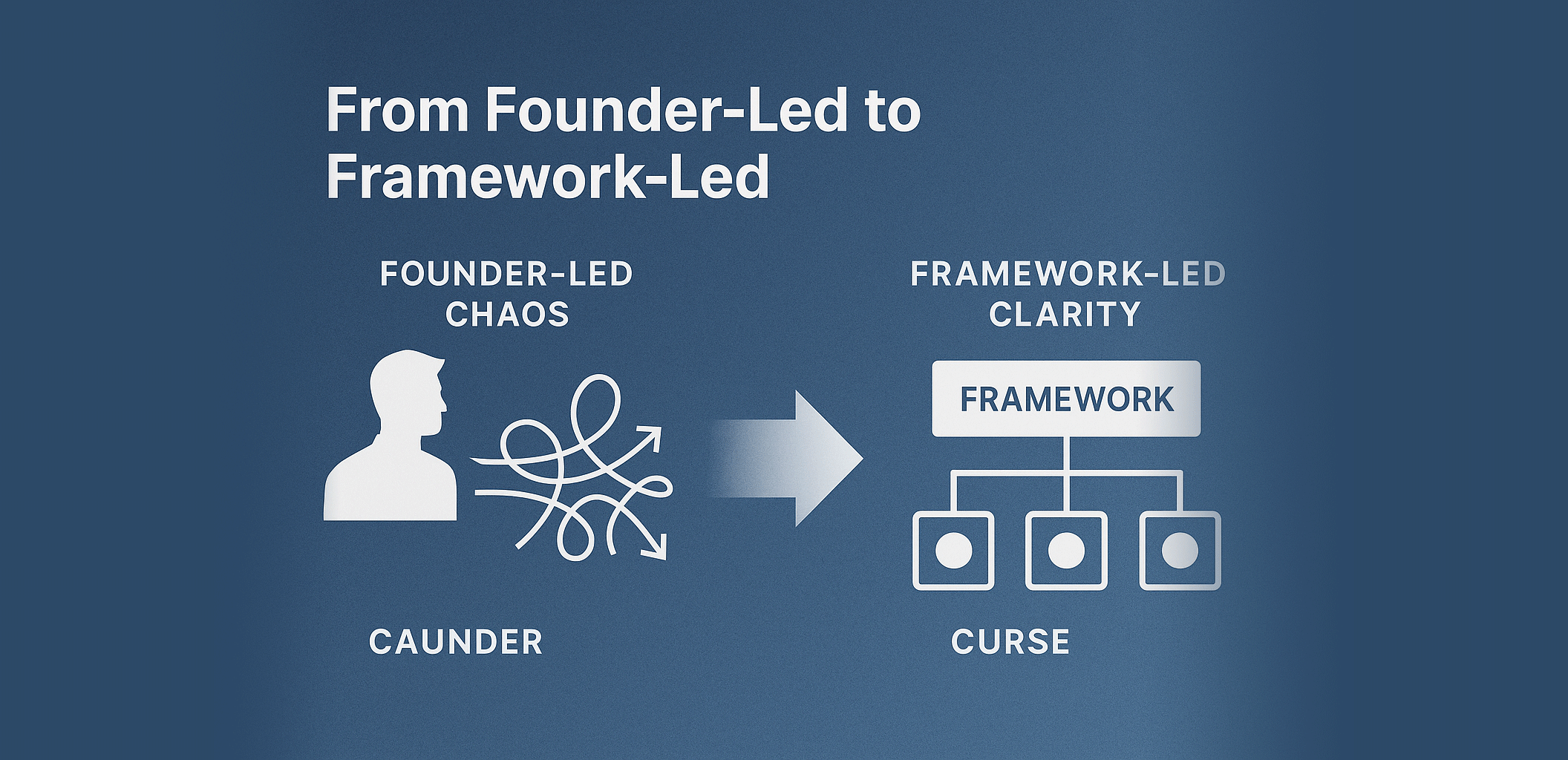
Founder-led agencies become limited by one person’s capacity. Framework-led agencies can scale decisions, culture, and operations beyond the founder.
Most founders never truly scale their businesses—not because they lack ambition, but because they never escape the operational gravity they created.
They build brilliant systems, hire loyal people, and achieve impressive growth, yet remain trapped in the daily firefighting that once made them indispensable.
The truth is, being indispensable is not a badge of honor; it’s a bottleneck.
To truly grow, you must give yourself the final promotion: moving from founder-led to framework-led. This means replacing your constant supervision with a self-sustaining operating system that governs your agency even when you’re not in the room.
Every great company begins this way: with the founder’s energy, charisma, and obsession. The founder is the chief problem-solver, negotiator, and trainer. But what starts as necessary leadership quickly devolves into dependency. The team learns to ask instead of decide, to report instead of own. Every critical choice routes back to one person’s approval, creating one person’s inevitable burnout.
Symptoms of the Founder-Led Trap:This isn't leadership; it’s unsustainable, overclocked management.
A framework-led company doesn’t rely on a personality; it relies on systemized proof.
It has codified workflows that turn vague verbal agreements into verifiable actions. It transforms the founder’s intuition into an operating model that can be repeated, audited, and improved by the team.
This is the evolution every serious founder must make:
From memory-led to system-led.
From instructional to institutional.
From reactive to predictable.
When frameworks take over, leadership scales because fairness, visibility, and accountability are baked directly into the process.
In a truly framework-led agency, you don't wait for the founder to resolve cultural or operational issues—the system handles it.
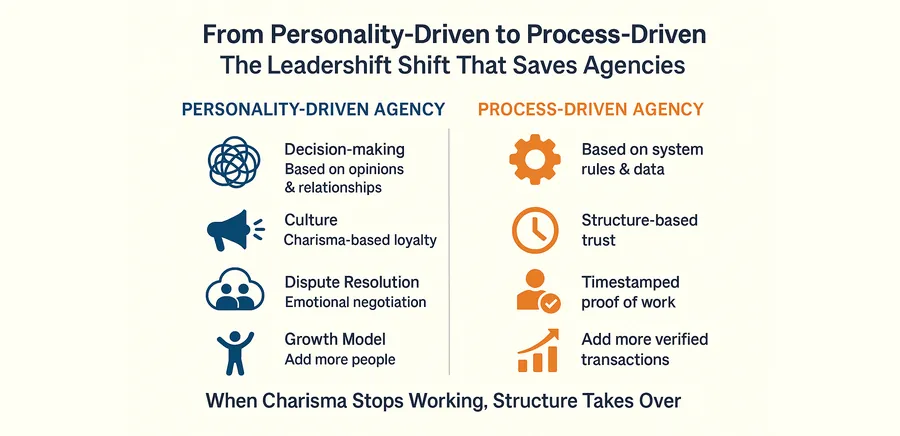
| Area | Founder-Led Agency | Framework-Led Agency |
|---|---|---|
| Decision Making | "Ask the boss." | Rules are defined in the ERP / SOP. |
| Commission Splits | Negotiated per deal. | Role-based, auto-calculated via ACN. |
| Accountability | Emotion and hierarchy. | Event logs and proof of contribution. |
| Conflict Resolution | Depends on personal relationships. | Guided by transparent, data-based rules. |
When you install frameworks, you replace centralized control with decentralized confidence. Your team no longer needs you to approve every step—they need you to lead the evolution of the system itself.
The real promotion isn't a title change; it's disappearing from your own daily org chart.
To "fire yourself" means:
You stop being the company’s daily decision point.
The established system—not your presence—keeps operations aligned.
You invest your energy into refining the framework, not constantly rescuing it.
When you can leave for a month and return to a company that grew without you, you've crossed the threshold from founder to the leader of a living system.
The founder’s ultimate job isn't to grow headcount or revenue. It's to build the machine that grows both without them.
When you transition from founder-led to framework-led:
You don't lose control—you gain altitude.
You don't stop leading—you start designing.
You stop being the fireman—and start being the city planner.
Firing yourself isn’t quitting. It’s graduating.
When your business runs on frameworks—on codified rules, objective proofs, and fairness instead of emotion—you’ve created something rare: a company that can outlive and outperform its founder.
That is the only promotion that truly lasts.

Founder of ListingMine and author of Agent for Life. Building ERP for Malaysian real estate agencies since 2008 — and writing to reshape how agencies grow.
More about Marvin Foong →More articles in this topic