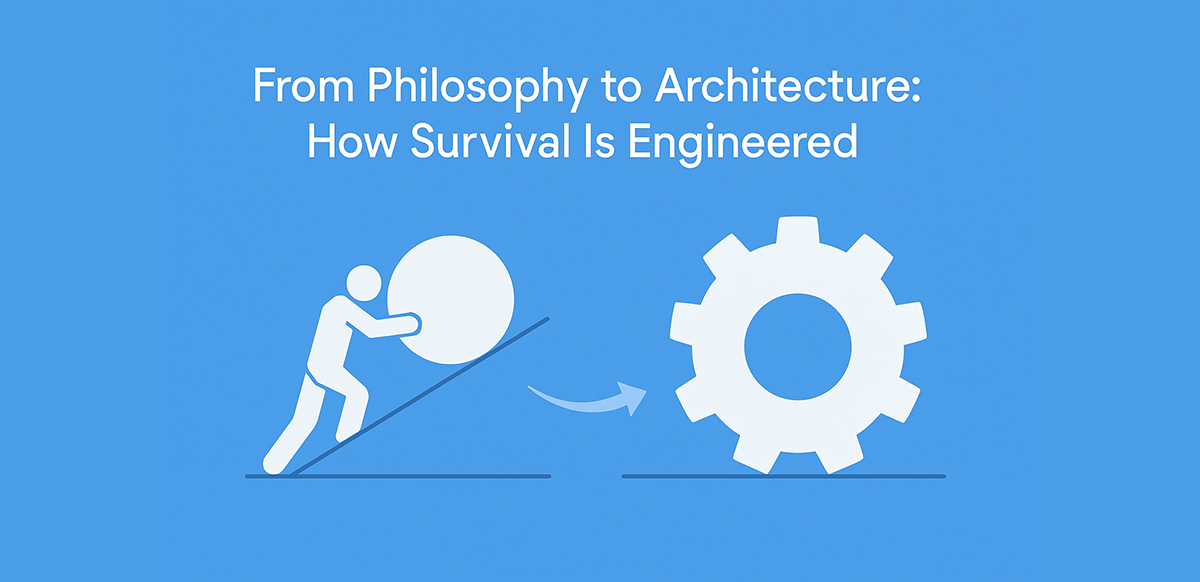
Survival improves when beliefs are converted into operating architecture. Agencies need systems that turn philosophy into workflows, roles, rules, and daily behaviour.
Every industry begins with philosophy. Real estate was built on a simple one: “If you work hard enough, you’ll survive.”
For decades, this belief was treated as moral truth, professional doctrine, and business logic at the same time. It is none of those. What we are witnessing today is not a cultural failure, a generational problem, or a discipline issue. It is the collapse of a philosophy that was never translated into architecture.
Philosophy answers why. Architecture determines whether.
You can believe in:
And still fail — if the structure you operate inside makes survival statistically unlikely. This is the uncomfortable truth most industries avoid: Outcomes are not caused by beliefs. They are caused by systems.
Real estate didn’t burn agents because people were weak. It burned them because survival was never engineered.
For years, the industry treated effort as a substitute for architecture. If agents failed, the explanation was always personal:
But effort does not create:
Effort scales fatigue. Architecture scales survival. When exposure became paywalled, attention became scarce, and ad costs rose, the philosophy collapsed. What followed was not reform — but denial.
In a well-designed profession:
Real estate inverted this. It demanded performance before survival — then blamed agents when the math didn’t work. The conclusion is unavoidable:
If 90% of participants fail, failure is not a trait. It is a design outcome. And design outcomes can be redesigned.
Engineering survival does not mean:
It means building structural guarantees so capable people don’t die before competence emerges. Across every high-retention model, the same architectural shifts appear:
Old model:
Visibility is something individuals buy. If you can’t pay, you disappear.
New model:
Exposure is pooled. No one pays alone to exist. Visibility becomes infrastructure, not a personal expense.
Old model:
Early volatility is pushed onto the weakest participants. Failure is financed by personal savings.
New model:
Uncertainty is buffered by structure. Risk is absorbed upward instead of dumped downward.
Survival stops depending on who can bleed the longest.
Old model:
Cooperation relies on goodwill. Everyone competes by default.
New model:
Cooperation is hard-coded. Listings and leads interlock structurally. They do not compete by accident.
These are not cultural values. They are architectural decisions. Once these shifts are made, survival stops being a personal trait — and becomes a predictable outcome of the system.
Every industry eventually learns the same lesson: You cannot ask people to behave better inside a broken system. You cannot motivate your way out of bad math. And you cannot scale trust when incentives are misaligned.
This is why:
Architecture removes the need for belief. When systems are visible, auditable, and rule-based, cooperation survives without heroics.
The industry is quietly undergoing a transition — whether it admits it or not.
From:
“Good agents survive.”
To:
“Good systems let agents survive.”
This is not ideological. It is economic. When survival is engineered:
The industry doesn’t become softer. It becomes more professional.
Once survival is engineered:
This is why architectural reform is uncomfortable. It removes narratives. It exposes truth. But it is the only path forward.
The old industry asked:“Are you strong enough to survive this?”
The new industry asks:“Is this designed for capable people to survive?”
That single question changes everything. Because once survival is engineered,
performance finally becomes meaningful. And professionalism stops being a slogan — and starts being a system.

Founder of ListingMine and author of Agent for Life. Building ERP for Malaysian real estate agencies since 2008 — and writing to reshape how agencies grow.
More about Marvin Foong →More articles in this topic