Agency bosses must shift from sales thinking to shareholder thinking before listing. Public-market readiness requires governance, reporting discipline, profit structure, and institutional credibility.
ListingMine Academy | Real Estate System Design
The road to listing doesn’t end when the bell rings.
It begins there.
Most agency founders dream of the IPO moment — the headline, the celebration, the validation that their company has finally “made it.”
But few understand what happens after that moment.
Once you enter the capital market, you stop answering only to clients and agents.
You now answer to capital.
And the capital speaks a different language.
In a private company, speed is everything. You can pivot, test, fail, and rebuild in a week — and no one outside your office will ever know.
In a public company, everything slows down — not because you’re inefficient, but because you’re accountable. Every decision needs board approval, disclosure, audit, and justification. You can’t just chase growth; you must defend governance.
Your DNA changes overnight:
That doesn’t kill innovation — it forces justified innovation.
Agents and bosses live on monthly commission cycles. Capital lives on quarterly earnings calls. Your agency may be proud of long-term vision, but fund managers want short-term predictability. They expect:
As Warren Buffett reminds us:
“If your financial report can’t deliver at least 15 % ROE, you’re not creating value for both sides.”
Once capital enters, you’re judged not by enthusiasm or headcount — but by discipline.
Capital doesn’t issue commands. It votes with its legs. When your quarterly report disappoints, investors don’t argue — they sell.
That sell-down is their version of a performance review. It pressures management to take short-term actions: cut costs, trim staff, or chase vanity growth. Before long, you’re no longer building the company you founded — you’re maintaining the company the market expects.
This is how many once-innovative property platforms, local and abroad, lost their edge after listing. Their DNA shifted from problem-solving to price-defending.
Most management teams oversell good news and under-explain problems. But in the capital market, honesty is a strategy.
When Warren Buffett releases Berkshire’s reports, he doesn’t hide bad quarters — he explains them. He treats shareholders as partners, not audiences. That’s why his reputation compounds faster than his returns.
Public-company leadership isn’t about always winning. It’s about communicating why you’re still worth believing in — even when you lose.
For many founders, the dream of listing hides a simple truth: Private freedom is often worth more than public valuation.
In practical terms, the 20 % annual growth and total control of a private company are often more valuable than a 3× P/E multiple and quarterly scrutiny from analysts. When you go public, your reward becomes predictable but capped; your freedom, measurable but limited.
Even if the law allowed agencies to list directly, most would still struggle to fetch strong multiples. Pure-agency businesses rarely trade above 3× earnings because profits are people-dependent, not system-dependent. You trade flexibility for compliance and agility for disclosure.
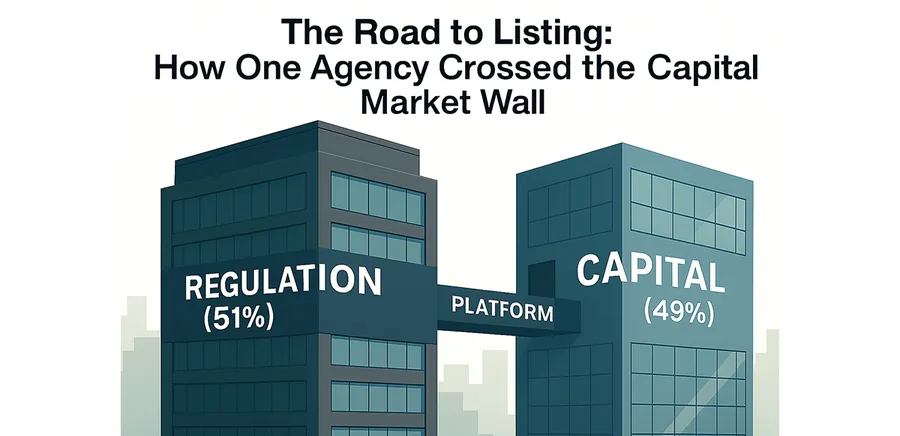
Some try to shortcut the process through a Reverse Takeover (RTO) — buying a dormant listed shell and injecting their operations. It can work, but the compliance load remains identical. RTO merely relocates your audit headaches to a bigger room. Without governance maturity and clean financial reporting, the same cracks just echo louder.
The takeaway: going public isn’t a reward for growth — it’s a test of structure. You must already operate like a listed company before attempting to become one.
Many agency bosses lack financial depth. They’ve mastered recruitment and sales but not valuation mechanics — and that blind spot quietly destroys their future worth.
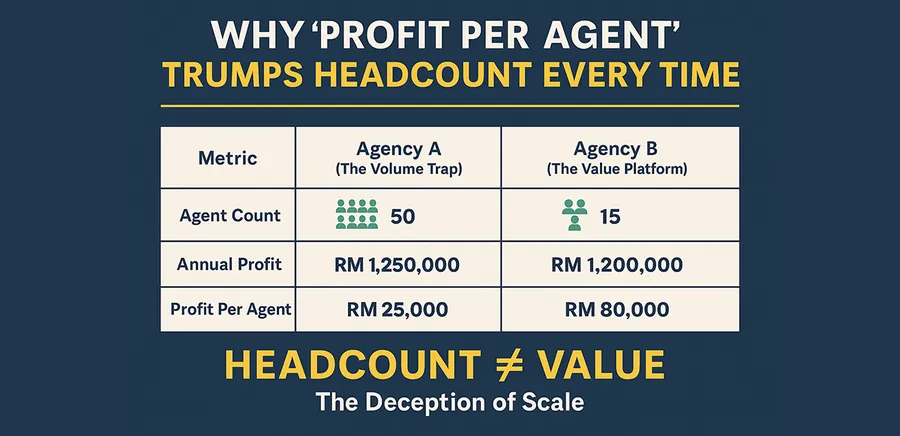
Some spend ten years building the wrong thing: chasing headcount instead of assets investors value. When due diligence arrives, the books show high revenue but no transferable equity, no audited systems, and no defensible margins.
Before you approach capital, fix your foundation:
The right financial brain doesn’t just prepare you for listing. It tells you whether you should list at all.
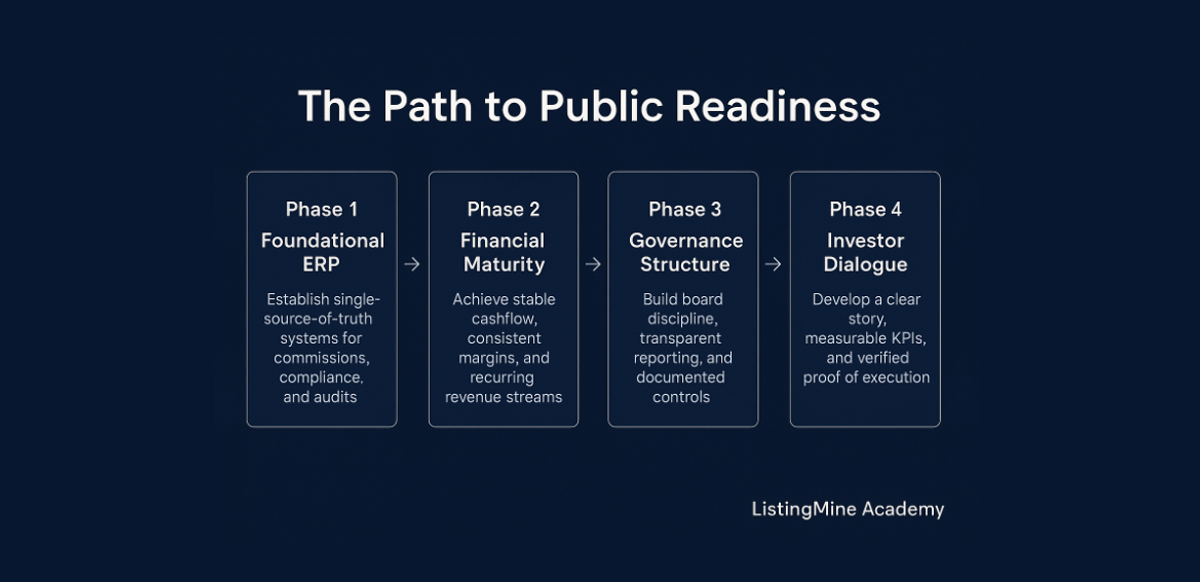
When you can demonstrate all four, the market stops seeing you as a risk — and starts valuing you as infrastructure.
Going public isn’t about “getting listed.” It’s about who you’re willing to answer to — agents, clients, or capital.
If your systems are strong, your reporting is clean, and your culture is disciplined, capital will trust you. If not, capital will teach you — sometimes brutally.
The capital market is not your enemy — it’s your mirror. It doesn’t change you; it reveals you. And the only way to face that mirror confidently is to build a company that can already stand without makeup.
So before you talk to investors, build your rails. Before you dream of listing, pass your own audit. Then, when the market finally looks your way — you’ll already look like a public company that just hasn’t listed yet.
If you’re an agency boss preparing for the next growth stage, or a team leader who wants to understand how real businesses scale beyond commission — read the full library at ListingMine Academy.
Every article is original writing by the founder — combining operational experience, system design, and capital-market insight tailored for Malaysia’s real-estate industry.
Learn how agencies evolve from sales teams into investment-grade enterprises. It’s not a theory. It’s the playbook the next generation of property firms will follow.

Founder of ListingMine and author of Agent for Life. Building ERP for Malaysian real estate agencies since 2008 — and writing to reshape how agencies grow.
More about Marvin Foong →More articles in this topic
This article is one of the sources behind this assessment. Take it to see what you already know and what to read next.
Educational self-assessment. Not a licensing examination or professional certification.