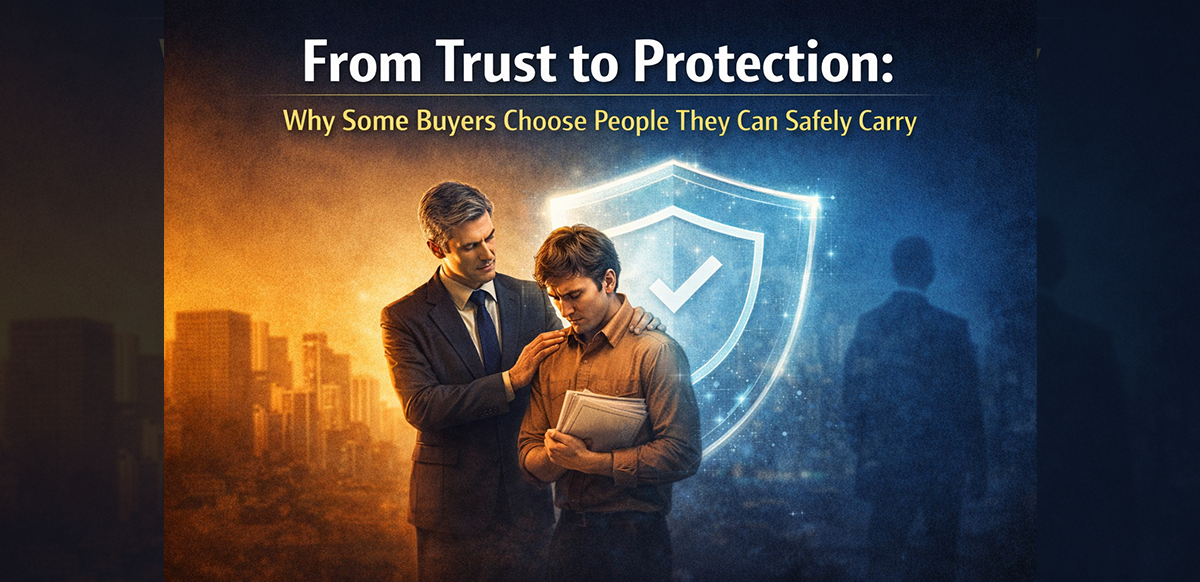
Buyers may choose agents who feel safe, manageable, and protective rather than the most credentialed. Trust is emotional as well as technical.
At first glance, the behavior appears irrational. Why would a sophisticated, high-net-worth buyer choose an inexperienced junior agent, someone visibly underpowered, or someone who clearly does not control the transaction?
From a conventional "Reputation" framework, this makes no sense. But the behavior is not accidental. It is Protective Trust Compression—a distinct trust mode that activates only when massive power asymmetry exists.
Most professionals assume trust always flows upward: the weaker party trusts the stronger party for protection. This is only true when the client is vulnerable and requires a shield.
But when a buyer is capital-rich, knowledge-dense, and structurally protected, the direction of trust flips. The buyer no longer asks, “Can this person protect me?” They ask:
“Can I safely carry this person?”
In this scenario, trust is no longer about Capability; it is about Containment.
Protective Trust Compression occurs when a dominant party evaluates Harm Potential over Competence. The buyer isn't trusting the agent to "win" the deal—they already know how to win. They are trusting that the agent will not cause irreversible damage through ego or manipulation.
This mode only activates when the buyer possesses:
For these buyers, the agent is not a "Consultant." The agent is an Execution Proxy.
Why is a junior agent often "safer" for a powerful buyer than a confident veteran?
The buyer doesn't need your strength; they have their own. They need your transparency so they can apply their strength effectively.
In this trust mode, Benevolence is the ultimate trust signal. When a buyer sees an agent acting kindly toward the helpless or protecting someone with no potential upside, they aren't just seeing "niceness." They are seeing a Non-Exploitation Protocol.
If you are benevolent to those who can do nothing for you, the dominant buyer assumes you will not exploit the transaction when they "carry" you into the deal. Moral alignment is the only asset that cannot be reverse-engineered under pressure.
Often, the transaction is not the product; it is the medium. The buyer may use a complex asset and a manageable junior agent as a "live-fire" training exercise for:
The agent becomes part of the Curriculum. By selecting a "weaker" agent, the buyer creates a controlled environment where the stakes are real, but the human variable is manageable and non-threatening to the lesson.
Most agents never experience this because they are too busy posturing as "Power Players." They misread kindness as naivety and assume buyers are always shopping for "the best."
Protective Trust only activates when:
Traditional trust asks: “Are you strong enough to protect me?”
Protective Trust asks: “Are you safe enough for me to protect you?”
Most professionals spend their entire careers competing in the first world. Only a few understand the strategic power of the second.
In broken or commoditized markets, this distinction determines who gets invited into the rooms where Learning and Legacy, not just profit, are the real currency.

Founder of ListingMine and author of Agent for Life. Building ERP for Malaysian real estate agencies since 2008 — and writing to reshape how agencies grow.
More about Marvin Foong →More articles in this topic