Agents may contribute to gentrification by marketing areas in ways that raise prices and displace communities. Ethical awareness is needed when property growth affects residents.
ListingMine Academy | Urban Economics, Agency Ethics & Market Behaviour
Few words in property spark more conflict than Gentrification.
To an investor, it means progress: Starbucks, safety, paved roads, and rising capital appreciation.
To a long-term resident, it means displacement: The kopitiam becomes a café, rent doubles, and the community is pushed out.
For real estate practitioners, the question is uncomfortable:
Are we accelerating the displacement of the poor, or can we manage the transition responsibly?
This article explores that dilemma with nuance — grounded in Malaysian realities, not imported Western narratives.
Stripped of politics, gentrification is economic displacement.
It is the process where higher-income households replace lower-income households due to rising property values and commercial upgrades.
It is driven by three forces:
The Hard Truth:
Gentrification is not caused by agents. It is caused by supply and demand.
But agents sit at the control panel. We influence how quickly it happens — and who gets prioritised.
Every major district in KL follows the same four-stage cycle:
The question is not “Can we stop it?” (We can’t.) The real question is “How should we behave while it happens?”
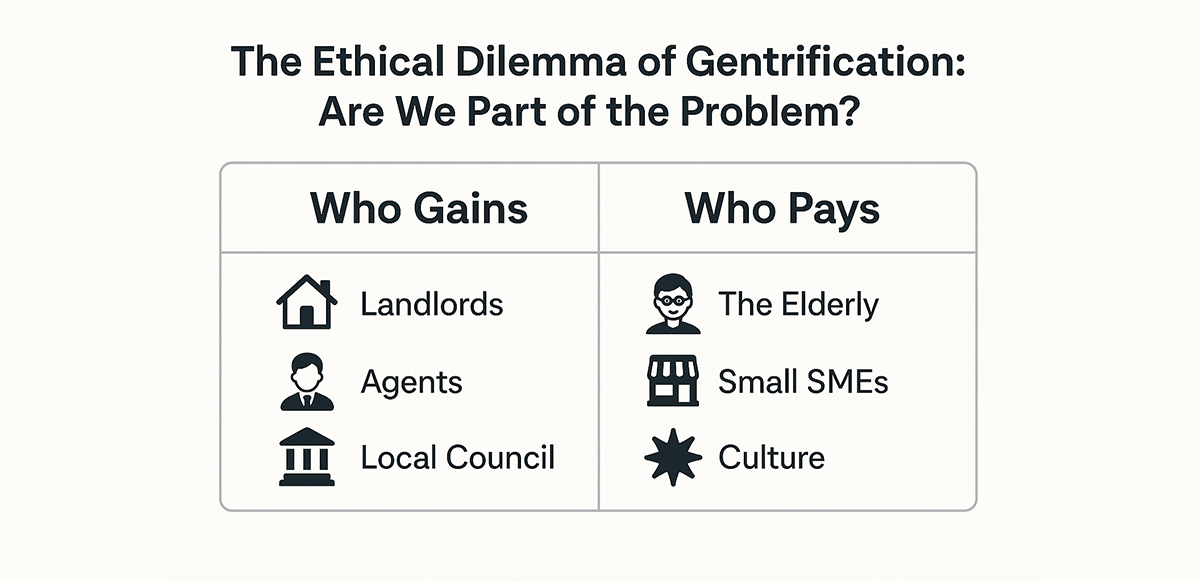
When a neighbourhood “upgrades,” the winners are obvious:
But the losers are often invisible until they’re gone:
The Agent’s Dilemma
If you aggressively force every landlord to chase the “highest possible rent,” you accelerate the destruction of the very community that makes the area valuable.
Not intentionally. But functionally — often, yes.
Agents accelerate displacement when they:
Example: Canvassing an old neighbourhood with flyers screaming "Sell Your Old House for CASH Now Before Market Crashes." This preys on fear and accelerates community fragmentation.
A commission-driven agent behaves like a mercenary. A career-driven agent behaves like a community guardian.
We cannot stop economic gravity. But we can be an ethical buffer.
Here is how responsible agents operate in transitioning neighbourhoods:
A. The “Stability Premium” Advisory
Bad Agent Advice:
“Kick out the family paying RM1,500. I can get students at RM2,200.”
Ethical Agent Advice:
“This family has paid on time for five years. A 40% hike will force them out. Let’s look at the Risk-Adjusted Return:
A reliable RM1,500 tenant has a higher Net Present Value (NPV) than a RM2,200 tenant who brings a 50% risk of vacancy and RM5,000 in repair costs. Stability pays better than volatility.”
Result: You protect the tenant AND the landlord’s long-term risk profile.
B. Prioritise Owner-Occupiers Over Speculators
When selling in gentrifying areas (Sentul, Pudu, Kampung Baru):
C. Respect History in Marketing
Don’t market a heritage area by trying to erase its past.
Instead of: “Demolish this old shack and build a bungalow.”
Say: “Restore this heritage gem and own a piece of KL history.”
This attracts buyers who value culture, not just yield.
In the traditional “every man for himself” agency model, agents oversell and squeeze deals because their survival is at stake.
In an ACN (Agency Co-Operation Network) structure:
When desperation is removed, ethics become possible.
Why should agents care? Why not just make the money?
Because neighbourhoods that become soulless investment districts eventually CRASH.
When the culture disappears, units sit empty, local SMEs die, and zero owner-occupiers remain... the entire area becomes a dormitory, not a destination.
Long-term value is supported by character, history, and community. Preserve these — and prices rise sustainably, not artificially.
Gentrification is a force of nature. We cannot stop the tide.
But we stand at the shore deciding how the waves hit the community.
We can choose to be:
The ethical agent understands a simple truth:
Community is the ultimate asset class.
Destroy the community, and eventually, the property value follows.
Understanding the "why" is the first step. The next is mastering the "how."
For a practical tool, we have prepared the “Landlord Advisory Script: The Stability Pitch”—a proven negotiation framework to convince landlords that a stable, lower rent is a smarter financial decision than a high-risk hike.

Founder of ListingMine and author of Agent for Life. Building ERP for Malaysian real estate agencies since 2008 — and writing to reshape how agencies grow.
More about Marvin Foong →More articles in this topic