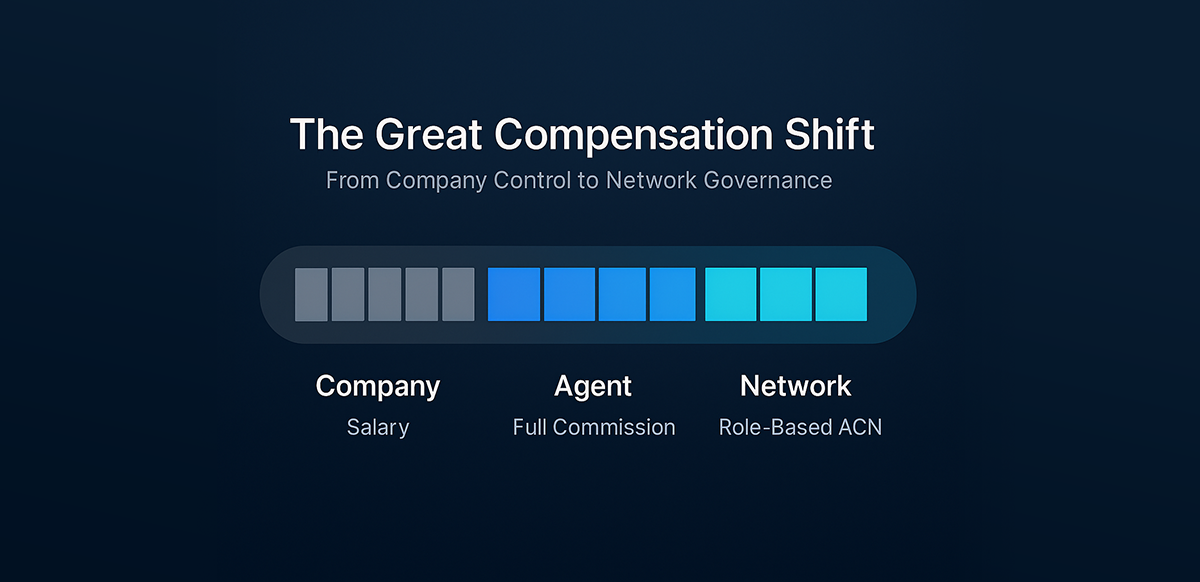
Compensation is moving from simple company-controlled splits toward network-based contribution logic. Role-based governance can reward real work more fairly.
The evolution of real estate compensation is not a story about changing agent behaviour — it is a story about shifting power.
Every compensation structure the industry has adopted — from fixed salary to hybrid to full commission to role-based network income — was never about preference. It was always a reaction to who controlled the essential parts of the transaction at that moment in time.
Compensation doesn’t change because people change.
Compensation changes because leverage moves.
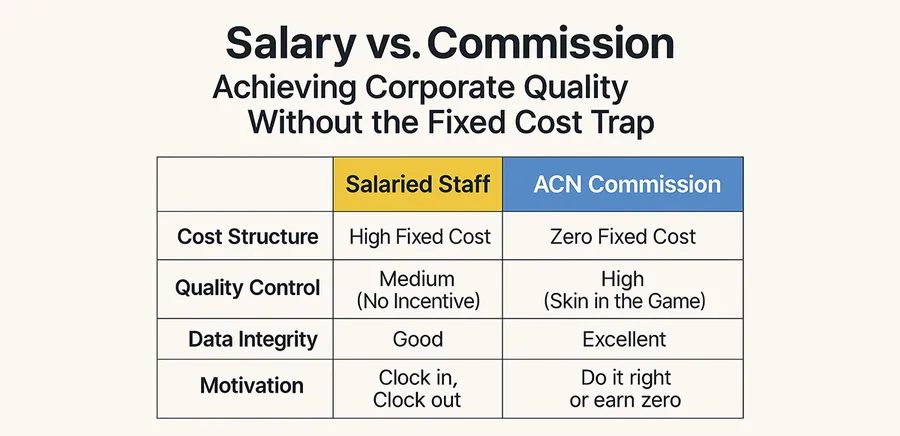
Model: Full Salary + Small Bonus
Power Holder: The Company
In dominant Western markets (US, UK, Australia), brokerages controlled the entire value chain: exclusive listings, client database, newspaper advertising, licensing, and office systems. Agents were true employees. They did not source leads, build personal brands, or control any part of the pipeline.
Because the company controlled the leads, the company controlled the agent. And when the company controls the agent, salary is the logical model.
Model: Hybrid (Low Salary + 30–50% Split)
Enabling Tech: Property Portals (iProperty 1999, PropertyGuru 2007)
Power Holder: Still the Company, but Power Is Leaking
Property portals democratized visibility of listings. For the first time, an agent could advertise without the company’s newspaper budget.
But agents still depended on the company for branding, licensing, developer access, and admin support.
So the industry invented a halfway model:
A small salary to retain control, a partial split to reward production.
The company still owned the pipeline — but the agent was beginning to own the audience.
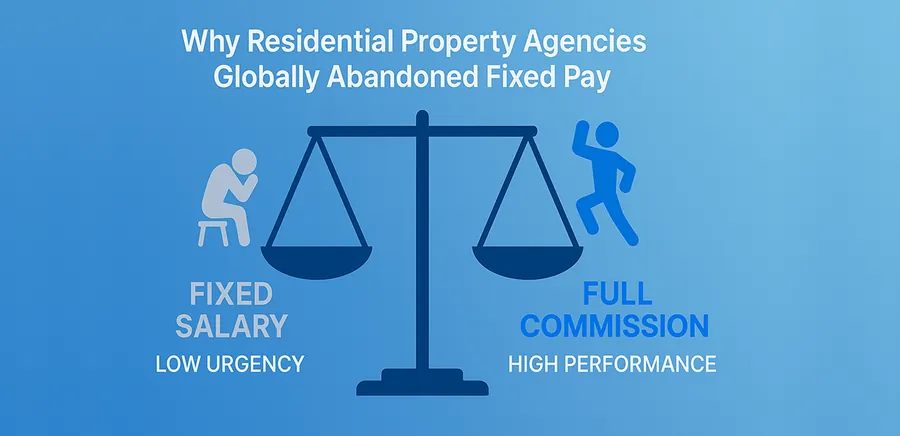
Model: Full Commission (100% / 90-10 / 80-20)
Enabling Tech: Facebook Ads, YouTube, TikTok, WhatsApp
Power Holder: The Agent
Social media ended the Hybrid Era.
A single agent could now:
The logic became unavoidable:
If the agent brings the customer, why should the agency take 50–70%?
Full commission wasn’t a trend — it was a structural correction.
But the new freedom came with a ceiling:
Full commission unlocked income, but produced isolation, hoarding, and zero collaboration.
Full commission solved motivation. It did not solve the scale.
Agents eventually learned what every industry discovers:
Isolation has a ceiling. Specialisation and teamwork can close more deals than any individual can alone.
So the industry built its first internal network model.
Model: Fixed-Role Splits (4-3-3, 4-4-2, 5-3-2)
Structure: Leads / Caller / Closer
Where Used: Project Sales Teams
This was the first time commission was tied to contribution by role, not rank or seniority. Splits like 4-3-3 were the industry’s primitive attempt at the Agent Cooperation Network (ACN).
It worked — but only inside one agency.
It relied on trust, WhatsApp screenshots, and manual payout.
It collapsed the moment cross-agency cooperation was required.
It was ACN in spirit, but without governance, proof, or scalability.
Model: Role-Based Split Across Multiple Agencies
Power Shift: From Team-Level → Network-Level
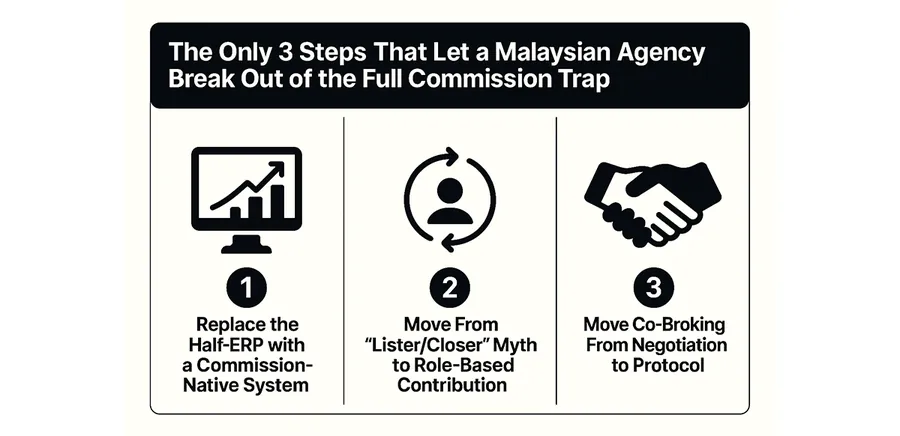
Traditional co-broking is trust-based, dispute-prone, and impossible to audit.
ACN Alliance replaces negotiation with protocol:
The industry stops behaving like “my deal vs your deal” and starts behaving like shared workflow, shared income.
Cooperation becomes more profitable than isolation.
Stage 6: National ACN (Federated rails for verified deals)
Stage 7: ACN-MLS (Institutionalized, regulator-aligned standard)
At this stage:
The result is the real estate equivalent of Visa — a neutral, trusted network that governs the exchange of value across many independent participants.
Not a portal.
Not a super-agency.
A transaction network.
When the company controlled the leads, it controlled the agent.
When the agent controlled the audience, they kept the commission.
When the network controls the workflow, it controls the income layer.
That is the next decade of real estate.
Portals cannot reach this endgame.
Agencies cannot reach this endgame.
Only a neutral platform combining ERP + ACN + compliance + transaction governance can.

Founder of ListingMine and author of Agent for Life. Building ERP for Malaysian real estate agencies since 2008 — and writing to reshape how agencies grow.
More about Marvin Foong →More articles in this topic
This article is one of the sources behind this assessment. Take it to see what you already know and what to read next.
Educational self-assessment. Not a licensing examination or professional certification.