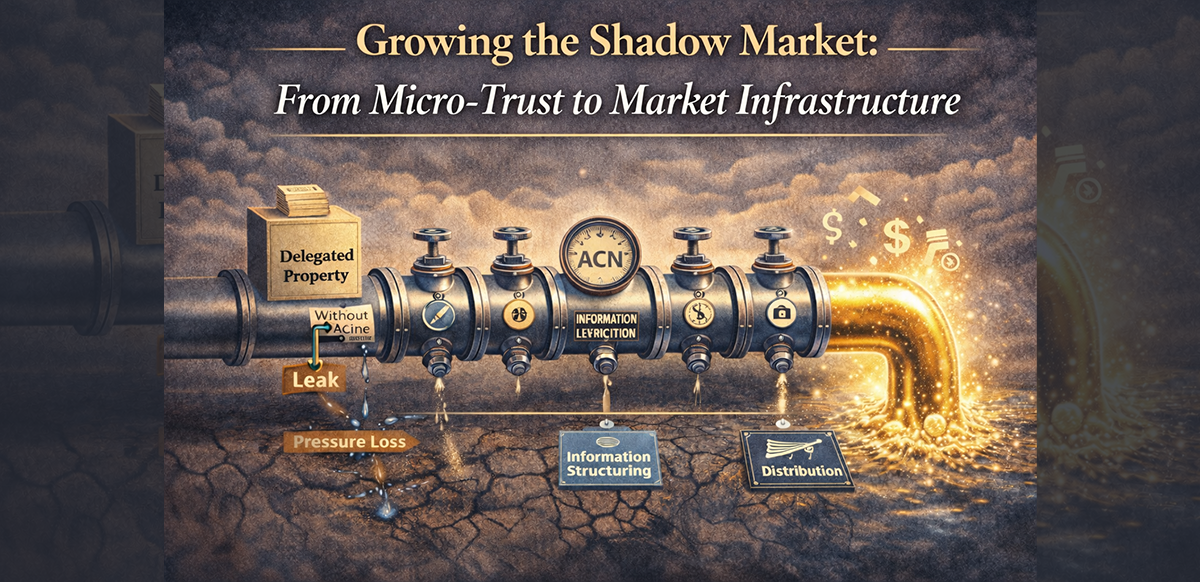
Informal micro-trust networks can become industry infrastructure when rules, proof, and roles are added. ACN grows cooperation from personal trust into scalable systems.
Once you recognise that the shadow market already exists, the real question is no longer whether it grows—but how it grows without collapsing the trust that sustains it.
Shadow markets do not scale like public platforms. They do not grow through mass recruitment or open invitations. They scale like cells.
Every real shadow market begins extremely small. Not a "group," not a "network," but a nucleus of three to five people—at most.
At this size:
Cooperation is not formal; it is instinctive. Members share off-market listings, real buyer intent, and sensitive pricing information. Trust exists because social consequence is immediate. This is not networking; it is survival-grade cooperation.
The most common mistake agents make is trying to add people too early. Shadow markets do not grow by adding nodes; they grow by repeating successful outcomes.
At this stage, the same small nucleus closes multiple deals together. Roles start to become implicit, and behaviour patterns stabilise. Trust deepens vertically before it expands horizontally. Only after repeated, clean cooperation does expansion even become possible.
Growth, when it happens, is surgical. A new person is added only to solve a specific bottleneck:
The group does not ask, "Is this person good?" It asks, "Does this person reduce friction?" Anyone who introduces noise, ego, or information leakage is rejected immediately. This is how a shadow market reaches 8–12 people without collapsing its trust structure.
Once the network reaches critical density, a distributed firm emerges organically. People stop trying to do everything:
No one assigns these roles; they emerge as a response to speed and efficiency. The shadow market now behaves like a professional firm—without hierarchy, branding, or payroll.
No matter how strong trust is, informal shadow markets always hit a ceiling. This is not a failure of character; it is a law of mathematics.
In a chat-based environment (like WhatsApp), the number of potential interactions (I) grows much faster than the number of agents (n). The formula for this complexity is:
I = [ n * (n - 1) ] / 2
This means that in a group of 5 people, there are only 10 potential lines of communication to manage. But in a group of 30, there are 435 potential lines of communication.
As the network size (n) increases, manual coordination inevitably collapses for three reasons:
| Number of Agents (n) | Potential Interactions (I) | Coordination Method |
|---|---|---|
| 5 Agents | 10 | High-trust, informal chat |
| 10 Agents | 45 | Maximum limit of memory |
| 20 Agents | 190 | Structural collapse begins |
| 30 Agents | 435 | Pure chaos without infrastructure |
Every high-performing shadow market eventually faces a choice. In high-stakes sectors—commercial, luxury, distressed—going public is not an option as it destroys discretion. The choice is to Infrastructurise:
Modern infrastructure (such as ListingMine) solves the privacy–scale paradox through Zero-Knowledge Discovery:
You gain the discovery power of 500 agents with the noise level of your original 5-person circle.
Shadow markets do not grow by becoming public. They grow by becoming denser, safer, and more precise. Real growth is not measured by more people or more messages; it is measured by less repetition, less uncertainty, and less risk. The final evolution of the shadow market is a private, high-fidelity infrastructure where privacy is a feature and human trust remains the final gatekeeper. It begins with three to five people who refuse to work alone—and ends with a system that allows them to dominate the market without the market ever knowing they were there.

Founder of ListingMine and author of Agent for Life. Building ERP for Malaysian real estate agencies since 2008 — and writing to reshape how agencies grow.
More about Marvin Foong →More articles in this topic