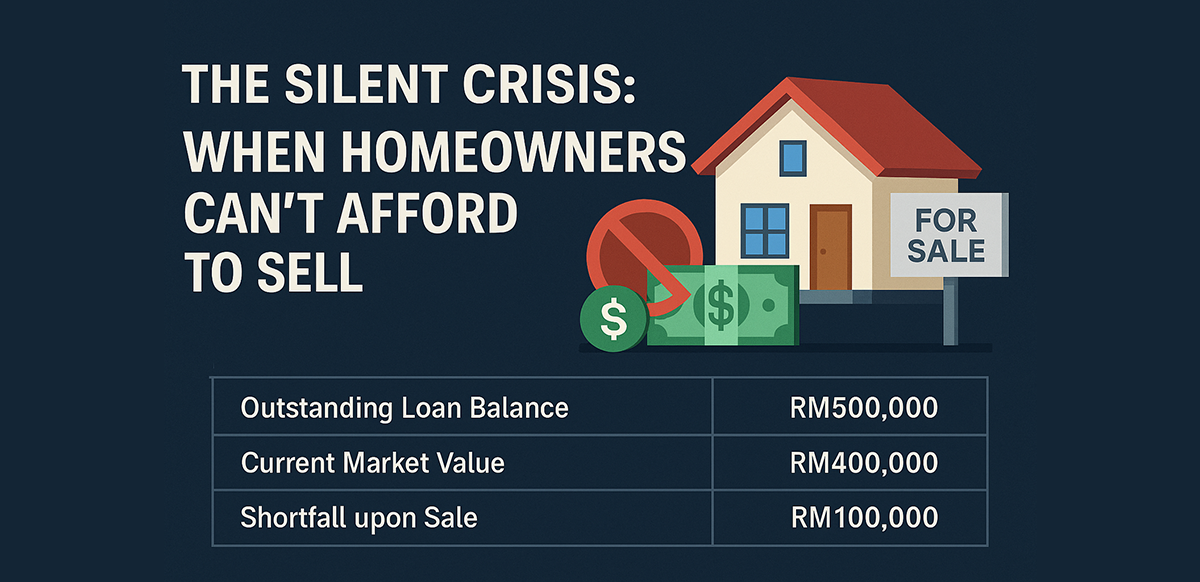
Some homeowners cannot sell because redemption sums, market prices, loans, and costs trap them. Agents must understand seller financial constraints before pushing transactions.
For years, Malaysia’s property debate revolved around one painful reality:
“Young people cannot afford to buy a home.”
That is still true — but it is no longer the full story.
A deeper, quieter crisis is now emerging:
Thousands of existing homeowners can no longer afford to sell.
They are not unwilling to sell — they are financially unable to.
This is the scenario playing out in more and more households:
| Item | Amount |
|---|---|
| Outstanding Loan Balance | RM500,000 |
| Current Market Value | RM400,000 |
| Cash Shortfall to Settle | RM100,000 |
If the owner sells at RM400,000, the bank still requires full loan settlement of RM500,000. That missing RM100,000 must be paid in cash before the title is released.
And most owners do not have that kind of money sitting in a bank account.
Result: the owner is trapped.
They cannot exit, upgrade, refinance, or restructure.
They are house-rich, cash-poor, and locked in.
The Inflated SPA “Cash-Out” Trick
Yes, some properties genuinely fell in value due to oversupply or weak demand. But the far bigger driver of negative equity is self-inflicted:
Example:
| Scenario | Amount |
|---|---|
| Actual Market Value (then) | RM400,000 |
| Inflated SPA Price | RM500,000 |
| Bank Loan Approved (90%) | RM450,000 |
| “Cash Out” Pocketed by Buyer | RM50,000 |
That RM50,000 seemed like “free money” — used for renovation, furniture, or just extra cash.
But the system doesn’t forget:
The loan today is still based on RM500,000
The market today reflects only RM400,000
The “harmless” trick has now mutated into a six-figure exit penalty
What looked like profit has turned into debt you must pay to leave.
These owners aren’t defaulting. They’re still paying instalments every month. From the outside, they look financially stable.
But in reality:
This is not foreclosure. This is immobilization.
A home that cannot be sold is no longer an asset — it is a frozen liability.
| Old Market Problem | New Market Problem |
|---|---|
| Buyers can’t afford to buy | Owners can’t afford to sell |
| Price ceiling issue | Price floor issue |
| Demand crisis | Supply lock-up crisis |
When a large portion of housing stock is stuck in negative equity:
Inventory stops moving
Upgraders stop upgrading
Developers lose upgraders as buyers
Transaction volume drops even if prices look “stable”
The market looks calm — but is actually frozen
Everyone played a part:
You can manipulate the document. You cannot manipulate economic gravity.
The key question for buyers is no longer:
“Can I afford the monthly instalment?”
It is now:
“If I buy this today, will I still be able to sell it 10 years later — without paying money to the bank?”
Malaysia’s housing crisis is no longer just about affordability of entry. It is now about the affordability of exit.
The era of “cannot afford to buy” has collided with the era of “cannot afford to sell.”

Founder of ListingMine and author of Agent for Life. Building ERP for Malaysian real estate agencies since 2008 — and writing to reshape how agencies grow.
More about Marvin Foong →More articles in this topic
This article is one of the sources behind these assessments. Take one to see what you already know and what to read next.
Educational self-assessment. Not a licensing examination or professional certification.