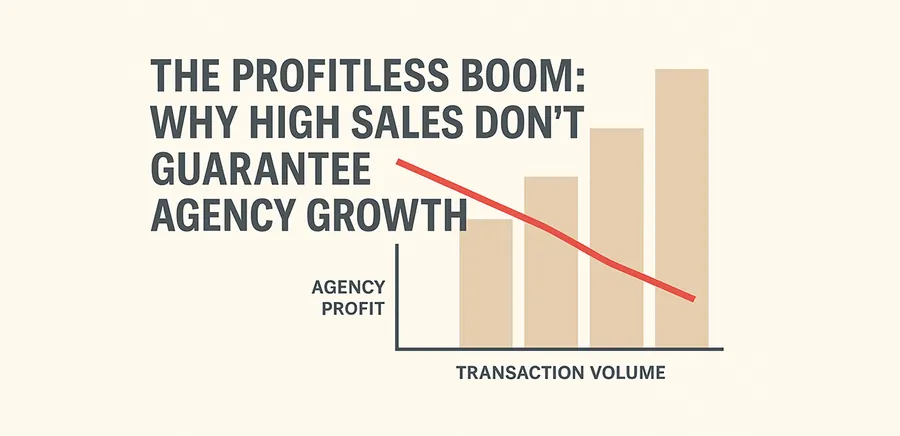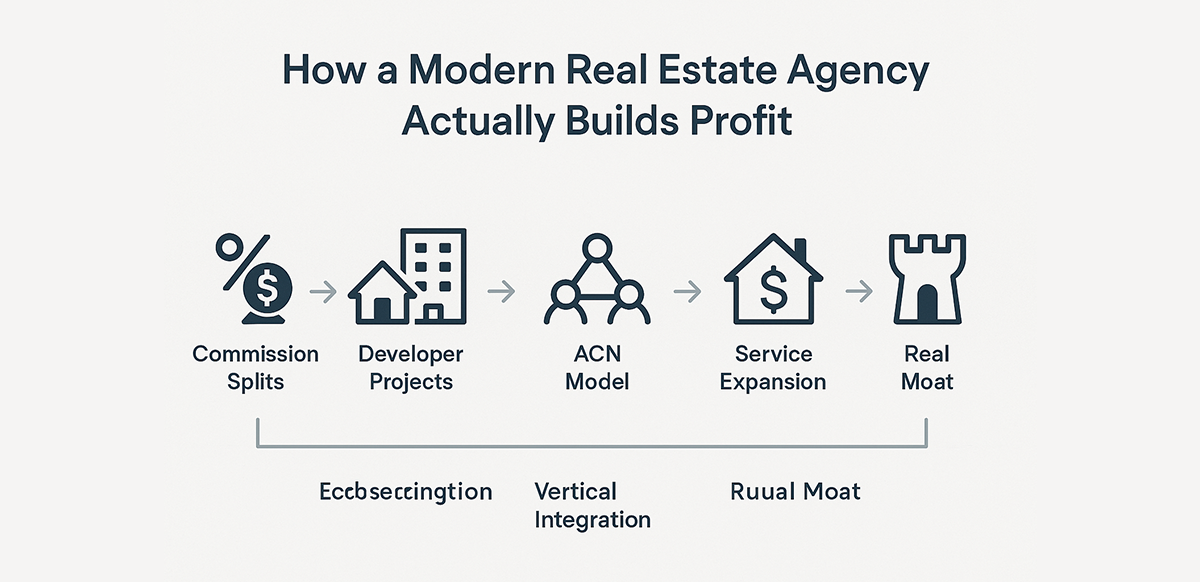
Modern agency profit comes from margin discipline, systems, productivity, service design, and controlled growth. Headcount and gross sales alone do not prove business strength.
The old saying is that real estate agencies simply "take a cut" of the agent's commission. That's a huge understatement. Today's successful agencies don't just collect fees; they build profit like sophisticated investment houses, creating multiple, layered revenue streams.
To understand how a modern agency makes money, you need to look at its profit engines across six key dimensions.
This is the core engine. Every sale's total commission is split among the agent, the team lead, and the brokerage. Most agencies use a tiered system (e.g., 60/40 for a new agent, 90/10 for a top producer) to drive agent performance.
The agency profits here in two ways:
The biggest profit accelerators come from securing exclusive rights to sell new development projects. This is about unlocking sophisticated financial models, not just high volume.
The Exclusive Appointment (Payout Control): The agency gains full control over the agent payout structure. If the total commission is 5%, the agency might pay co-broking agents 3%, retaining the remaining 2% as pure profit. Since they control all desirable inventory, the agency is not afraid of co-broking agents seeking stock from other agencies that might offer a slightly higher payout.
The Wholesale Model (Master Distribution): The agency acts as the master broker, keeping a strategic cut (e.g., 5%–15%) and letting other brokerages sell for the remainder. This converts a staffing limitation into a pure, risk-free distribution profit.
Commission Tier Accumulation (The Volume Bonus): Agencies strategically "accumulate" sales to hit developer volume targets faster, unlocking exponentially higher commission rates (e.g., jumping from 2% to 4%) on all units sold.
The Agent Cooperation Network (ACN) model allows a modern agency to profit by transforming its internal departments from cost centers into value-contributing roles that earn a percentage of the commission pool. This turns the company into an active deal participant, not just a middleman.
| Agency Role | Value Contributed | Commission Entitlement |
|---|---|---|
| Lead Generator | Running ads and delivering verified prospects. | 40% (Example) |
| Qualifier/Caller | Managing the call center, setting appointments. | 30% (Example) |
| Verifier/Admin | Document checking, compliance, and systems input. | 15% (Example) |
This structure rewards the value contributed by company resources, making revenue no longer solely dependent on the closing agent.
A sale is a one-time event; a client relationship is a revenue stream. Modern agencies monetize the entire property lifecycle by seamlessly integrating adjacent services.
This creates a recurring revenue source:
The most ambitious agencies move beyond collecting fees to owning parts of the value chain. This shifts their income from commission-based to equity-based.
While the five models above define how an agency profits, they are all ultimately easy to copy. Every competitor can eventually replicate a tiered split or a wholesale structure.
A truly sustainable agency profit model requires a Real Moat—an unfair, structural advantage that cannot be bought or easily copied:
Only when the business model is secured by these high-trust relationships and competitive barriers can an agency's profitability truly be sustainable.
The modern real estate agency is a multi-faceted enterprise. The difference between survival and sustained dominance, however, is the Real Moat—the structural advantages like global lead flow, unbreakable developer relationships, and a culture of trust that prevent competition from eroding your profits.

Founder of ListingMine and author of Agent for Life. Building ERP for Malaysian real estate agencies since 2008 — and writing to reshape how agencies grow.
More about Marvin Foong →More articles in this topic
This article is one of the sources behind this assessment. Take it to see what you already know and what to read next.
Educational self-assessment. Not a licensing examination or professional certification.