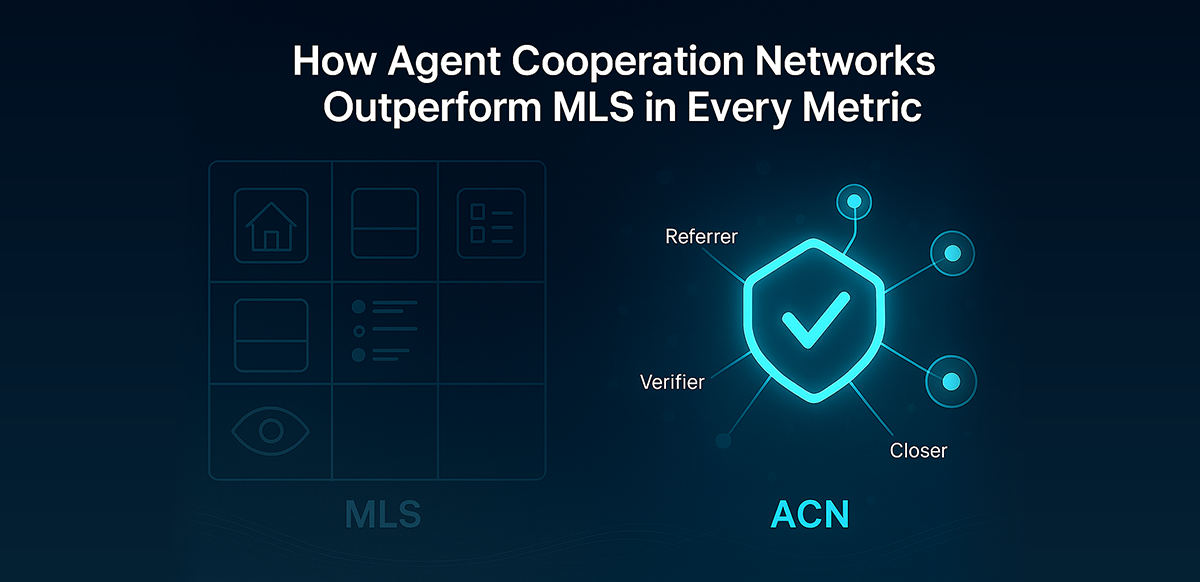
ACN can outperform MLS where agent roles, contribution tracking, split logic, and workflow governance matter more than listing exposure alone. Cooperation quality becomes more important than listing centralization.
ListingMine Academy | Real Estate System Design
For decades, the Multiple Listing Service (MLS) was the gold standard of cooperation.
It unified listings, standardised data, and gave buyers a single window into the market.
In its era, that solved the hardest problem: visibility.
But in the current time, visibility is abundant.
Every agent can advertise on Facebook, TikTok, or PropertyGuru in minutes.
The real scarcity now is verification, attribution, and efficiency.
That’s where the Agent Cooperation Network (ACN) begins.
The MLS was built for an age when trust was assumed.
ACN is built for an age when trust must be proven.
In an MLS, any agent can upload a listing; accuracy depends on goodwill.
In an ACN, each listing carries a digital proof trail—timestamped by a verifier who’s paid only when the deal closes.
Verification becomes an economic function, not an admin task.
| Function | MLS | ACN |
|---|---|---|
| Listing accuracy | Based on trust | Based on proof |
| Data update | Manual | Incentivised |
| Fraud control | Reactive | Preventive |
| Audit trail | Weak | Immutable |
MLS assumes honesty. ACN pays for honesty.
MLS cooperation lives in association bylaws.
ACN cooperation lives in code.
Each participant—listing agent, buyer referrer, closing agent, verifier—has a pre-defined role with an event trigger.
Once proof is logged, payout is automatic.
No mediation, no politics.
| Metric | MLS | ACN |
|---|---|---|
| Enforcement | Committee | Algorithm |
| Disputes | Frequent | Near zero |
| Transparency | Hidden splits | Public proof |
| Scalability | Regional silos | Infinite replication |
ACN converts cooperation from compliance to computation.
The MLS charges membership dues regardless of performance.
ACN charges success-based fees only when a verified deal closes.
Every role is funded by its own contribution.
If no value is created, no one gets paid.
This structure eliminates “ducks”—people who sit on payroll without output.
In ACN, there is zero passive income and zero political cost.
The system enforces merit automatically.
| Cost Driver | MLS | ACN |
|---|---|---|
| Membership dues | Fixed | None |
| Platform revenue | Subscription | Micro-fees from verified success |
| Overhead | Administrative | Algorithmic |
| Agency ROI | Linear | Compounding |
ACN scales productivity, not bureaucracy.
MLS measures how many homes are listed.
ACN measures how many deals are verified and closed.
Every buyer lead becomes a role—referrer, closer, verifier—inside the same proof system.
Each successful deal funds the next cycle of leads and education.
That keeps liquidity circulating internally, not leaking to ad platforms.
ACN turns listings into a living economy.
Where MLS relies on boards and hearings, ACN encodes governance into workflow:
Proof timestamps replace verbal disputes.
CP58-ready logs replace manual reports.
PDPA compliance is automatic.
Paper governance becomes protocol governance.
U.S. agencies are trapped by REALTOR® politics and state-law inertia.
Malaysia isn’t.
We have no national MLS, no entrenched dues system, and a fast-digitising agency culture.
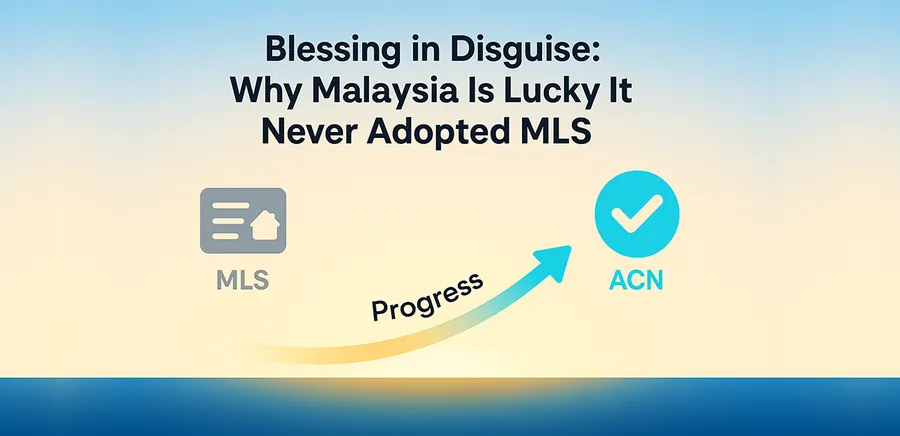
That gives Malaysia a first-mover advantage: we can adopt the verified-cooperation standard directly, just as China skipped landlines and went mobile.
ListingMine’s ERP already encodes it:
We don’t need to reform legacy infrastructure; we can start at the destination.
MLS measures exposure.
ACN measures trust.
In a world flooded with listings, whoever controls verified truth controls liquidity.
That’s why the next decade won’t belong to whoever owns the most data—it will belong to whoever can prove it.
The future of real estate is measured in proof, not promises.
The decisive difference lies in economics.
ACN Is Alive
ACN is a living network.
It can create or retire roles instantly:
| Role | Function | Funding |
|---|---|---|
| Lead Referrer | Introduces buyers/sellers | % of closing commission |
| Verifier | Validates data and docs | Verification fee |
| Educator | Trains productive agents | Education-pool bonus |
| Key Holder | Manages viewings | Micro fee |
| Closer | Handles negotiation | Buyer-side split |
If a new need arises—say, mortgage liaison or renovation consultant—ACN can spawn the role and tie it to transaction proof immediately.
Everyone’s payout depends on one thing: a successful verified closing.
That makes every participant a self-interested whistle-blower who protects integrity to protect income.
Alignment becomes enforcement.
MLS Is Static
MLS runs on flat-rate dues.
Its income is unrelated to performance, so innovation creates no reward.
Committees debate; software stagnates.
| Metric | MLS | ACN |
|---|---|---|
| Revenue model | Fixed fees | % of verified success |
| Incentive to innovate | None | Continuous |
| Funding for improvement | Capped by dues | Scales with volume |
| Evolution | Policy-driven | Market-driven |
Flat-fee systems fossilise; success-fee systems evolve.
Each verified transaction makes ACN richer and smarter.
MLS, meanwhile, collects the same cheque no matter how outdated it becomes.
One feeds on bureaucracy. The other feeds on progress.
| Category | MLS | ACN |
|---|---|---|
| Core Value | Visibility | Verifiability |
| Incentive Design | Membership dues | Proof-based payouts |
| Structure | Bureaucratic | Event-driven |
| Governance | Human | Algorithmic |
| Network Effect | Geographic | Transactional |
| Economic Impact | Rent-seeking | Productivity-generating |
Agent Cooperation Networks don’t compete with MLS. They obsolete it.

Founder of ListingMine and author of Agent for Life. Building ERP for Malaysian real estate agencies since 2008 — and writing to reshape how agencies grow.
More about Marvin Foong →More articles in this topic