Agencies can reduce dropout and grow revenue by changing structure, training, support, and workflow. The article points toward system design as the solution to agent churn.
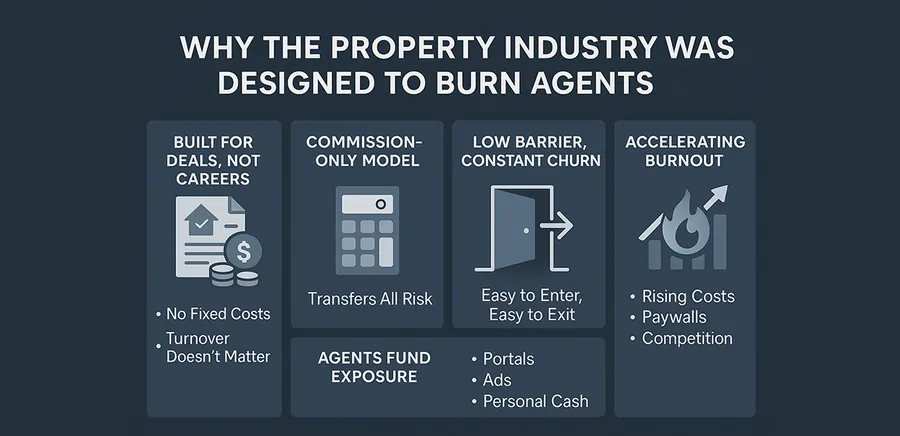
This industry does not burn agents by accident. It burns them by design. For decades, the property business accepted one assumption as unavoidable: most agents will fail, most will quit, and only a few will survive.
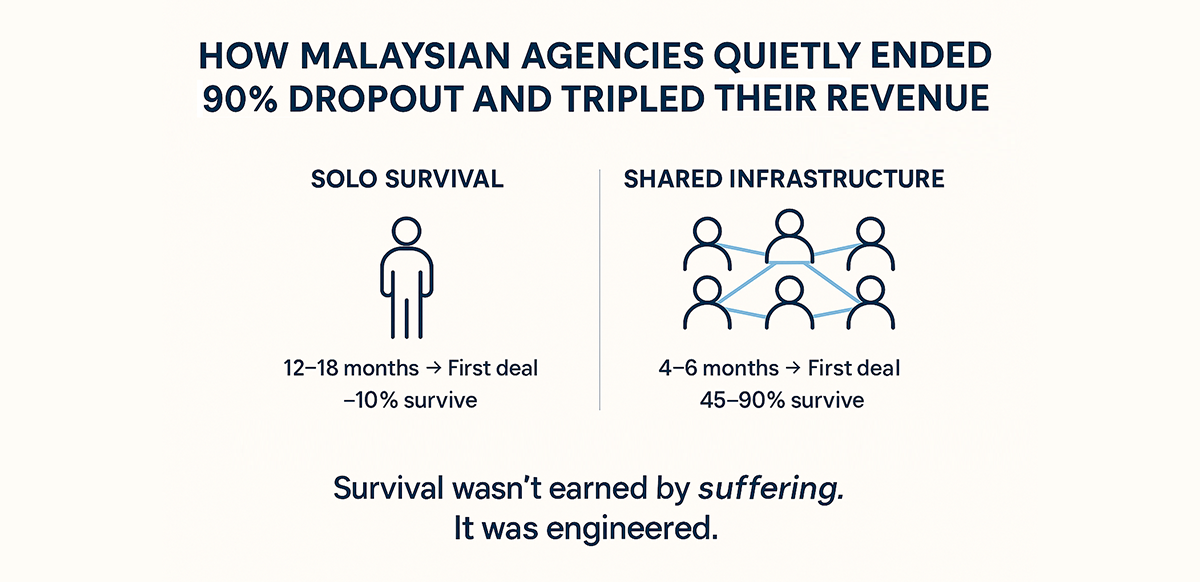
What has changed is not agent quality. What has changed is that some agencies quietly stopped running the burn-and-churn model — and the results are now too large to ignore.
Different structures. Same outcome: agents survive longer, close faster, and generate more revenue per head.
Some agencies intervene at the most fragile point: month one. They do not expect new agents to survive on optimism alone.
Structure
Outcome
Nothing magical happened. Agents were simply given a runway instead of starvation.
Other agencies did not introduce allowances or salaries. Instead, they redesigned how agents cooperate from day one.
Structure
What this creates — intentionally or not — is a mini cooperation network:
Outcome
Year-one dropout fell below 50% for the first time in company history
Pressure remains. Isolation disappears.
This model is fundamentally different — and often misunderstood. Here, cooperation is no longer informal. It is organised.
Structure
Agents are not passive. They contribute inventory, not cash.
Functionally, this creates a scaled cooperation network:
Outcome
This is not generosity. It is industrialised cooperation.
Traditional Model
Survival-First Model
Same SPM leavers. Same Klang Valley market. Same Facebook algorithm. Only the architecture changed — and survival tripled.
A small number of agencies go further — but only selectively.
They treat junior agents as professionals in training, not disposable contractors.
Structure
Outcome
This model does not scale infinitely. It scales quality.
These agencies did not copy one another. But all rejected the same assumption:
"If you can't survive alone, you don't deserve to stay."
Across all four models:
The industry is already rebuilding itself into cooperation networks — just without admitting it yet.
These agencies are not charities.
They outperform because the economics flip.
Burn-and-churn optimises for
Survival-first optimises for
Results
One model replaces people. The other compounds capability.
In the past, running these cooperation-based models required custom software and heavy admin teams. Only large agencies could afford the plumbing.
That barrier is now gone.
In Malaysia, this infrastructure is already embedded inside ListingMine. It allows a team of 5 to operate with the same structural advantage as an agency of 500 — handling shared listings, transparent lead distribution, and cooperative workflows without custom builds.What used to be a scale advantage has been democratised.
A profession is not defined by exams, dress codes, or conventions. Those are aesthetics. A profession is defined by whether a capable person can:
Without private wealth or extreme sacrifice. The traditional property industry fails this test. It measures cash endurance, not skill.
The property industry was built to burn you. That does not make burnout inevitable. It makes the old design obsolete.
The agencies above did not succeed despite protecting agents. They succeeded because they stopped burning them.
The burn-and-churn model is not dying because it's immoral. It's dying because it's now the less profitable one. And in business, money always speaks loudest.

Founder of ListingMine and author of Agent for Life. Building ERP for Malaysian real estate agencies since 2008 — and writing to reshape how agencies grow.
More about Marvin Foong →More articles in this topic
This article is one of the sources behind this assessment. Take it to see what you already know and what to read next.
Educational self-assessment. Not a licensing examination or professional certification.