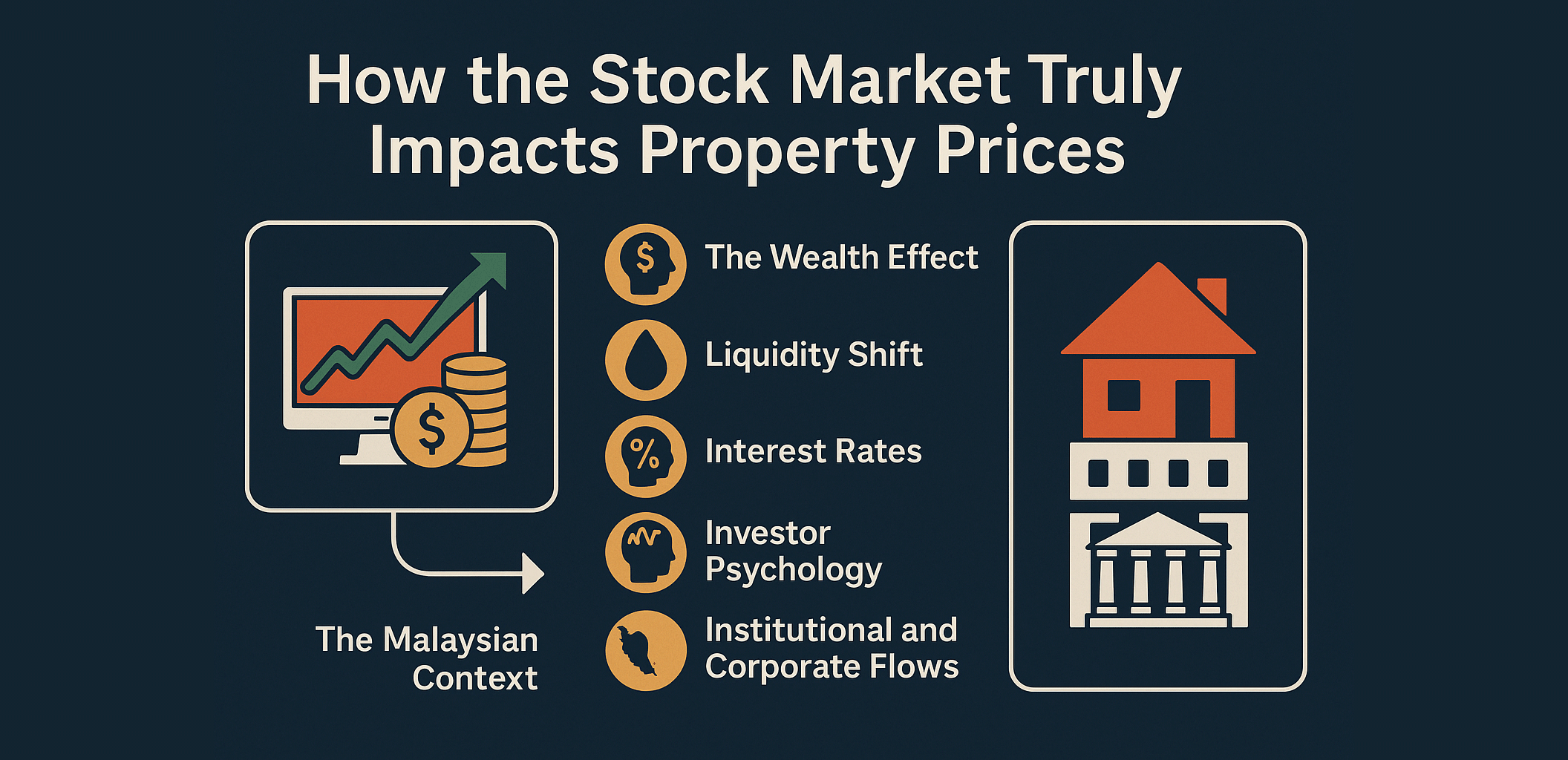
Stock market movements affect wealth perception, liquidity, confidence, and investor behaviour. Property agents should understand how financial markets influence demand.
Most people view the stock market and the property market as existing in separate worlds: one digital and volatile, the other physical and stable. In reality, they are deeply and financially intertwined.
When investors gain or lose money in the stock market, those decisions don't stay digital—they create ripples that affect property prices, bank lending practices, and even rental demand.
Here is a breakdown of the six key connections between the two markets.
A successful stock market creates what economists call the wealth effect. When an investor's portfolio value rises, they feel wealthier and more financially secure, even if they haven't sold any shares.
Confident Spending: This confidence encourages investors to upgrade their lifestyles—buying new cars, renovating their homes, and, crucially, purchasing premium property.
High-End Demand: This connection is most visible in luxury areas like KLCC, Mont Kiara, or Damansara, where high-net-worth individuals deploy their equity gains into lifestyle homes or rental properties.
The takeaway: Bull markets in stocks feed optimism and direct capital into the higher tiers of the property market.
When stock prices fall sharply, investors often seek out something safer and more tangible. Property is frequently the next asset class they turn to for shelter.
Physical Security: Physical assets feel "real"; they don't vanish overnight like share values can.
Capital Preservation: During times of high market volatility, you will often see a sudden spike in interest for land banking, stable subsale properties, and commercial units valued for their reliable rental yield, with developers shifting their messaging from "high returns" to "capital preservation."
The takeaway: While property offers temporary refuge during a stock panic, this shift is often short-lived. Since property is far less liquid (slower to sell) than stocks, capital tends to flow back to equities once the panic subsides.
Interest rates are the true common denominator that dictates the rhythm for both asset classes.
Rate Cuts: When central banks cut rates, borrowing becomes cheaper.
Stocks Rise: Lower rates make a company's future earnings more valuable today (less discounted).
Property Rises: Mortgages become more affordable, pulling more buyers into the market.
Rate Hikes: When banks raise rates, both markets suffer.
Stocks Fall: Company profits shrink due to higher borrowing costs.
Property Falls: Buyers retreat as loan repayments become unaffordable.
The takeaway: Interest rates synchronize both markets, which is why the property market's cycle typically lags the stock market's by a few quarters.
Ultimately, human emotion drives both markets.
Greed: When greed is rampant in the stock market, speculative money flows into every asset class, encouraging flipping, pre-launch bookings, and betting on new property projects.
Fear: When fear returns, sentiment collapses simultaneously across the board:
The takeaway: Property corrections often lag stock market crashes because it simply takes longer for property owners and sellers to admit the new market reality and lower their prices.
Beyond individual investors, large funds and corporations constantly rebalance their massive portfolios between equities and real estate.
Expansion: When the stock market (like Bursa Malaysia) is booming, REITs and large developers can issue shares at high valuations to raise cheap capital for land acquisition and new project expansion.
Contraction: When equity markets weaken, these same firms will conserve cash, slow down new launches, or even sell non-core assets to remain financially stable.
The takeaway: While retail investors focus on individual houses, the institutional layer shifts billions that shape the overall supply, pricing, and confidence beneath the surface.
While Malaysia's property market is more insulated than, say, Hong Kong or Singapore, the connection remains strong through several key channels:
The takeaway: A weak Bursa will see developers slow down and banks get conservative. A Bursa recovery is quietly and quickly followed by a rise in property market sentiment.
The stock market is the emotional pulse of the financial world, while the property market is the body that reacts.
Stocks move first: They are fast, speculative, and forward-looking.
Property follows: It is slow, physical, and anchored in long-term financing realities.
If you want to anticipate tomorrow's property trend, watch today's stock market. When liquidity, confidence, and credit converge in the stock market, real estate is almost always the next destination.
Do you currently invest in both markets, and have you noticed this lagging effect yourself?

Founder of ListingMine and author of Agent for Life. Building ERP for Malaysian real estate agencies since 2008 — and writing to reshape how agencies grow.
More about Marvin Foong →More articles in this topic
This article is one of the sources behind this assessment. Take it to see what you already know and what to read next.
Educational self-assessment. Not a licensing examination or professional certification.