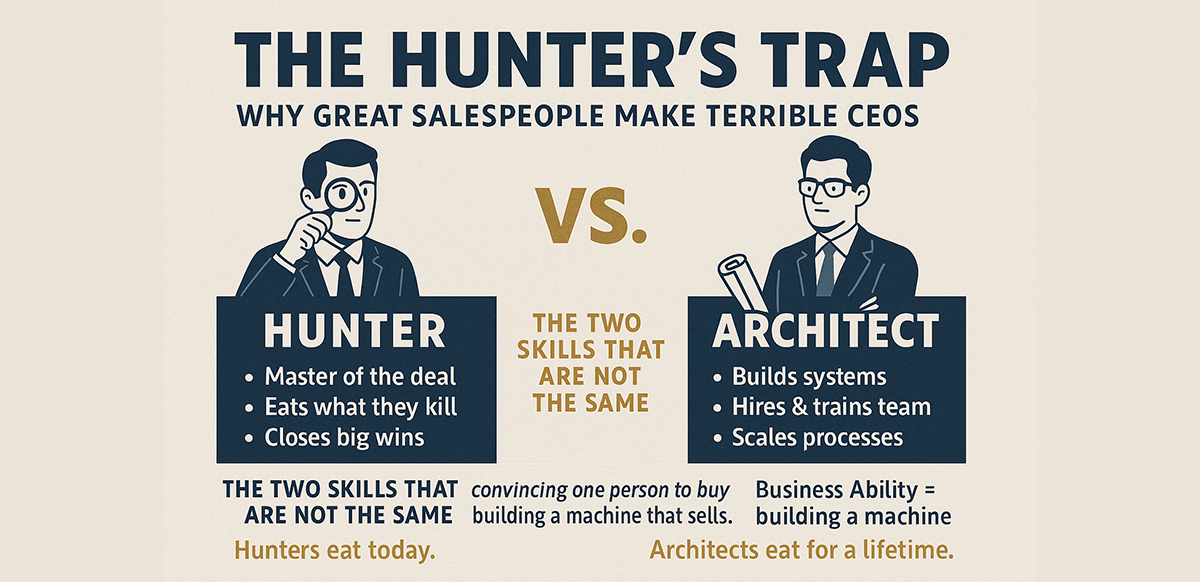
Great salespeople may struggle as CEOs because leadership requires systems, finance, people management, and long-term thinking. Selling skill alone does not build a company.
In real estate, insurance, and high-ticket sales, a predictable tragedy repeats itself every year.
A top performer smashes records. Closes seven-figure deals. Gets celebrated as "future agency boss material."
Eventually, they look at their leader and think: "I'm bringing in all the revenue. Why am I giving away a cut?"
So they resign. Register a Sdn Bhd. Print name cards that say Founder.
Twelve months later? They are drowning in overhead. Paralysed by operations. Burning through savings.
And quietly wondering: "Why does being a boss feel like a trap?"
Because they fell for The Hunter's Delusion: They confused the ability to close deals with the ability to build a company.
Sales Ability = Convincing one person to buy. Business Ability = Building a machine that sells when you're asleep.
One earns commission. The other earns freedom.
Top producers are masters of the hunt. But real businesses are farms—systems, seasons, structure, and teams.
Hunters chase. Farmers cultivate. Architects build. Scaling requires the last two.
A hunter knows how to:
But they often cannot:
So what do they build? Not a company. A personal franchise powered entirely by themselves.
Revenue stops the moment they stop. Stability depends on their next deal. Momentum dies during sickness, burnout, or family emergencies.
They didn't build leverage. They built a beautiful, expensive cage.
Salespeople understand commission. Entrepreneurs understand capital.
Most new founders cannot read the dashboard of the business they just created:
This is why so many new agencies collapse: They sell like CEOs, but spend like top agents. They are rich in revenue but bankrupt in sustainability.
When operations fail and finances tighten, panic takes over. The "CEO" retreats to the only thing they know:
They become everything except what a CEO should be. They didn't build a business. They built a job with more pressure and less freedom.
If you are a top performer dreaming of going out on your own, ask yourself:
If it dies, you don't own a company — you own a registered job title.
Sales ignites the engine. Operations keep it running. Financial logic prevents it from exploding.
Hunters eat today. Architects eat for a lifetime.
To build something that outlasts you: Stop obsessing over the next deal. Start obsessing over the system behind the deal.
Stop asking, "How can I close more?" Start asking, "How can this close without me?"
That is the difference between self-employment and entrepreneurship.
One has a title. The other builds a legacy.

Founder of ListingMine and author of Agent for Life. Building ERP for Malaysian real estate agencies since 2008 — and writing to reshape how agencies grow.
More about Marvin Foong →More articles in this topic
This article is one of the sources behind this assessment. Take it to see what you already know and what to read next.
Educational self-assessment. Not a licensing examination or professional certification.