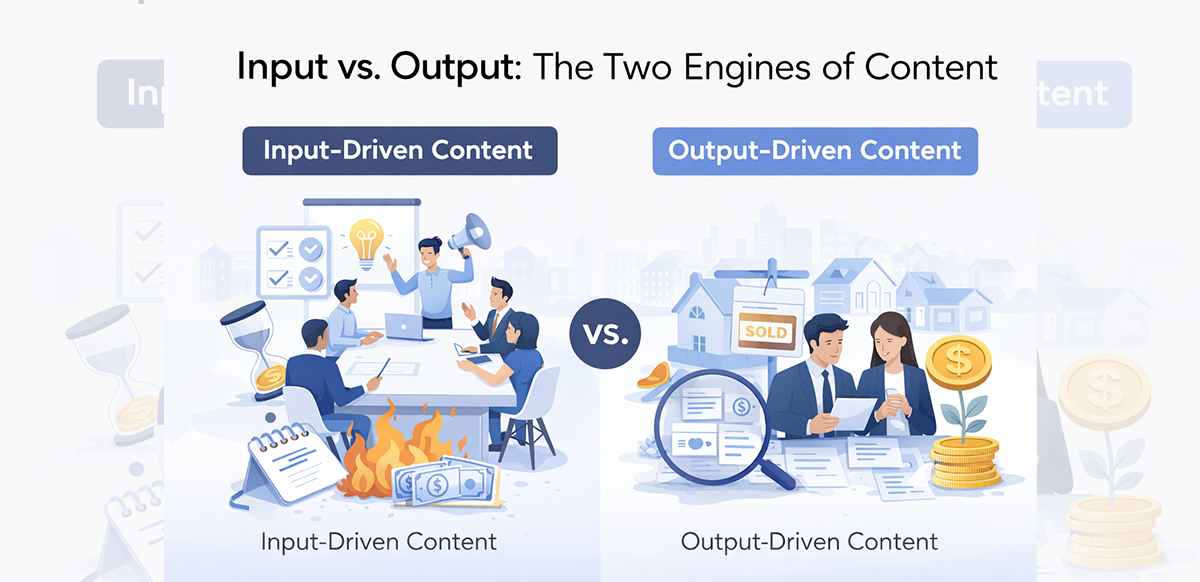
Content success depends on both input quality and output distribution. Agencies need strong ideas, market knowledge, and consistent publishing channels to create influence.
Most property agencies believe they have a content problem. They don't.
They have a sourcing problem.
There are two fundamentally different ways to generate content. Both are legitimate—but only one compound over time.
This is the default model for 99% of the industry.
How it works: Content starts with a brainstorming session. The team sits down and tries to invent value from scratch:
The agency decides on a message it wants to push, then manufactures content to support that message.
The Structural Weakness While this model is easy to understand and outsource, it has a fatal flaw: It is decoupled from daily operations.
Because it is not tied to the actual work being done, it relies entirely on motivation. The moment the marketing team gets tired, the content stops. Over time, the messages become repetitive, and the claims become generic.
It can convince a client, but it does not accumulate proof.
This is the model that creates asymmetric advantage. Very few agencies use it, not because it is complex, but because it requires operational discipline.
How it works: Content does not start with an idea. It starts with work that has already been finished.
The agency never asks, "What should we talk about?" It asks, "What problem did we just solve?"
Why Output-Driven Content Compounds
To execute Model 2, you must make one uncomfortable change: Work must be documented.
Most agencies operate on a "burn" cycle:
The intelligence gained from the transaction evaporates instantly. Model 2 refuses to let that happen. It captures the exhaust of the engine and turns it into fuel.
You do not need to turn your agents into writers. You only need to turn them into reporters.
Step 1: The Mandatory Debrief
After every completed deal (or failed attempt), the agent must answer three specific questions:
No storytelling. No formatting. Just raw facts.
Step 2: Centralize and Preserve
These notes are stored centrally—linked to the listing and the agent.
This becomes your Case Logic—a growing library of how real problems were solved in real transactions. Even if the agent leaves the company, the intelligence stays.
Step 3: Selective Extraction
Only later does a content team look at this data.
Publishing is optional. Documentation is mandatory.
Model 1 (Input) still has a role, especially in Malaysia where basic digital visibility is low. It signals professionalism and builds initial awareness.
However, the hierarchy is critical:
When you rely only on Model 1, you sound confident, but fragile. When you lead with Model 2, you sound calm, because the evidence is there.
Most agencies try to speak louder to get attention. The dominant agencies simply leave a trail of solved problems.
From the outside, it looks like "content." From the inside, it is just work that wasn't wasted.
That is the difference between making noise and building an institution.

Founder of ListingMine and author of Agent for Life. Building ERP for Malaysian real estate agencies since 2008 — and writing to reshape how agencies grow.
More about Marvin Foong →More articles in this topic
This article is one of the sources behind this assessment. Take it to see what you already know and what to read next.
Educational self-assessment. Not a licensing examination or professional certification.