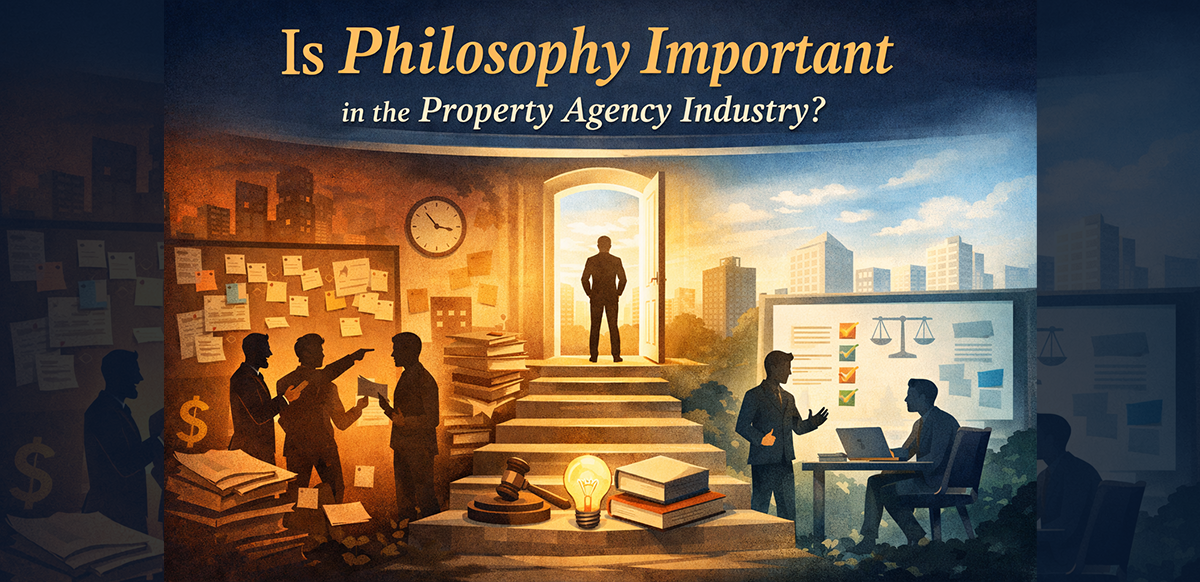
Philosophy matters because it shapes leadership, values, decisions, cooperation, and long-term direction. Agencies without philosophy often drift into short-term tactics.
At first glance, property agency looks like a purely transactional business. Listings in, buyers out, commissions paid. From the outside, philosophy feels unnecessary—almost indulgent. Many agencies proudly say, "We don't need philosophy. We just sell houses."
That belief is precisely why philosophy matters.
Philosophy is not something you add to a business; it is the operating system you run on, whether you realize it or not.
An agency that operates on:
...these are not strategies. They are philosophies in disguise. The question is not whether an agency has a philosophy; the question is whether that philosophy is explicit, coherent, and defensible.
Property agencies sit at a unique intersection of money, trust, asymmetrical information, and high emotional stakes. That combination guarantees one thing: If values are not designed, power will fill the vacuum.
In the absence of philosophy:
You may still close deals, but the organization never compounds. You are building a collection of people, not a company.
Two agencies can operate in the same market, with the same agents, and the same portals—yet behave completely differently. Philosophy is the "invisible hand" that determines what success means:
These choices shape culture far more than any training program.
Saying "we just sell houses" sounds humble, but it actually avoids responsibility. Agencies do not just facilitate transactions; they:
When agencies deny this, their philosophy becomes accidental. And accidental philosophy is the most dangerous kind—it is the root of the "low trust" perception that plagues the industry.
Every industry that matures eventually asks deeper questions:
Property is no different. As participants become more sophisticated, the tolerance for chaos declines. At that point, how you operate matters as much as what you sell. That "how" is your philosophy.
Markets fluctuate, regulations evolve, and portals reset advantages. What remains is how an organization thinks.
Agencies without philosophy react to every change, copy whatever looks successful, and lurch between strategies.
Agencies with philosophy adapt without losing identity. They reject growth that violates their first principles.
Philosophy is not rigidity; it is orientation.
Trust is not built by friendliness; it is built by predictability. Clients trust agencies when behavior is consistent, outcomes are explainable, and mistakes are handled systematically.
Without philosophy, trust is personal (and fragile). With philosophy, trust becomes institutional (and scalable).
Agencies that reject philosophy often say, "We're practical people." In practice, what they usually mean is: "We haven't agreed on what matters."
That vacuum gets filled by short-term incentives, loud personalities, and quiet resentment. Philosophy doesn't slow an agency down; it prevents it from pulling itself apart as it grows.
Agencies that never ask these questions still survive—they just don't mature. And in an industry built on trust, maturity is the ultimate competitive advantage.

Founder of ListingMine and author of Agent for Life. Building ERP for Malaysian real estate agencies since 2008 — and writing to reshape how agencies grow.
More about Marvin Foong →More articles in this topic