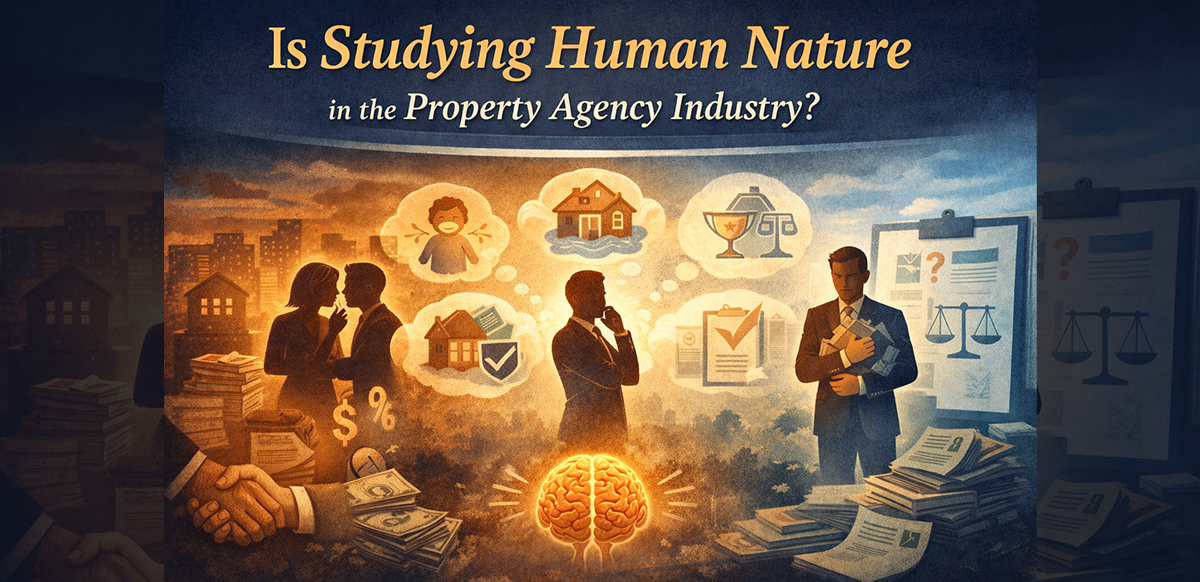
Property agency is deeply shaped by fear, trust, ego, greed, hope, and social status. Understanding human nature helps agents advise, negotiate, and lead better.
Yes — because property agency is not a business of listings, deals, or commissions. It is a business that operates directly on human survival instincts, identity, fear, and meaning.
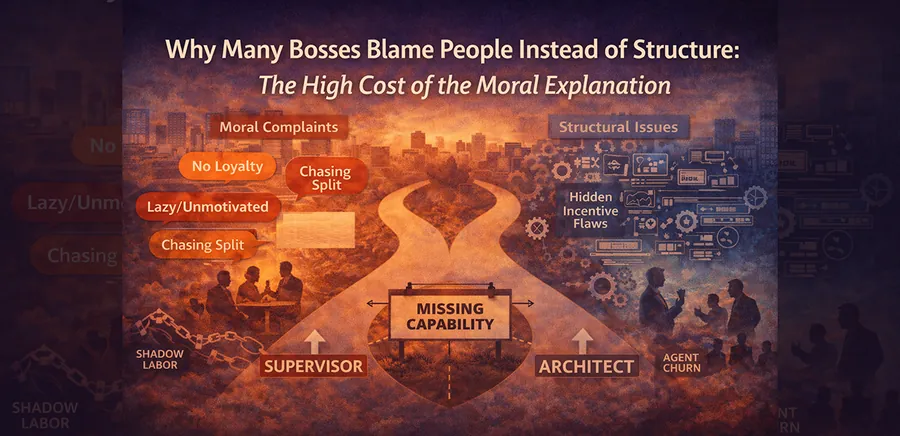
Any industry that ignores human nature does not become more efficient. It becomes more political, more exhausting, and more fragile over time. Agencies do not struggle because people are greedy, lazy, or irrational. They struggle because their systems are built on assumptions that contradict how humans actually function.
Humans did not evolve as lone optimizers. They survived by belonging to groups. In our ancestral past, reputation meant safety; exclusion meant death. That wiring never disappeared.
This is why humiliation hurts more than financial loss. This is why a seller in Malaysia will often reject a fair market offer simply to avoid "losing face." These are not "ego problems"—they are social survival reflexes. Any industry that repeatedly triggers social threat without structural protection will always feel hostile, no matter how "professional" it claims to be.
Humans do not experience decisions as spreadsheets; they experience them as stories about themselves. Every serious decision answers a silent question: "What does this say about me to the people I care about?"
Property decisions are identity anchors. Buying too high feels like personal failure; selling too low feels like being taken advantage of. Logic comes later. Facts are filtered through narrative. This is why buyers rationalize after committing and sellers resist evidence that threatens their self-image. Systems that ignore narrative coherence create resistance by default.
Humans can tolerate effort, hardship, and delayed reward. They cannot tolerate arbitrary uncertainty.
What looks like laziness is often uncertainty avoidance. Agents disengage when effort does not compound—when rules feel random and outcomes feel unpredictable. They don't leave because work is hard; they leave because the legible cause-and-effect has collapsed. When the rails are unclear, the human instinct is not to push harder—it is to freeze.
Humans do not optimize for maximum upside. They optimize for meaningful control. People will accept lower income and more effort if they believe their actions matter, rules are consistent, and effort compounds.
Opaque commission structures and moving goalposts do not create resentment because of money—they create resentment because people no longer feel in control of their outcomes. People don't want more reward first; they want predictable systems.
Before people ask, "Is this efficient?" they ask, "Is this fair?" If a system feels unjust, cooperation breaks down—even if the system is technically correct.
Property agencies fail not because of bad math, but because of moral illegibility. When contribution, risk, and reward cannot be clearly seen, people stop cooperating—not because they are unethical, but because they feel biologically exposed.
The property industry keeps trying to train, motivate, and discipline people. But human nature is not corrected by instruction; it is shaped by structure.
Structure determines behavior. Culture follows structure—not intention.
Mature agencies stop trying to fix people. They build systems that:
Human nature is ancient and unforgiving. Industries that ignore it become adversarial and unstable. Industries that respect it become calm, legible, and scalable.
Property agencies do not grow up by becoming louder or tougher. They grow up by building systems that allow humans to succeed by default. Stop trying to change people. Start digging the channels that let human nature flow in the right direction.

Founder of ListingMine and author of Agent for Life. Building ERP for Malaysian real estate agencies since 2008 — and writing to reshape how agencies grow.
More about Marvin Foong →More articles in this topic