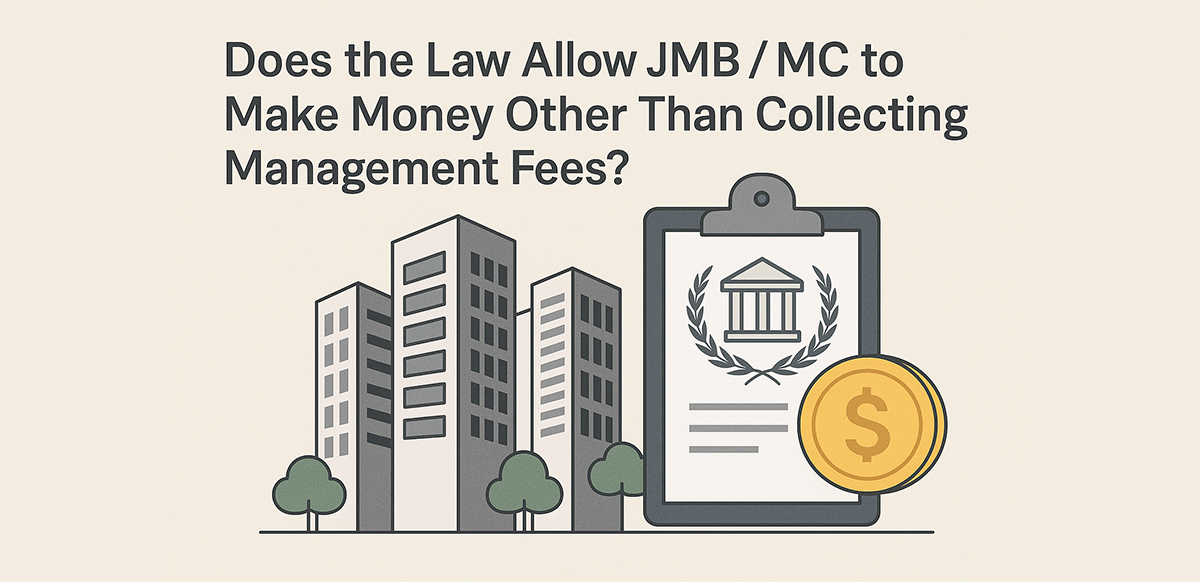
JMB and MC income sources must be considered within legal powers, by-laws, and proper governance. Agents should understand management-body limits when advising owners or investors.
A common assumption governs strata management in Malaysia: that a Joint Management Body (JMB) or Management Corporation (MC) is legally limited to collecting service charges and sinking fund contributions, and that any other income-generating activity is either prohibited or legally risky.
This assumption is not supported by the Strata Management Act 2013 (SMA).
Malaysian strata law does not prohibit JMBs or MCs from generating income. What it regulates are purpose, approval, governance, transparency, and avoidance of abuse.
The Strata Management Act 2013 is enacted to ensure the proper maintenance, management, and long-term financial sustainability of stratified developments.
It is an enabling framework for stewardship, not a statute that prescribes a single, exclusive funding mechanism.
The Act requires that:
It does not state that owner levies must be the only source of funding.
Under the SMA, every strata development must maintain two statutory funds:
Maintenance Fund (Service Charges)
For management, maintenance, insurance, utilities, and day-to-day operations.
Sinking Fund
For major repairs, replacements, and long-term capital expenditure.
Parcel proprietors are legally obliged to contribute when levied. This obligation is statutory and enforceable.
The SMA does not state that:
The law requires funding sufficiency, not funding exclusivity.
Malaysian administrative and corporate law recognises that statutory bodies possess implied powers reasonably necessary to discharge their statutory duties, provided such actions are:
Sections 21 (JMB) and 59 (MC) of the SMA contain broad enabling language allowing management bodies to do all things reasonably necessary to perform their duties and enforce by-laws.
In Badan Pengurusan Tiara Duta v Timeout Resources Sdn Bhd [2015], the Court of Appeal confirmed that powers to lease, license, or otherwise utilise common property may be implied where reasonably connected to management and maintenance obligations.
While the case arose under earlier legislation, the relevant enabling provisions are substantively mirrored in the SMA.
Accordingly, income-generating arrangements that are incidental to maintenance funding and benefit proprietors collectively fall within the scope of lawful management powers, not outside them.
Monetisation is not unilateral.
Where common property is:
approval of not less than 75% of the share units present and voting at an AGM or EGM is generally required (SMA 2013, section 60(3)).
This safeguard exists to:
Any monetisation implemented without required approval is not innovative—it is invalid.
Certain revenue mechanisms may be established before the JMB is constituted, during the period when the developer retains unified control. This is not a circumvention of the law.
During this phase, the developer—acting within its rights as:
may lawfully design and implement revenue-generating infrastructure, contracts, and operating arrangements as part of the original development.
These arrangements become part of the common property and operating environment transferred to the JMB or MC upon handover.
Post-handover, the JMB’s role is to manage inherited assets, not to retroactively approve their existence.
The legal boundary is not income generation. The boundary is conflict of interest and misuse.
Permitted:
Prohibited:
The law restricts abuse—not revenue.
There is no statutory prohibition against revenue-sharing or profit-sharing arrangements between a JMB/MC and independent third-party operators, provided that:
From a risk perspective, revenue-linked arrangements often reduce financial exposure, as payment arises only from realised income.
Management actions that:
are a recognised and legitimate extension of a JMB or MC’s role, provided they are properly governed.
This aligns with fiduciary obligations to act in the best financial interest of proprietors, including mitigating avoidable costs and preserving long-term value.
The Personal Data Protection Act 2010 regulates how personal data is used, not whether management bodies may communicate with residents.
PDPA prohibits:
PDPA allows:
Compliance depends on data governance, not silence.
Income earned by a JMB or MC is not automatically tax-exempt.
The Inland Revenue Board treats income from non-parcel owners—such as advertising, licensing, or facility rentals—as taxable.
Taxability does not determine legality, but it confirms that such income is recognised as a normal incident of management activity, subject to compliance.
A JMB or MC is a separate legal entity with capacity to:
This exposure already exists in ordinary management activities.
Commercial arrangements increase the importance of:
Risk is managed through governance and insurance, not avoided through inaction.
The COB does not prohibit income generation.
Its role is to:
COB scrutiny focuses on conflicts, approvals, and transparency—not on the mere existence of income.
The Strata Management Act 2013 does not confine JMBs or MCs to collecting management fees alone.
It requires:
Income generation beyond owner levies—when properly designed, approved, governed, insured, and audited—is lawful.
This is not a loophole. It is a legitimate exercise of stewardship within the framework the law was designed to support.

Founder of ListingMine and author of Agent for Life. Building ERP for Malaysian real estate agencies since 2008 — and writing to reshape how agencies grow.
More about Marvin Foong →More articles in this topic
This article is one of the sources behind this assessment. Take it to see what you already know and what to read next.
Educational self-assessment. Not a licensing examination or professional certification.