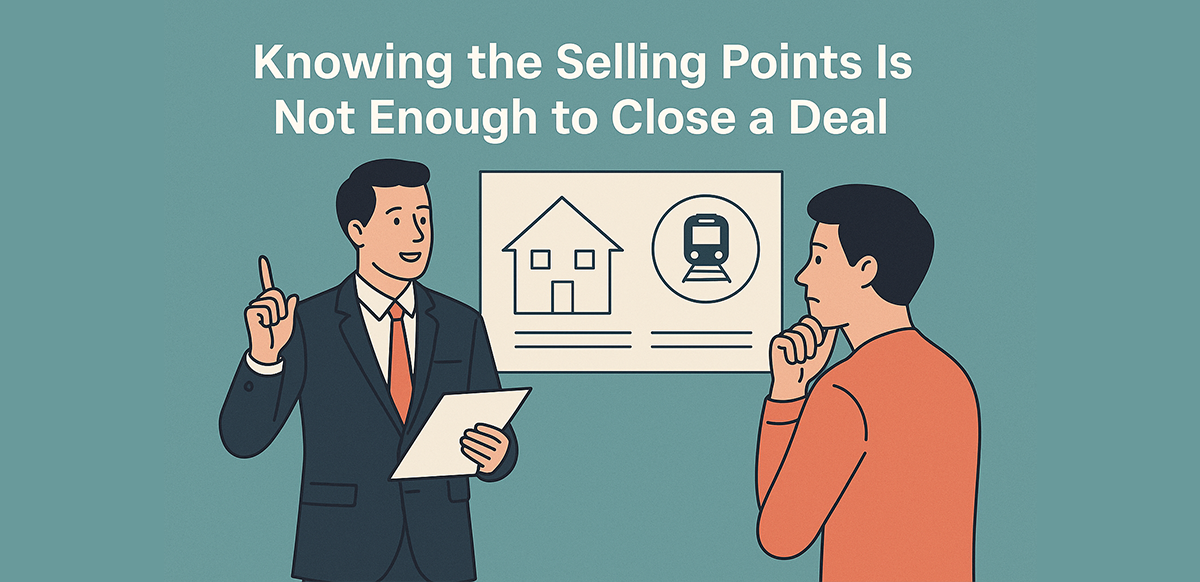
Product knowledge alone does not close deals. Agents also need trust, timing, qualification, negotiation, and emotional understanding.
Many agents believe that closing a deal is about memorising selling points.
Facilities.
MRT access.
Developer reputation.
Rental yield.
Future appreciation.
They deliver these points fluently—and still lose the deal. Why? Because prospects often know the selling points already.
Today's buyer is informed. They Google the project, compare prices across portals, read Lowyat forums, and watch YouTube walkthroughs before they even text you.
By the time they meet you, they likely know:
If your pitch is just repeating what is on the brochure, you are not an advisor. You are a background noise. Repeating what they already know does not add value. It creates friction.
This is the fundamental mistake most agents make. A Selling Point is a feature (what the product has). A Buying Reason is a personal trigger (what the product does for them).
They are not the same.
Example:
If your prospect drives a Mercedes and values privacy, the MRT is not a feature—it might even be a negative (noise/crowds). If you keep pushing the MRT, you aren't selling; you are annoying them.
Great agents spend less time talking and more time observing. They watch:
Silence is data. A prospect who keeps asking about school zones, neighbours, and noise is telling you they value Security and Community. A prospect asking about rental rates and ROI is telling you they value Math and Cashflow.
If you sell "cozy family living" to the "math buyer," you lose.
Instead of pitching features, ask diagnostic questions to find the Buying Reason.
Don't ask: "Do you like this layout?"
Ask: "How does your family usually spend Sunday mornings?"
Don't ask: "Do you want to see the gym?"
Ask: "Is a gym important to your daily routine, or do you prefer outdoor jogging?"
Don't ask: "Is the price okay?"
Ask: "What is the biggest concern preventing you from making a decision today?"
These answers tell you how to frame the property.
Your job is not to explain the property. The brochure does that. Your job is to translate the property into the prospect's life.
Filter the noise.
Highlight what actually matches their lifestyle.
Ignore the features they don't care about.
When prospects feel understood, resistance drops. They stop evaluating. They start imagining. That is when decisions happen.
Selling points close no deals by themselves. Understanding people does.
If your prospect doesn't take the MRT, stop selling the MRT. Observe first. Listen deeper. Then speak.
That is the difference between an agent who presents—and an agent who closes.

Founder of ListingMine and author of Agent for Life. Building ERP for Malaysian real estate agencies since 2008 — and writing to reshape how agencies grow.
More about Marvin Foong →More articles in this topic
This article is one of the sources behind this assessment. Take it to see what you already know and what to read next.
Educational self-assessment. Not a licensing examination or professional certification.