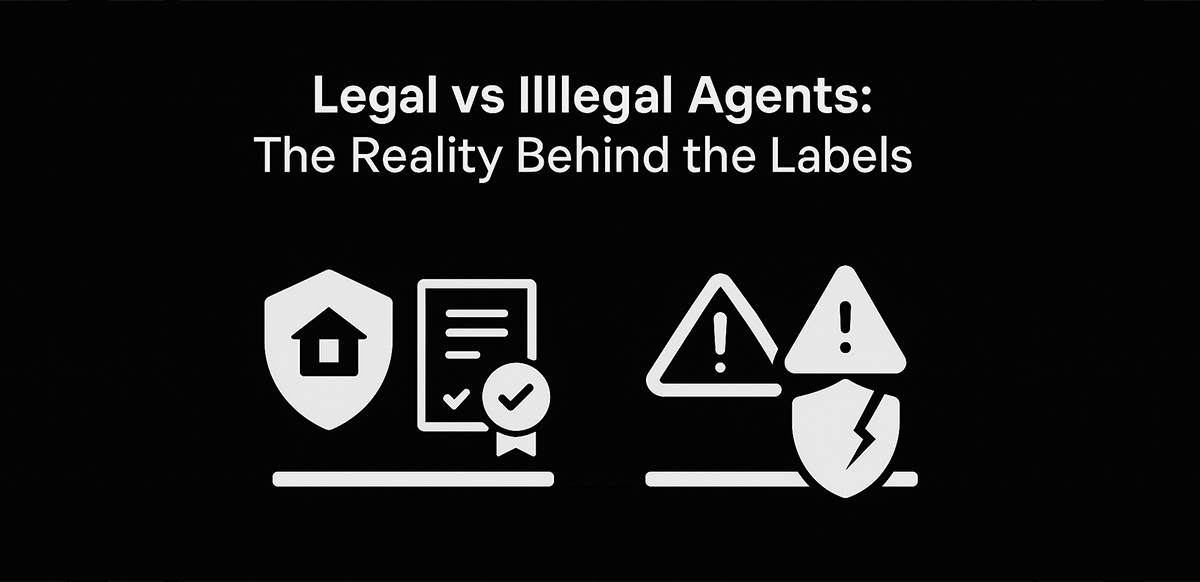
The legal-illegal divide is not only a label; it affects trust, compliance, client protection, and industry credibility. Professional systems help make legality meaningful in practice.
ListingMine Academy | Consumer Behaviour, Industry Structure & Professional Standards
For years, Malaysian consumers have been told one message:
“Illegal agents are dangerous. Use only RENs.”
But the real world is far more complex.
A REN tag is a license to operate, not a certificate of competence.
An “illegal agent” is not automatically a scammer.
And consumers themselves play a major role in sustaining both groups.
This article clarifies what the legal/illegal labels truly mean, how misinformation spreads, why consumers behave the way they do, and what Malaysia must fix to raise professional standards.
The only formal difference is:
Becoming a REN requires:
There is no exam, no apprenticeship, no competency assessment.
The REN tag certifies legality, not mastery.
Consumers often assume:
But legality does not guarantee:
Some RENs are excellent.
Some RENs are dangerously uninformed.
Some unregulated brokers are dangerous.
Some are surprisingly competent.
The labels do not tell the whole story.
A REN completes a 2-day course → receives a tag → becomes a TikTok “property educator.”
Because the training pipeline is minimal, misinformation spreads confidently and widely.
Here are the most common examples — with clear FALSE labels so no consumer mistakes them as correct.
Example 1 — The Tenure Confusion Myth
FALSE: “Tenure is freehold, leasehold, and bumiputera.”
Fact:
These are three different legal concepts, each with different implications.
Tenure:
Bumiputera Lot: A developer sales quota (State Interest Restriction), NOT a tenure.
Confusing these is not a small mistake — it changes resale eligibility, financing, and legal obligations.
Example 2 — The Condominium Title Misunderstanding
FALSE: “Before buying a condo, check the individual title first.”
Fact:
Condominiums use strata titles, never individual titles.
Before strata issuance (often 8–12 years), a buyer can only check:
Advising buyers to look for a “condo individual title” is technically impossible.
The cycle is predictable:
REN posts incorrect information online.
Consumers challenge it.
REN says, “These customers are so low quality.”
Team leader responds with motivational scripts: “Don’t give up. You’ll find good customers.”
Why? Because many team leaders were promoted after 1–2 years, with limited technical grounding.
This creates: A generation of “Blind Leading the Blind.”
The leader knows recruitment scripts, not real estate law.
The term “illegal agent” lumps everyone together. But in reality, there are three very different groups:
Consumers must recognise which type they are dealing with — and bear the full risk when dealing outside the regulated system.
This is NOT an endorsement of illegal practice — this is consumer behaviour analysis.
Consumers often choose unregulated brokers because they are:
Unless the agency demonstrates that the 8% SST adds real value (safety, due diligence, documentation), price-sensitive consumers choose the discount.
This is not encouragement — it is the reality of market behaviour.
Consumers and “illegal agents” are not the only contributors to the problem.
Agencies
Many brokerages prioritise:
The business model often depends on quantity over quality.
Developers
Developers frequently choose agencies based on:
This reinforces weak standards.
Consumers frequently:
But at the same time:
Professionalism requires a market willing to value professionalism.
Malaysia is not there yet.
Legal agents offer protections no unregulated broker can match:
Not all RENs are undertrained or misinformed. Thousands of RENs in Malaysia:
These competent, ethical RENs are often the most frustrated because:
If Malaysia raises standards, good RENs benefit the most. They are the natural allies of reform, not its targets.
Malaysia’s 2-day REN entry requirement is among the lowest in Asia.
| Market | Training Hours | Exam? | When You Can Practice |
|---|---|---|---|
| Malaysia (REN) | ~12 hours | No | Immediately |
| United States | ~60–180 hours | Yes | After exam + broker sponsorship |
| Japan | 150+ hours | Yes (~15% pass rate) | After national exam + registration |
| Singapore | ~80 hours | Yes (<20% pass rate) | After passing RES exam + joining a firm |
Singapore’s RES exam has a failure rate above 80%.
Japan has a 15% pass rate.
Professionalism begins at the entry gate, not after.
Professionalism must be systematic, not optional.
The labels “legal” and “illegal” describe legal status, not professional ability.
Legal agents offer:
Unregulated brokers offer:
Some consumers ultimately choose competence, honesty, clarity, and results — not badges.
But the safest route remains the regulated one, backed by BOVAEP oversight.
Malaysia’s issue is not illegal vs legal. It is low entry standards, weak training, misinformation, and misaligned incentives.
Raising standards protects: the public, the profession, and especially the good RENs who want a real career.
This article is for public education. It does not evaluate or criticise any individual REN, REA, or firm. References to misinformation or practice patterns describe structural issues in the industry, not personal conduct. Nothing in this article should be interpreted as endorsing or encouraging unlicensed real estate practice. Consumers are strongly advised to engage legally registered practitioners to receive full protection under Malaysian law.

Founder of ListingMine and author of Agent for Life. Building ERP for Malaysian real estate agencies since 2008 — and writing to reshape how agencies grow.
More about Marvin Foong →More articles in this topic
This article is one of the sources behind this assessment. Take it to see what you already know and what to read next.
Educational self-assessment. Not a licensing examination or professional certification.