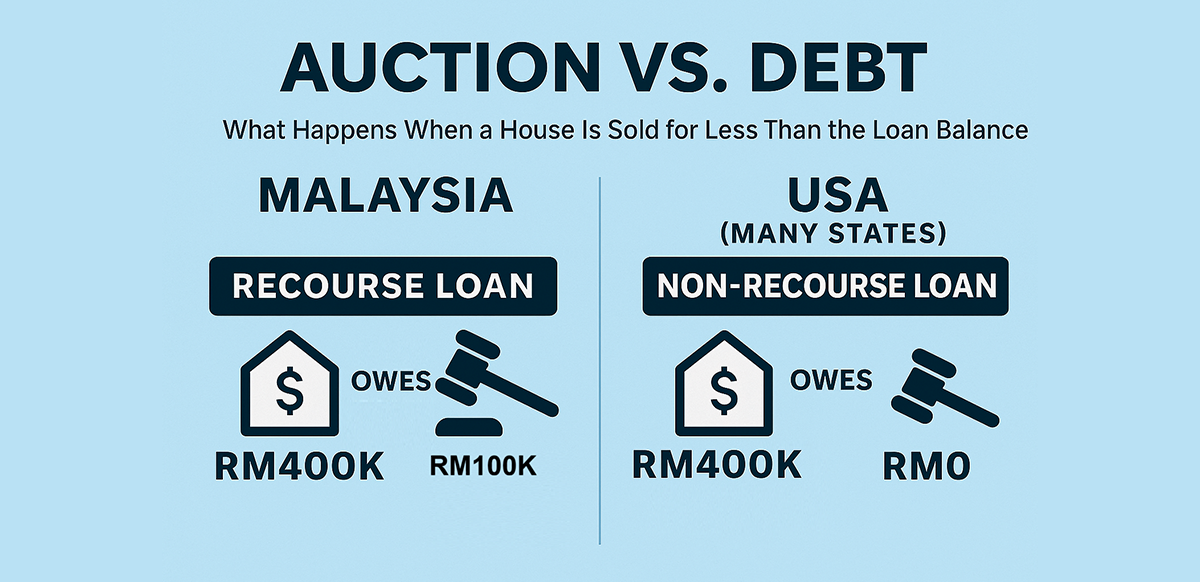
Auction or foreclosure may not fully clear a borrower’s debt if sale proceeds are insufficient. Agents should understand the financial aftermath of distressed sales.
Ask any Malaysian what happens if they can't pay their housing loan, and they'll likely say: "The bank will lelong (auction) the house, and that's the end of it."
This is the most dangerous financial myth in the country.
The reality is terrifying: In Malaysia, losing your house does not mean you are free from debt. Our system is fundamentally different from what many see in American movies or on the news, and this misunderstanding can lead to financial ruin.
The entire problem boils down to one word: Recourse.
Non-Recourse (Many US States): The loan is secured only by the property. If you default, the bank seizes the property. Even if it's auctioned for less than the loan, the bank absorbs the loss. You, the borrower, can walk away.
Recourse (Malaysia): The loan is secured by the property and by you, the borrower, personally. If the auction proceeds are not enough to cover the loan, the bank has the legal right to pursue you for the remaining balance (the "shortfall").
| Country | Loan Type | If Auction Price < Loan Outstanding | Who Pays the Shortfall? |
|---|---|---|---|
| Malaysia | Recourse | Borrower is still personally liable | The Borrower |
| USA (Many States) | Non-Recourse | Borrower walks away after foreclosure | The Bank (absorbs the loss) |
Imagine you default on your RM500,000 loan. The property market is bad, and the bank can only auction your unit for RM400,000.
| Location | Loan Outstanding | Auction Sale Price | Shortfall (What's Still Owed) |
|---|---|---|---|
| Malaysia (Recourse) | RM500,000 | RM400,000 | The borrower still owes RM100,000 |
| USA (Non-Recourse State) | RM500,000 | RM400,000 | The borrower owes RM0 |
The US borrower walks away with a bad credit score. The Malaysian borrower walks away with a bad credit score and a RM100,000 personal debt.
For the bank, the auction is just Step 1. For the borrower, it's the start of a new legal battle. Here is what the bank can (and often will) do to recover that RM100,000 shortfall:
You can lose your house and be forced into bankruptcy, remaining in debt for years.
This is no longer a rare, theoretical scenario. It is now a systemic risk due to:
Many owners in distress believe they can “just let it lelong.” They are walking into a financial trap.
For decades, an agent's job was to sell the "dream." In today's market, their job is to explain the risk.
A new generation of buyers, armed with internet research, is no longer just asking, "Can I afford the installment?" They are asking, "What happens if I can't?"
Agents who can't answer this, or worse, give the wrong answer ("Don't worry, the bank just takes the house"), will lose all credibility.
| The "Old" Agent (Promoter) | The "New" Agent (Advisor) |
|---|---|
| "Don't worry, property always goes up." | "Let's review the real financial risks and your exit strategy." |
| Sells a lifestyle. | Explains the legal contract. |
| Avoids the topic of default. | Uses the risk of recourse to build trust. |
| Loses credibility with savvy buyers. | Becomes a trusted, long-term advisor. |
Agents who can explain this recourse risk will instantly stand out. You stop being a salesperson and become an essential advisor. You build trust, convert hesitant clients, and protect them from financial ruin.
This knowledge is no longer a "bonus"; it's a professional necessity.
Do not mistake Malaysia's property laws for America's. There is no "walking away." A housing loan is not just a loan against your house; it's a loan against you.
The debt follows you long after the property is gone.
Agents who understand this protect their clients. Buyers who understand this protect their future.

Founder of ListingMine and author of Agent for Life. Building ERP for Malaysian real estate agencies since 2008 — and writing to reshape how agencies grow.
More about Marvin Foong →More articles in this topic
This article is one of the sources behind this assessment. Take it to see what you already know and what to read next.
Educational self-assessment. Not a licensing examination or professional certification.