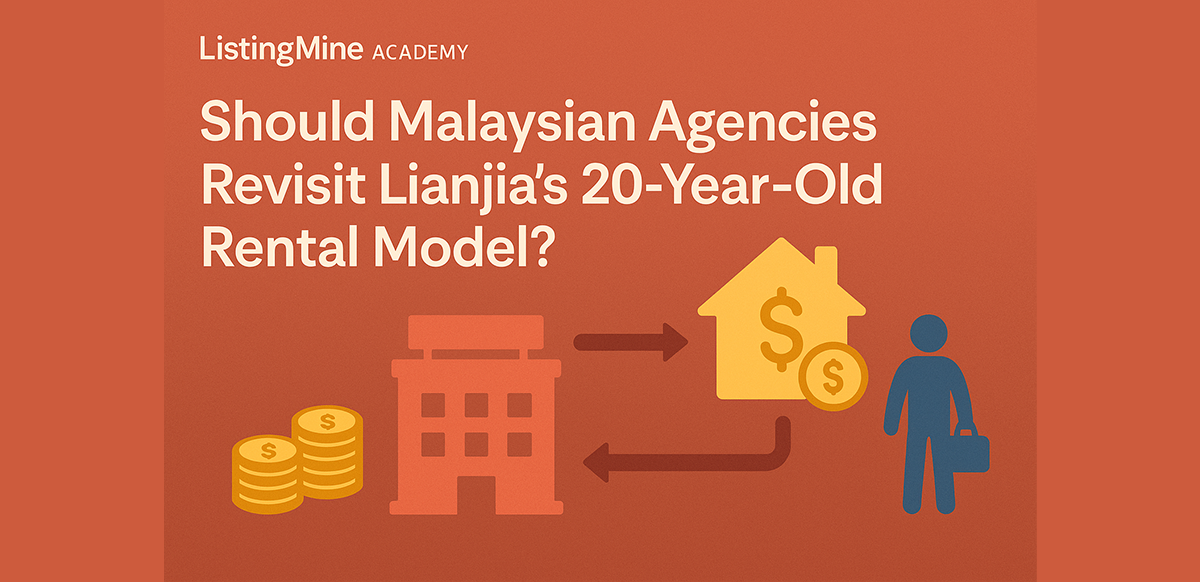
Lianjia’s rental model offers lessons on recurring relationships, owner control, and structured service. Malaysian agencies may adapt parts of it to build stronger rental foundations.
ListingMine Academy | Agency Economics, Rental Innovation & Financial Strategy
Twenty years ago, Lianjia (HomeLink) built one of the most powerful rental engines in Asian real estate. Through its operational arm and later Ziroom, they transformed rentals from a low-fee administrative service into a dual-income, cashflow-driven financial product.
Malaysia saw early entrepreneurs attempt similar ideas — but they collapsed for a simple reason: no capital and no financial discipline.
Some tried pushing tenants to “pay 12 months rental upfront using a credit card.” This made no sense. If a tenant has that kind of credit limit, they aren’t the target user.
Others said: “Malaysia’s borrowing cost is too high. One month's rent is not enough ROI.” Valid — but irrelevant for agencies with capital that want to dominate recruitment and landlord acquisition.
If a model produces positive spread and strategic advantage, it becomes a weapon — not an expense.
This is why Malaysia should revisit Lianjia’s proven rental model.
Lianjia’s strength was solving two landlord fears:
They did not take units blindly. They only activated the “master lease” after securing a tenant. This is the safe version Malaysian agencies can adopt.
Step A — Agency Pays Landlord a Discounted Lump Sum (After a Tenant Is Found)
Example:
Market Rent: RM2,000/month
12-month value: RM24,000
Agency pays landlord upfront: RM21,600
Landlord receives instant guaranteed income.
Step B — Tenant Pays Agency Monthly
RM2,000 × 12 = RM24,000 collected
Step C — Agency Earns the Spread
RM24,000 – RM21,600 = RM2,400 spread
PLUS the Standard Rental Commission
± RM2,000
Total Agency Revenue Per Case: ± RM4,400
This turned a simple rental deal into a dual-layer financial product, fueling Lianjia’s exponential growth.
A. Malaysian Agencies Already Run Financial Pipelines (Project Fast Commissions)
Most agencies now advance project commissions using financing partners.
This requires:
Agencies already behave like micro-finance operators. The capability needed for this model already exists.
B. Landlord Insurance Now Exists (Risk Transfer)
Malaysia’s insurance market now covers:
This insurance layer did not exist in China 20 years ago. Today it dramatically lowers the risk profile of this model.
C. Malaysia Has a Distributed ACN — Stronger Than China’s 2005 Version
Lianjia invented ACN internally. Malaysia has ACN in a multi-agency, PDPA-aligned, MLS-compatible architecture via ListingMine ERP.
This enables:
Our environment is cleaner, safer, and more transparent than China’s early ACN ecosystem.
Rental offers:
Subsale follows sentiment.
Projects follow developer timing.
Rental follows human necessity.
This is where financial innovation thrives.
Because each rental case produces two income layers, agencies gain massive flexibility.
Layer 1 — Financial Spread (~RM2,400)
Discounted upfront payout → monthly collection → positive cashflow.
Layer 2 — Standard Rental Commission (~RM2,000)
Traditional agency fee.
Total Revenue: ~RM4,400 per case
More than double a normal rental deal.
A. Agencies Can Offer 90%–100% Payout — And Still Profit
Because profit comes from the spread, agencies can:
Agents get:
Agencies get recurring spread, float growth, and explosive expansion.
B. A Unique Selling Point No Competitor Can Copy
“We can pay your 12-month rental upfront once a tenant is found.”
Landlords choose you instantly because they get:
This creates a landlord acquisition advantage nobody else can match.
C. The Real Play: This Attracts Seasoned Agents Instantly
Top agents switch agencies for:
When you can say:
“We pay 100% rental commission — and we pay landlords upfront.”
You become the most attractive agency in the market.
This model turns your agency into a mini-fund. It requires discipline — not guesswork.
You must have:
This is not “creativity.” It is financial governance — something mature Malaysian agencies already practice.
There are two realistic capital models:
Model A — Agency Balance Sheet (Most Powerful)
Agencies with capital can run this directly. They enjoy:
Model B — Third-Party Financing (Like Project Fast-Commissions)
The same way agencies partner financiers for project commissions, they can:
Both models work. The only difference is how much the agency wants to internalize.
Once activated, this model doesn’t grow linearly — it compounds. Each gain reinforces the next, creating a structural advantage no competitor can copy without capital, discipline, and system governance.
The Flywheel: The Self-Reinforcing Engine of Market Domination
Upfront Rental Offer → More Landlords → Exclusive Listings → Better Inventory → Attract Top Agents → Higher Tenancy Closures → More Spread Income → Bigger Float → More Upfront Rental Offers → Repeat.
This loop accelerates over time, turning a simple rental strategy into a market-dominating engine — exactly how Lianjia scaled its influence across China.
Lianjia succeeded because they understood:
Landlords don’t want tenants. They want certainty.
Malaysia today has:
The question is no longer: “Can this model work?”
It already has — in the world’s largest property market.
The real question is:
Which Malaysian agency will use this model to pull the top rental agents out of every competitor — and dominate the market?
This article is an exploratory discussion intended for educational and strategic analysis. It is not legal, financial, tax, lending, or regulatory advice. Any agency considering rental guarantees, lump-sum payouts, spreads, or commission advancement must consult qualified professionals and ensure full compliance with Malaysian real estate, tenancy, and financial laws.

Founder of ListingMine and author of Agent for Life. Building ERP for Malaysian real estate agencies since 2008 — and writing to reshape how agencies grow.
More about Marvin Foong →More articles in this topic
This article is one of the sources behind this assessment. Take it to see what you already know and what to read next.
Educational self-assessment. Not a licensing examination or professional certification.