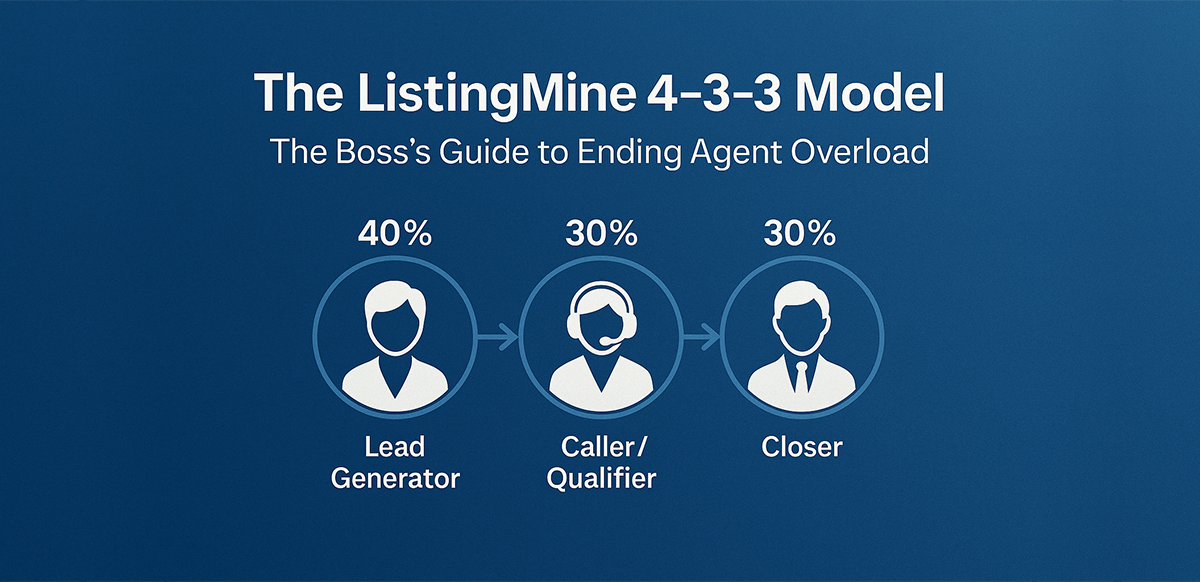
The 4–3–3 model breaks agent workload into specialized functions so one person no longer carries everything. ListingMine uses role design to reduce overload and improve team output.
The structural fix that makes high commissions finally sustainable.
ListingMine Academy | Agency Economics & ACN Design
Most agency owners raised payouts because they believed:
“Higher payout = better retention.”
So commissions climbed: 70% → 80% → 90% → even 100%.
But after all that… agents are still struggling.
Not because they’re lazy.
Not because they lack training.
Not because marketing is weak.
They are drowning in expectations.
A modern negotiator is somehow expected to be:
This is not empowerment.
This is an overload disguised as freedom.
And the symptoms appear everywhere:
The 4–3–3 Model solves this by replacing chaotic solo work with a specialised workflow, the simplest and most practical entry into ACN (Agent Cooperation Network) operations.
A clean, three-role specialist structure:
40% → Lead Generator
30% → Caller / Qualifier
30% → Closer
Commonly used in:
But every boss must answer one strategic question:
There are two correct methods—each produces a completely different culture.
(Protects margin + protects hierarchy)
Example:
Company takes 10%, agent receives 90%, and 4–3–3 happens inside the 90%.
Benefits:
This is the most common structure for internal ACN teams.
(Critical for external partners & vendors)
The 4–3–3 applies to the entire 100%.
Used when collaborating with:
These partners will never accept being paid from a shrinking agent portion —
so 4–3–3 must be applied “from the top.”
Many bosses make the fatal mistake of saying:
“We can remove the upline portion.”
But structurally, the upline exists because somebody must be responsible for:
In ACN logic:
Only the closer triggers the override, because the closer concludes the transaction inside the company and activates the leadership chain.
This is what keeps hierarchy intact when introducing specialists, vendors, or referral roles.
Each produces a different organisational culture and collaboration philosophy.
All roles (Lead, Caller, Closer) are internal team members.
They earn:
overrides
points
ranking entitlement
promotion pathways
ACN privileges
Internal 4–3–3 preserves the strongest long-term ACN culture.
Internal Distribution Logic (With Overrides)
Traditional structure:
70% agent
20% upline
10% company
| Role | Agent Portion | Upline Portion |
|---|---|---|
| Lead | 28% | 8% |
| Caller | 21% | 6% |
| Closer | 21% | 6% |
| Total | 70% | 20% |
This maintains:
the closer/upline relationship
clear career ladders
leadership motivation
ACN incentive flow
Lead/Caller can be external vendors or freelancers.
External roles:
are paid cleanly
receive no override
do not affect leadership ranking
Internal closer still triggers override, keeping the hierarchy intact.
| Role | Agent Portion | Upline Portion |
|---|---|---|
| Lead (External) | 28% | 0% |
| Caller (External) | 21% | 0% |
| Closer (Internal) | 21% | 20% |
This matches real Malaysian practice:
If the closing is internal, uplines must be rewarded.
Referral roles:
have no override
do not gain points
do not have leadership weight
Used for:
staff callers
junior agents
part-time introducers
admin helpers
| Role | Agent Portion | Upline Portion |
|---|---|---|
| Lead (Referral) | 28% | 0% |
| Caller (Referral) | 21% | 0% |
| Closer (Internal) | 21% | 20% |
This protects the purity of your leadership structure.
The numbers are not sacred.
Teams often run:
Different markets require different weights:
subsale
rental
project marketing
What matters is the architecture, not the ratio.
As long as you maintain:
clear role boundaries
override integrity
predictable incentive flow
stable culture
…your ACN variant is valid.
If your team is inexperienced with multi-role ACN: Get advice.
A poorly designed ACN harms your organisation more than the “traditional split” you’re currently using.
You can also run a dual channel:
traditional split (safe path)
ACN team (innovation lab)
(Final, Override-Correct, 4-Column Version)
| Model Structure | How the Money Moves | Override & Culture Impact | Best Use Cases |
|---|---|---|---|
| 1. Method 1 × Internal Co-Broke | 4–3–3 inside agent’s 90%. All roles are internal. | Strongest ACN culture. Leadership progression intact. | Subsale & project ACN teams. Growth-focused agencies. |
| 2. Method 1 × External Co-Broke | External roles paid cleanly; no override. Internal closer triggers override. | Hierarchy protected while using external help. | Outsourced callers, media vendors, freelance qualifiers. |
| 3. Method 1 × Referral Method | Referral roles paid from agent portion; no override. | Zero rank inflation. Very clean structure. | Staff callers, junior agents, introducers. |
| 4. Method 2 × Internal Co-Broke | 4–3–3 applied to total commission. | Maximum fairness; unified incentives. | Elite project teams; developer-linked units. |
| 5. Method 2 × External Co-Broke | External roles take from total; closer triggers override. | Strong B2B partnerships without internal disruption. | Calling centres, media companies, JV alliances. |
| 6. Method 2 × Referral Method | Referral paid from total; no override. | Cleanest organisational structure. | Staff bonuses, external introducers, campaign contributors. |
(When Designed Properly)
It solves modern agency problems by:
It transforms your organisation from:
Solo Agents → Specialists
Random Output → Predictable Workflow
High-Payout Chaos → Structural Intelligence
ListingMine supports:
Method 1 & Method 2
Internal / External / Referral
All 4–3–3 variations
Override logic (Hybrid Rule C)
Upline redistribution
Team-specific structures
Subsale / Rental / Project differences
Setup Time: 10 minutes
Coding Required: 0
Customisation Fee: RM0
Malaysia’s most ACN-ready ERP is already built.
The future of high-performing agencies is not higher payout — it is structural design.
4–3–3 is the most practical place to begin.

Founder of ListingMine and author of Agent for Life. Building ERP for Malaysian real estate agencies since 2008 — and writing to reshape how agencies grow.
More about Marvin Foong →More articles in this topic
This article is one of the sources behind this assessment. Take it to see what you already know and what to read next.
Educational self-assessment. Not a licensing examination or professional certification.