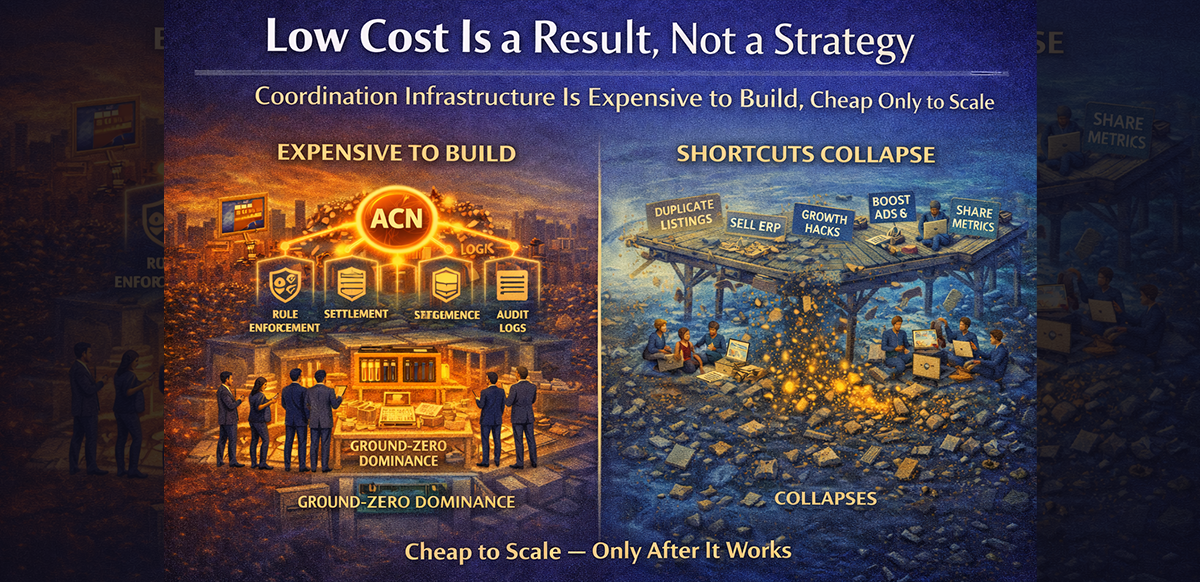
Real coordination infrastructure costs effort, design, and discipline before it becomes efficient. Agencies should not confuse cheapness with strategy.
Every platform pitch eventually claims the same thing: "We're low cost." It sounds disciplined. It sounds capital-efficient. Most of the time, it is a lie.
There is no cheap way to build coordination infrastructure. There are only cheap ways to scale after that infrastructure exists.
Founders often confuse low marginal cost with low upfront investment. They are not the same.
Real coordination systems are expensive to build because they require:
If your system has never faced conflict, it has never built coordination.
Because real liquidity is hard, many platforms take shortcuts. They aggregate listings without verification, allow duplicates, and rely on massive marketing spend to simulate activity.
This creates the appearance of liquidity, not the substance. The moment incentives tighten, participation drops and the platform collapses. Fake liquidity is cheap to create—but it is also cheap to destroy.
An Agent Cooperation Network (ACN) cannot be bootstrapped with hype. It requires a Ground-Zero Proving Ground. Before expansion, the model must dominate one real environment—one agency in one city.
In this phase, the work is slow and unglamorous:
Low cost is the reward for this foundational work, not the entry fee.
Every shortcut avoids immediate pain, but that avoided pain always returns as:
Infrastructure either absorbs complexity early or collapses under it later. There is no third option.
True capital efficiency in the Malaysian property market requires a specific trade-off:
| The Startup Approach | The Infrastructure Approach |
|---|---|
| High initial volume / Hype | High upfront discipline / Rules |
| Fast initial growth | Slow, verified growth |
| Political dispute resolution | Relentless, data-driven enforcement |
| Result: Fragile & Expensive to maintain | Result: Defensive & Cheap to scale |
"Low cost" is not a strategy; it is a result. If your coordination system looks cheap at the beginning, it is probably fragile. Real infrastructure is expensive to build, boring to operate, and extremely hard to replace.
But once it exists, it scales cheaper and faster than anything built on hype. That is the price of building something that lasts.

Founder of ListingMine and author of Agent for Life. Building ERP for Malaysian real estate agencies since 2008 — and writing to reshape how agencies grow.
More about Marvin Foong →More articles in this topic