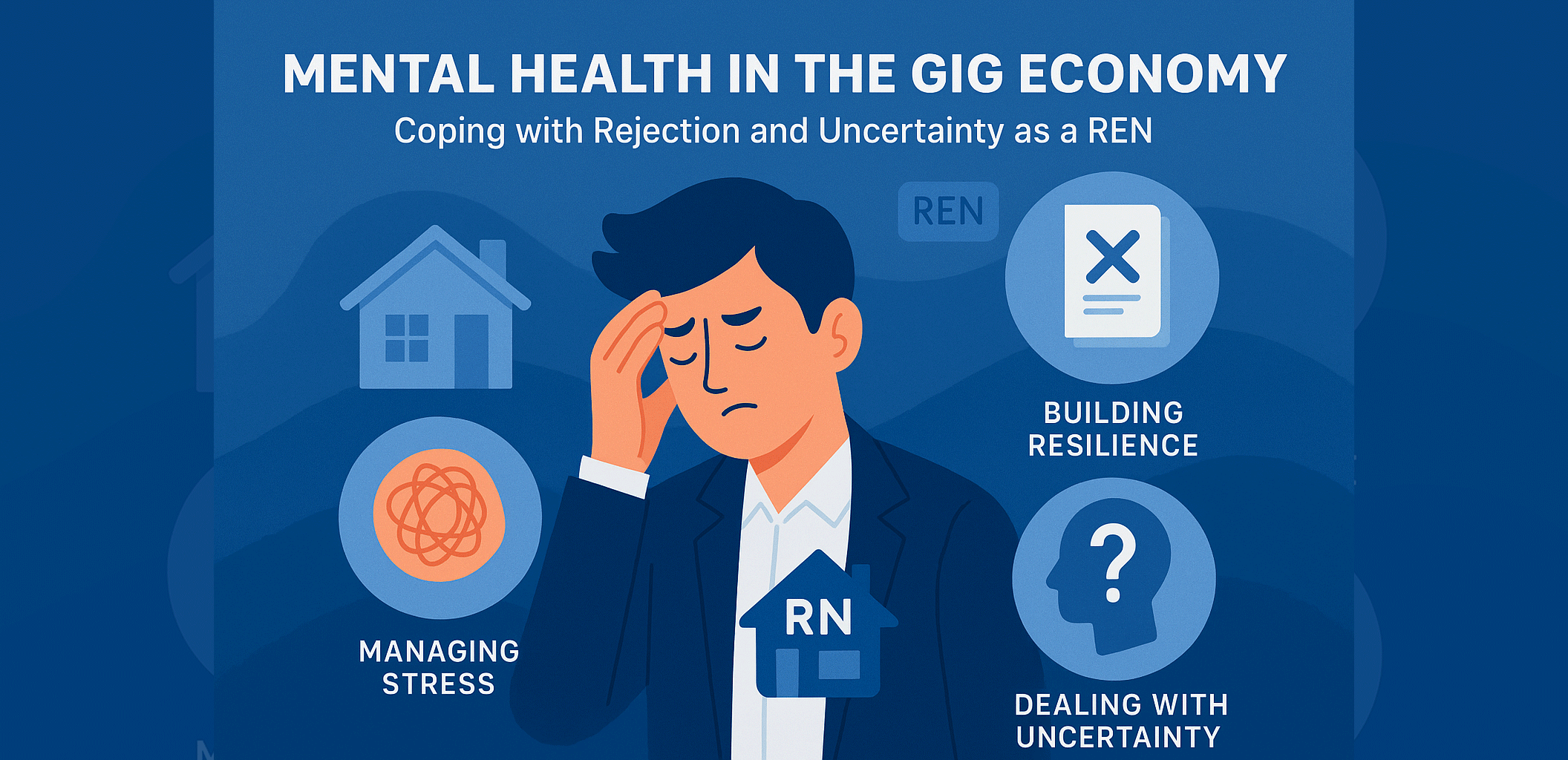
RENs face gig-economy pressure from rejection, uncertainty, and inconsistent income. Mental resilience and support systems are important for career survival.
Being a Real Estate Negotiator (REN) means living in the gig economy long before the term became popular. No salary. No guarantees. No safety net.
Every month starts at zero, and every deal depends on someone else’s “yes.” That uncertainty can turn even the strongest agents into anxious, overworked, and emotionally drained individuals.
Let’s talk about the part of real estate most people don’t see — the mental side of survival.
As a REN, your career is built on rejection. Out of 100 calls, maybe 10 people reply — and one might actually close.
But the bigger issue isn’t the rejection itself — it’s what happens after months of it. When you’ve spent money on ads, fuel, time, and emotional energy, and nothing lands, it’s easy to start doubting your worth.
That’s the emotional tax of the gig economy: you’re not just selling properties; you’re selling stability in an unstable career.
Old-school motivation tells you to “hustle harder” or “stay positive.” But let’s be honest — that doesn’t help when you’re exhausted, behind on bills, or watching peers close deal after deal while you’re stuck.
Motivation fades because it’s emotional fuel. What you need instead is structure — routines and systems that protect your mental bandwidth even when results fluctuate.
That’s why modern agents use platforms like ListingMine to bring clarity and control back into chaos. When your listings, leads, and reports are organized, your mind can breathe again.
Psychologically, humans are wired to crave predictability. Uncertainty — whether about income, clients, or your future — activates the same stress response as physical danger.
That’s why even small problems feel heavier in a commission-based job. Your brain constantly runs “what if” scenarios:
What if this deal falls through?
What if I don’t hit quota this month?
What if my team leaves?
The solution isn’t to eliminate uncertainty — it’s to buffer against it with emotional systems.
Here are three proven frameworks high-performing agents use to manage their emotional load:
Top performers in every field — sports, sales, entertainment — share one trait: resilience built on recovery.
Agents often confuse hard work with endurance. But resilience isn’t about pushing through pain; it’s about structured recovery after pressure.
Create mini recovery points:
You’re not a machine. You’re an athlete in a mental endurance game.
Many agents hide their burnout because they fear it shows weakness. But acknowledging struggle doesn’t make you less professional — it makes you human.
Team leaders and agency bosses have a role here too. When they build environments that encourage open conversation about burnout, anxiety, or overwhelm, they protect not just their agents — but their long-term retention.
A strong culture doesn’t come from motivation; it comes from mental safety.
Mental exhaustion often stems from disorganization. When you’re juggling listings, WhatsApp chats, and co-broking manually, the chaos compounds.
Platforms like ListingMine exist not just for productivity — but for psychological relief. When you can see every lead, every status, and every commission clearly, you eliminate one of the biggest triggers of anxiety: uncertainty.
Because clarity isn’t just efficiency — it’s therapy for the modern agent.
The next time a client ghosts you, remember this: Their “no” doesn’t define your value. Your consistency does.
You chose a career where uncertainty is the price of freedom — and resilience is the rent you pay for success.
Protect your mental energy like your most valuable listing. Because in real estate, you are the real asset.

Founder of ListingMine and author of Agent for Life. Building ERP for Malaysian real estate agencies since 2008 — and writing to reshape how agencies grow.
More about Marvin Foong →More articles in this topic