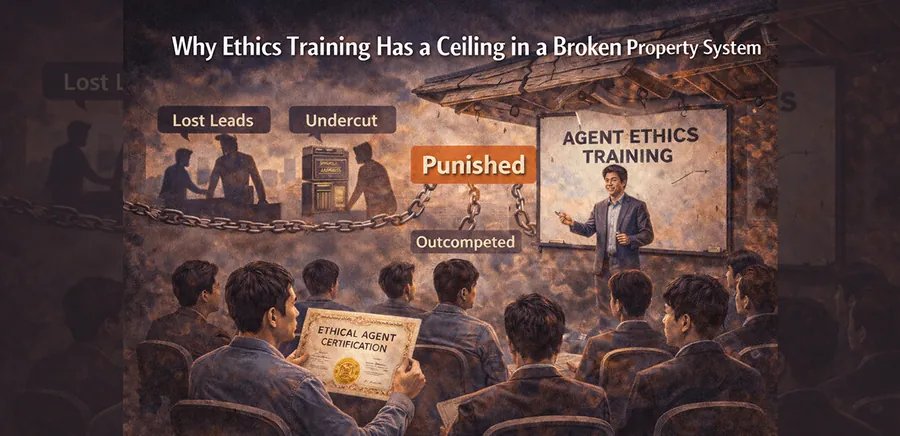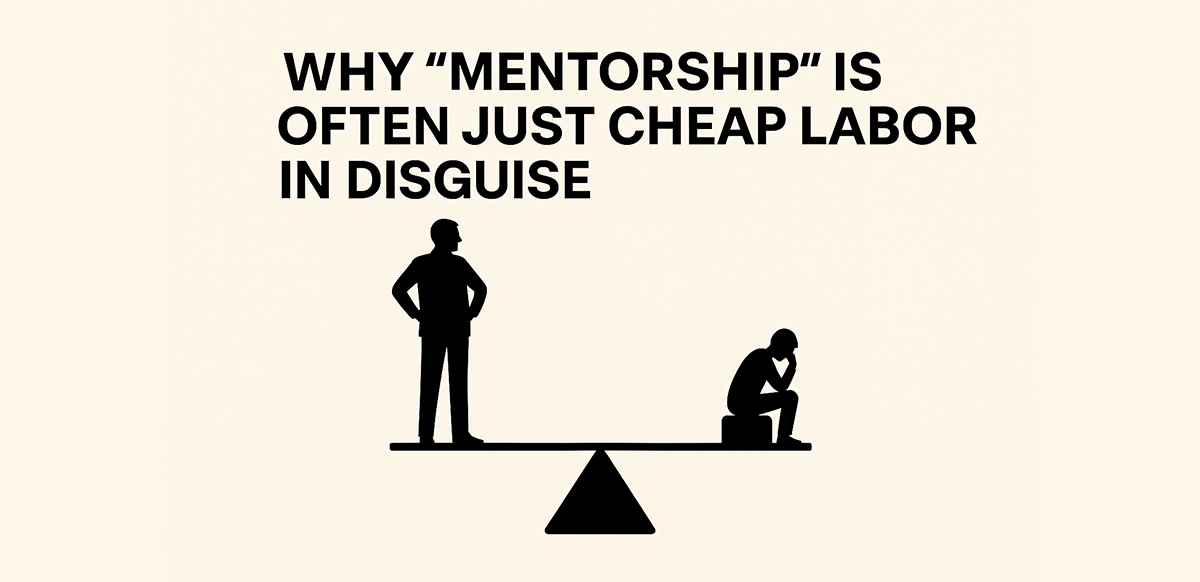
Mentorship becomes exploitative when new agents provide work without real training, structure, or career development. True mentorship must transfer skill, not just extract effort.
ListingMine Academy | Agency Leadership, Talent Economics & Industry Reality
Everybody sells the dream of “mentorship.” Few talk about its economics.
In Malaysian real estate, “mentorship” has become a branding tool — a feel-good word agencies use to attract new agents, especially fresh graduates and career switchers. But behind the inspirational speeches, WhatsApp group wallpapers, and “we grow together” slogans lies a harder truth:
Most mentorship is not mentorship. It is free labour disguised as guidance, and most new agents fall into the trap without realizing it.
This article explains why.
True mentorship is expensive.
A real mentor must give you:
All these have an economic cost. For a mentor to provide them, the mentor must either:
But in real estate, neither happens.
Most “mentors” don’t sacrifice their time.
Most mentees don’t pay anything upfront.
And most agencies don’t have structured systems to compensate mentors properly.
So something else must fill the gap.
That “something” is the mentee… doing work for the mentor.
When a mentor doesn’t have time and doesn’t get paid, the economics flip.
The mentee ends up doing things that benefit the mentor more than themselves:
The mentor calls it “training.”
The mentee calls it “learning.”
The agency calls it “culture.”
But the truth is: it is labour.
And in most cases, it is unpaid labour.
This is why so many mentees fail to close their own deals — they spend most of their time building someone else’s.
Mentorship often comes with a hidden cost: a permanent commission override. Many team leaders say:
“You’re using my system, my training, my guidance — so I take X% of every deal you close.”
Reasonable on the surface. But here’s the problem:
Yet the override continues UNTIL YOU RESIGN.
This turns mentorship into a lifetime tax.
When a mentee grows strong, the mentor benefits disproportionately.
When a mentee remains weak, the mentor uses the mentee’s labour.
Either way, the mentee bears the cost.
The reason is structural, not personal.
Most mentors are not trained teachers. They are performers, not instructors. What makes someone a top agent does not make them a good mentor:
So what happens?
They substitute real teaching with “just follow me.” And “just follow me” is not mentorship — it is shadow work.
Three psychological triggers explain why new agents willingly become free labour:
A. The Hope Shortcut
They believe proximity equals success.
“If I follow a top agent, their success will rub off.”
This is false. Shadowing creates dependence, not mastery.
B. Fear of Failure
Fresh agents don’t want to “waste leads,” so they hand everything to the mentor.
C. Sense of Belonging
Teams weaponize community language:
But when someone resigns, the “family” silence is deafening.
Mentorship becomes cheap labour because most agencies operate without:
Without systems, the only thing left is human labour.
And human labour will always flow downhill — to the newest, weakest, and most desperate agents.
The modern solution is not “better mentorship.”
It is less mentorship, more system.
A high-functioning agency should rely on:
When the system is strong, the mentor becomes optional.
When the system is weak, the mentor becomes a bottleneck — or a parasite.
This is why ListingMine’s ACN-inspired framework matters: it transforms mentorship from a personal favor into a role-based, system-driven, audit-capable learning pathway.
No exploitation.
No dependency.
No “follow me” culture.
Just documented work, measurable contribution, and fair compensation.
Good mentors exist. They are rare, expensive, and usually too busy to take on many students.
What most agents receive instead is a low-cost substitute:
The solution is not to chase mentors.
The solution is to demand a system — or join a team that already has one.
Because in real estate, the real enemy is not the bad mentor.
It is the absence of architecture.

Founder of ListingMine and author of Agent for Life. Building ERP for Malaysian real estate agencies since 2008 — and writing to reshape how agencies grow.
More about Marvin Foong →More articles in this topic
This article is one of the sources behind this assessment. Take it to see what you already know and what to read next.
Educational self-assessment. Not a licensing examination or professional certification.