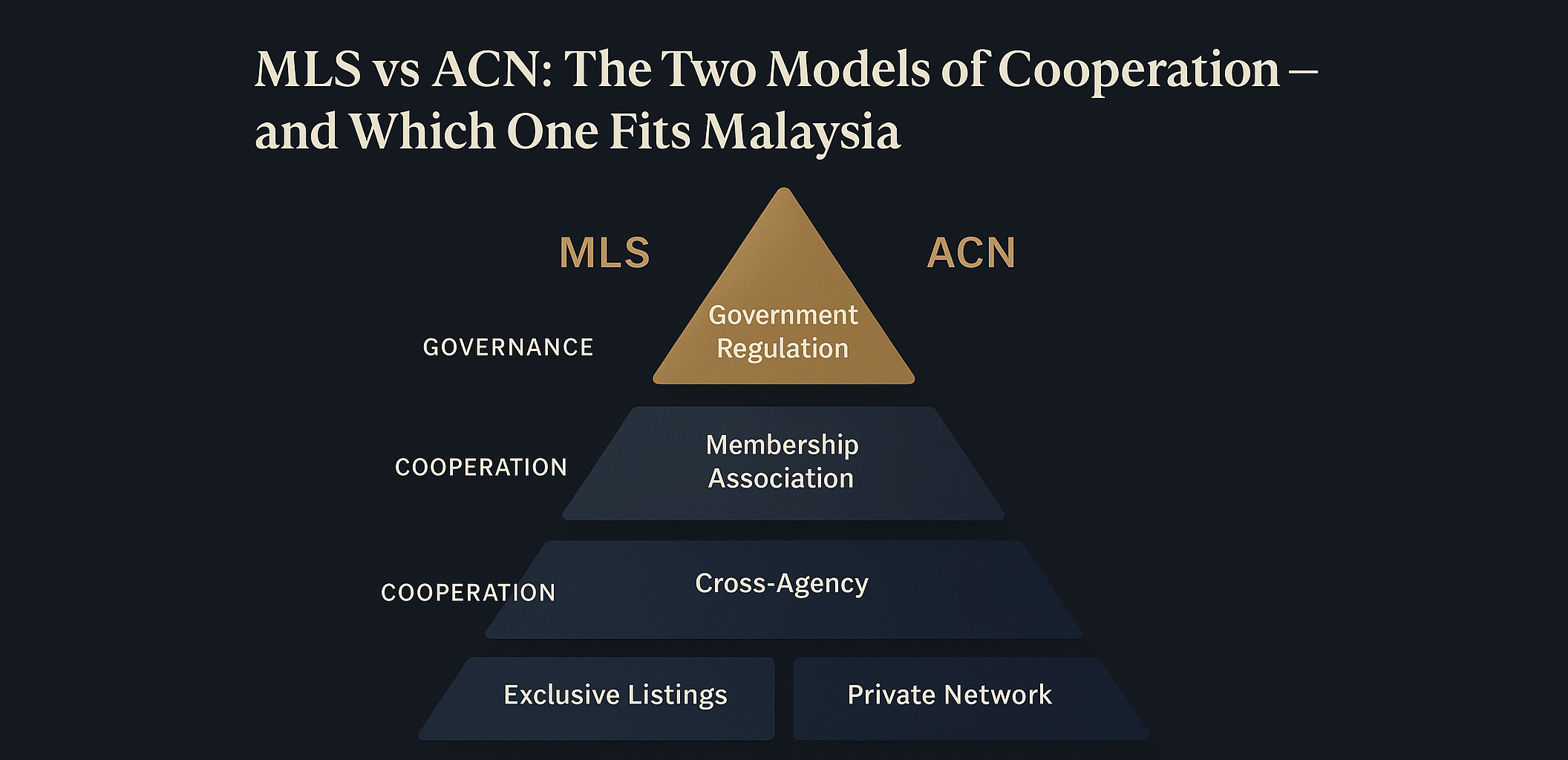
MLS and ACN solve cooperation differently. Malaysia’s fragmented agency market may need an ACN-style model based on roles, traceability, and local trust realities.
Every property market needs a framework for cooperation. Globally, two dominant models exist:
MLS (Multiple Listing Service) — a listing-centric, non-profit cooperation system.
ACN (Agent Cooperation Network) — an agent-centric, for-profit workflow ecosystem.
Both connect agents and enable co-broking. But their logic, revenue model, and legal foundations are very different — and those differences explain why ACN works where MLS cannot.
| Aspect | MLS (Multiple Listing Service) | ACN (Agent Cooperation Network) |
|---|---|---|
| Philosophy | “Share listings to expand exposure.” | “Verify cooperation to build trust.” |
| Core Unit | Property / Listing | Agent / Workflow |
| Ownership | Central database owned by association | Distributed ERP-based network owned by agencies / agents |
| Legal Foundation | Requires exclusive-listing law, disclosure statutes, and antitrust governance | Operates under existing agency licensing, PDPA & AMLA |
| Data Control | Association or MLS operator | Agent / Agency (decentralized, PDPA-compliant) |
| Trust Mechanism | Institutional + membership rules | Event-proof + audit trails |
| Profit Model | Non-profit; funded by membership fees | For-profit; sustained by ERP subscriptions & coordination fees |
| Scalability | Slow – requires national standardization | Fast – bottom-up through technology adoption |
How It Works
Agents upload exclusive listings into a shared database. Buyer’s agents access those listings; cooperation and commission splits follow association rules.
Pros
Cons
Bottom Line
MLS works only where law and association power enforce discipline. China and Malaysia both lack those legal foundations today.
How It Works
Each agent or team operates within an ERP (like ListingMine). Roles are assigned per deal — Lister, Buyer Agent, Verifier, Finance PIC — and every contribution is timestamped. Commissions are auto-split according to proof-of-work.
Pros
Cons
Bottom Line
ACN builds trust, traceability, and revenue — the three things MLS lacks in emerging markets.
| Dimension | MLS | ACN |
|---|---|---|
| Institution Type | Non-profit association | For-profit platform |
| Revenue Source | Membership & tech fees | ERP subscriptions, transaction fees, data services |
| Governance | Board / Union rules | Smart-contract / event logs |
| Economic Outcome | Cost center (maintained by dues) | Profit center (aligns with agent success) |
Key insight:
MLS survives on regulation. ACN scales on incentives.
Malaysia’s property ecosystem is:
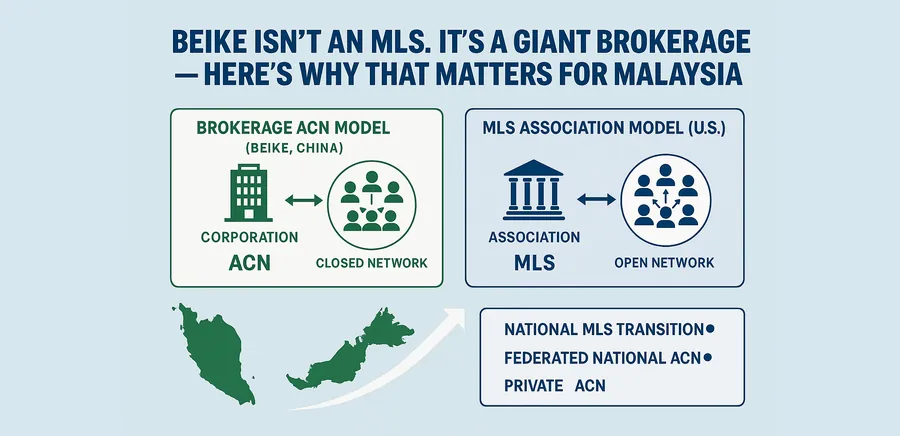
That makes ACN the only realistic model. Each agency can operate its own ACN inside ListingMine ERP, then link into a National ACN Network — achieving cooperation now, and preparing for a legal MLS later.
| MLS | ACN |
|---|---|
| Exposure | Verified Cooperation |
| Non-profit | For-profit sustainable |
| Legal & Institutional | Proof & Technology |
| Regulator-led | Market-led |
| ✖️ Not yet feasible | ✅ Already practical and compliant |
MLS improves exposure. ACN builds trust — and pays for itself. That’s why Malaysia’s real estate future starts with ACN inside ListingMine ERP — a bottom-up bridge to a national MLS when the law is ready.

Founder of ListingMine and author of Agent for Life. Building ERP for Malaysian real estate agencies since 2008 — and writing to reshape how agencies grow.
More about Marvin Foong →More articles in this topic
This article is one of the sources behind this assessment. Take it to see what you already know and what to read next.
Educational self-assessment. Not a licensing examination or professional certification.