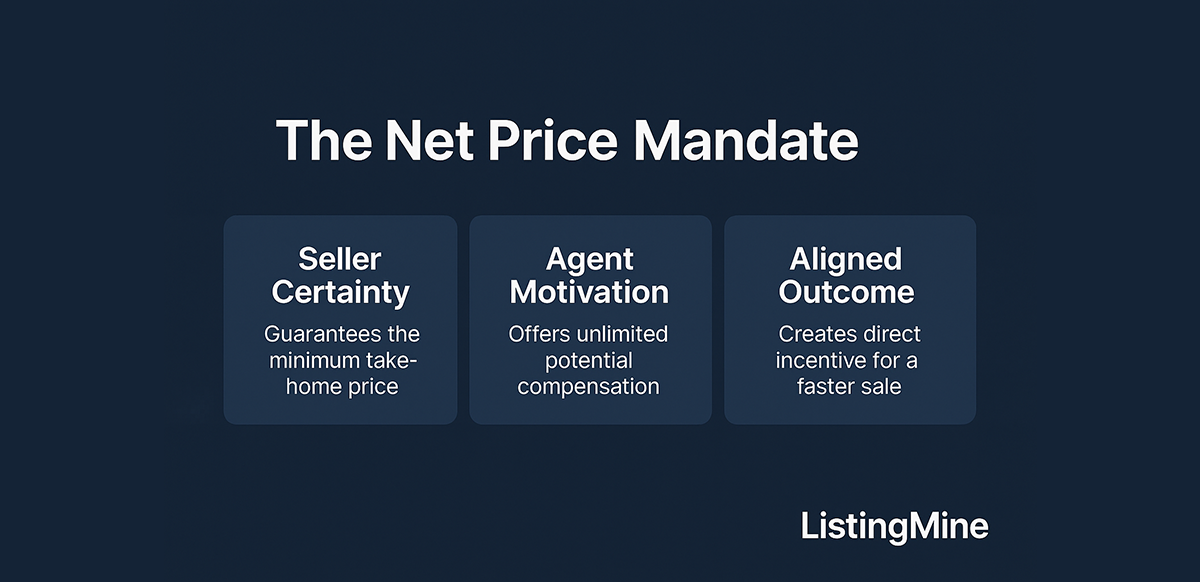
A net price mandate can motivate agents by clarifying the owner’s minimum expectation and potential upside. Clear pricing terms reduce confusion and improve effort.
A Performance-Aligned Structure for Serious Sellers and High-Level Negotiators
The Net Price Mandate is a sales strategy where the property owner sets a guaranteed take-home amount, and the agent is entitled to whatever is achieved above that figure. Unlike a standard fixed-commission model, this structure is designed to reward performance, not participation.
A seller who uses this model is not trying to save cost — they are trying to create urgency and unlock higher effort from the agent. The logic is simple:
A capped commission motivates an agent to close.
A performance mandate motivates an agent to maximize.
The goal is not to debate 2 percent versus 3 percent.
The goal is to give the agent a commercial reason to prioritise the listing, push the price ceiling, and move faster.
| Seller Objective | Strategic Advantage |
|---|---|
| Certainty of Outcome | The seller secures the minimum amount they require, regardless of final transacted price. |
| Stronger Agent Incentive | The agent is rewarded only when they outperform the baseline, creating aligned motivation. |
| Filters for Confidence | Only agents who believe they can achieve a higher market result will accept the mandate. |
| Results-First Relationship | The seller is paying for a realised outcome, not for time spent, marketing cost, or general effort. |
For the seller, the Net Price Mandate is not a discount — it is a performance contract.
| Agent Advantage | Explanation |
|---|---|
| Performance-Based Income | The agent earns based on proven ability to negotiate above expectation. |
| Priority Listing Status | The mandate turns the property into a high-leverage assignment worth focused energy. |
| Skill Becomes Equity | Market insight, buyer network, and negotiation talent translate directly into remuneration. |
High-calibre agents prefer mandates because they back themselves to outperform the average market result.
The Net Price Mandate does not change the ownership of the property, the role of the agent, or the SPA process. It changes only the way the outcome is rewarded.
Under this model:
It is not a “cheaper commission model.”
It is a variable-performance model.
| Works Well When | Because |
|---|---|
| Seller’s net price is realistic | There is room for the agent to create value |
| Property has demand upside | The gap between “market floor” and “achievable price” is meaningful |
| Agent has proven buyer network | Speed and price advantage are achievable |
| Roles and outcomes are documented | Both sides understand the structure, removing friction |
The mandate creates a different kind of agreement:
The seller controls the minimum.
The agent controls the outcome.
| Breakdown Point | Cause |
|---|---|
| Unrealistic net price | No space for the agent to perform |
| Ambiguous terms | Leads to dispute or mistrust |
| Poor documentation | Creates compliance and expectation risk |
| Misaligned incentives | Seller wants speed, agent wants price, or vice-versa |
The Net Price Mandate is powerful, but only when clarity is total and expectations are aligned.
The mandate must always be documented in writing, with:
This protects both parties and establishes transparency before the first viewing is arranged.
All remuneration arrangements must be documented in writing and billed in accordance with the Seventh Schedule and MEAS Standard 5.

Founder of ListingMine and author of Agent for Life. Building ERP for Malaysian real estate agencies since 2008 — and writing to reshape how agencies grow.
More about Marvin Foong →More articles in this topic
This article is one of the sources behind this assessment. Take it to see what you already know and what to read next.
Educational self-assessment. Not a licensing examination or professional certification.