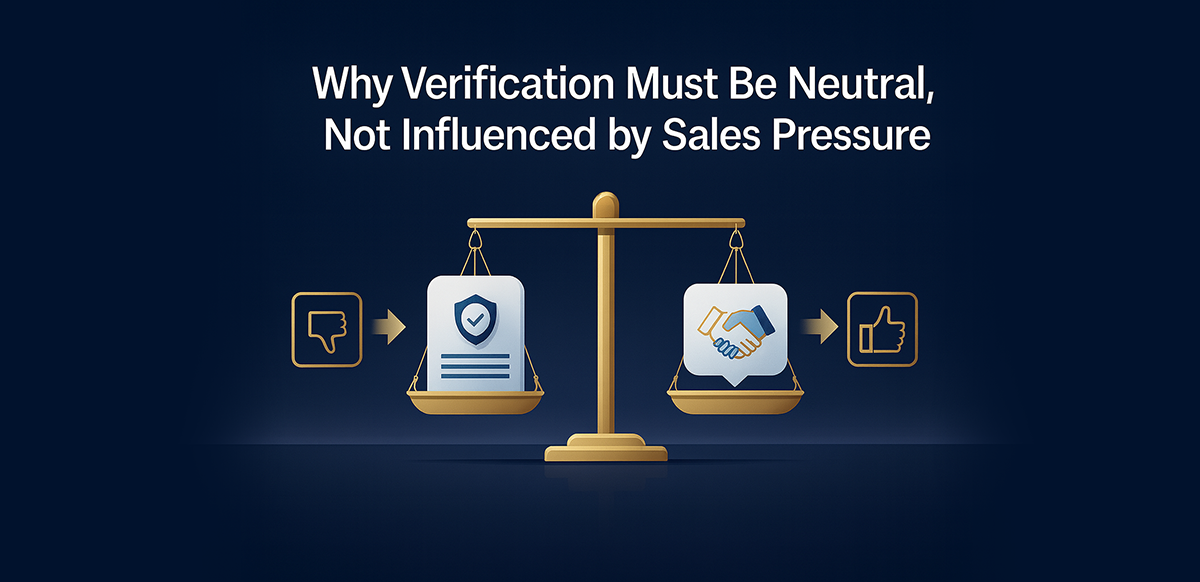
Verification must remain independent because sales pressure can encourage shortcuts, exaggeration, or weak checks. Neutral verification protects the agency, agents, and clients.
In a traditional real estate environment, most decisions are made through sales urgency, optimism, and relationship influence.
However, in an ACN (Agent Cooperation Network) framework, verification is not a sales function — it is a governance and risk-prevention function.
This means the person verifying a listing must not be influenced by sales targets, closing pressure, team momentum, or personal preferences.
Neutrality is not optional — it’s fundamental to trust, fairness, and system credibility.
Sales teams naturally operate with a speed and opportunity mindset:
Verification operates with a risk management mindset:
Both are important — but they must not be mixed into one decision-making unit.
When verification remains neutral, it ensures that:
| Protected Stakeholder | Protected From |
|---|---|
| Agents | Wasted effort, cost, reputation loss |
| Buyers | Misleading listings & disappointment |
| Sellers / Developers | Miscommunication & legal exposure |
| Agency | Disputes, complaints, and brand damage |
Neutral verification prevents problems before they start, while sales solves opportunities after validation.
The moment verification starts bending to sales demand, three predictable failures occur:
A. Lower Standards
Listings get approved simply because “we need stock”.
B. Blind Optimism
Hope replaces evidence; assumptions replace documents.
C. Network Fatigue
Agents waste energy chasing dead, illegal, stale, or impossible listings.
The short-term gain becomes a long-term morale and credibility loss.
A professional ACN must be perceived as a trusted listing environment, and trust only grows when verification is:
The moment an agent can “negotiate” verification standards, the system becomes worthless.
On the surface, verification looks like a “slowing factor”, but in reality, it accelerates closings because:
| Weak Verification | Strong Verification |
|---|---|
| Many listings but low quality | Fewer listings but high quality |
| Many enquiries but low conversion | Fewer enquiries but higher conversion |
| Low trust, high fatigue | High trust, sustainable performance |
| System feels busy | System produces results |
Verification is not a blocker — it is a filter.
A Verifier must operate under these principles:
If the Verifier is liked by everyone, standards are likely too soft.
If the Verifier is respected but sometimes feared, standards are working correctly.
Flexibility is not the same as compromise.
Verification can be flexible in process, but never in standards.
Example acceptable flexibility:
Example not acceptable flexibility:
Verification should serve the system, not the sale.
Sales pressure is temporary — listing integrity is permanent.
A neutral Verifier is not a “blocker” or “gatekeeper”;
They are the protector of trust, time, and professional credibility.
In ACN, the fastest way to close more deals…
is to stop working on deals that will never close.

Founder of ListingMine and author of Agent for Life. Building ERP for Malaysian real estate agencies since 2008 — and writing to reshape how agencies grow.
More about Marvin Foong →More articles in this topic
This article is one of the sources behind this assessment. Take it to see what you already know and what to read next.
Educational self-assessment. Not a licensing examination or professional certification.