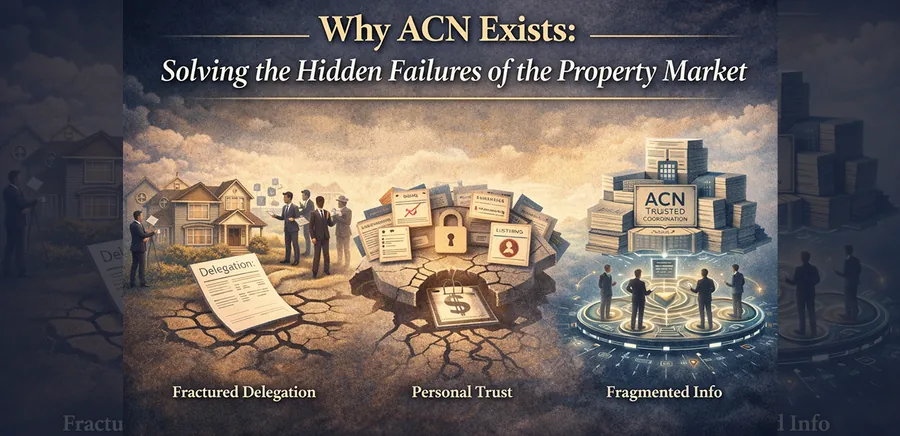
ACN allows agents to contribute through roles other than closing, such as sourcing, verification, access, buyer referral, or transaction coordination. Value should be recognized by function, not only final closing.
One of the biggest misunderstandings in real estate is the belief that every agent must be good at everything. The industry often glorifies the “all-rounder” — someone who can prospect, present, negotiate, close, manage paperwork, and handle after-sales seamlessly.
In reality, that expectation is neither practical nor necessary.
High-performing teams do not rely on individuals who can do everything. They rely on role specialization.
Many new agents begin their careers not as closers, but as callers. They focus intensely on one function: generating appointments. This is not casual prospecting or symbolic effort. Serious callers treat it like a profession.
Making between 100 to 300 calls per day is normal in structured teams. The objective is simple and measurable — secure face-to-face appointments.
The purpose of calling is not to close deals over the phone. It is to generate physical or virtual meetings.
In many structured teams, a disciplined caller who can secure six solid appointments per week is already creating meaningful value.
Consider the math.
Out of six appointments, perhaps two do not show up. Four remain. If the team assigns those appointments to an experienced closer with a closing rate above 50 percent, two deals may be secured.
Out of those two, perhaps one proceeds smoothly through loan approval.
Even in this conservative scenario, one successful case in a week can translate into approximately RM4,000 to RM5,000 in income share, depending on commission structure.
The caller did not close the deal personally, but the caller generated the opportunity.
The appointment is the true unit of production.
Many new agents struggle because they attempt to master negotiation and closing before mastering prospecting. The result is inconsistency.
When deals do not close, confidence drops. When confidence drops, prospecting slows. When prospecting slows, the pipeline dries up.
Specialization breaks this cycle.
If you are strong at building rapport over the phone, stay disciplined in that role. Generate volume. Let experienced closers handle the technical objections, valuation justification, and negotiation structure.
Teams with proper role allocation can convert higher percentages because each function is handled by someone who has refined that skill.
It is not weakness to focus on calling. It is leverage.
Real estate income feels unstable when it depends on sporadic effort. However, volume introduces statistical stability.
If you can consistently generate six quality appointments per week, that is twenty-four per month. Even with conservative show-up and conversion rates, predictable income emerges.
The key variable becomes consistency, not luck.
The more appointments you generate, the more predictable your pipeline becomes. When structured properly, even one confirmed case per week creates meaningful income.
When scaled across a month, the numbers compound.
Once you understand the mechanics of calling and appointment generation, you begin to see the system more clearly.
Calling builds skill. Skill builds confidence. Confidence justifies investment.
When you know how to convert calls into appointments, you can begin investing in lead generation channels such as digital ads or paid buyer inquiries.
Instead of purely cold outreach, you combine financed leads with calling discipline. The difference is that financed leads often come with higher intent.
In such scenarios, if one case closes from financed leads, commission quantum may be higher.
For example, one successful transaction from a financed lead may yield RM10,000 or more in commission share, depending on property value and structure.
The principle remains the same: appointment generation drives income.
The difference is scale.
Large teams do not depend on individual brilliance. They depend on structured repetition.
Within these teams, different roles contribute to the pipeline:
The myth that “I cannot close, so I cannot earn” is often incorrect.
Income in structured teams is frequently tied to contribution. If you generate opportunity, you participate in the outcome.
This approach also lowers emotional stress. Instead of carrying the full burden of prospecting and closing alone, you operate within a production system.
Volume becomes the engine. Skill specialization becomes the advantage.
Not every agent is naturally gifted at closing. Not every agent enjoys negotiation.
But many agents underestimate the value of disciplined prospecting.
If you can generate appointments consistently, you are not small in the system. You are foundational.
Try operating with structure instead of ego. Focus on measurable outputs.
Track appointment volume. Partner with stronger closers. Refine your calling technique. When predictable results emerge, reinvest into lead generation and scale.
Real estate income becomes less mysterious when broken into roles, numbers, and repetition.
Not every agent needs to be good at everything.
But every successful agent needs a system.

Founder of ListingMine and author of Agent for Life. Building ERP for Malaysian real estate agencies since 2008 — and writing to reshape how agencies grow.
More about Marvin Foong →More articles in this topic
This article is one of the sources behind this assessment. Take it to see what you already know and what to read next.
Educational self-assessment. Not a licensing examination or professional certification.